
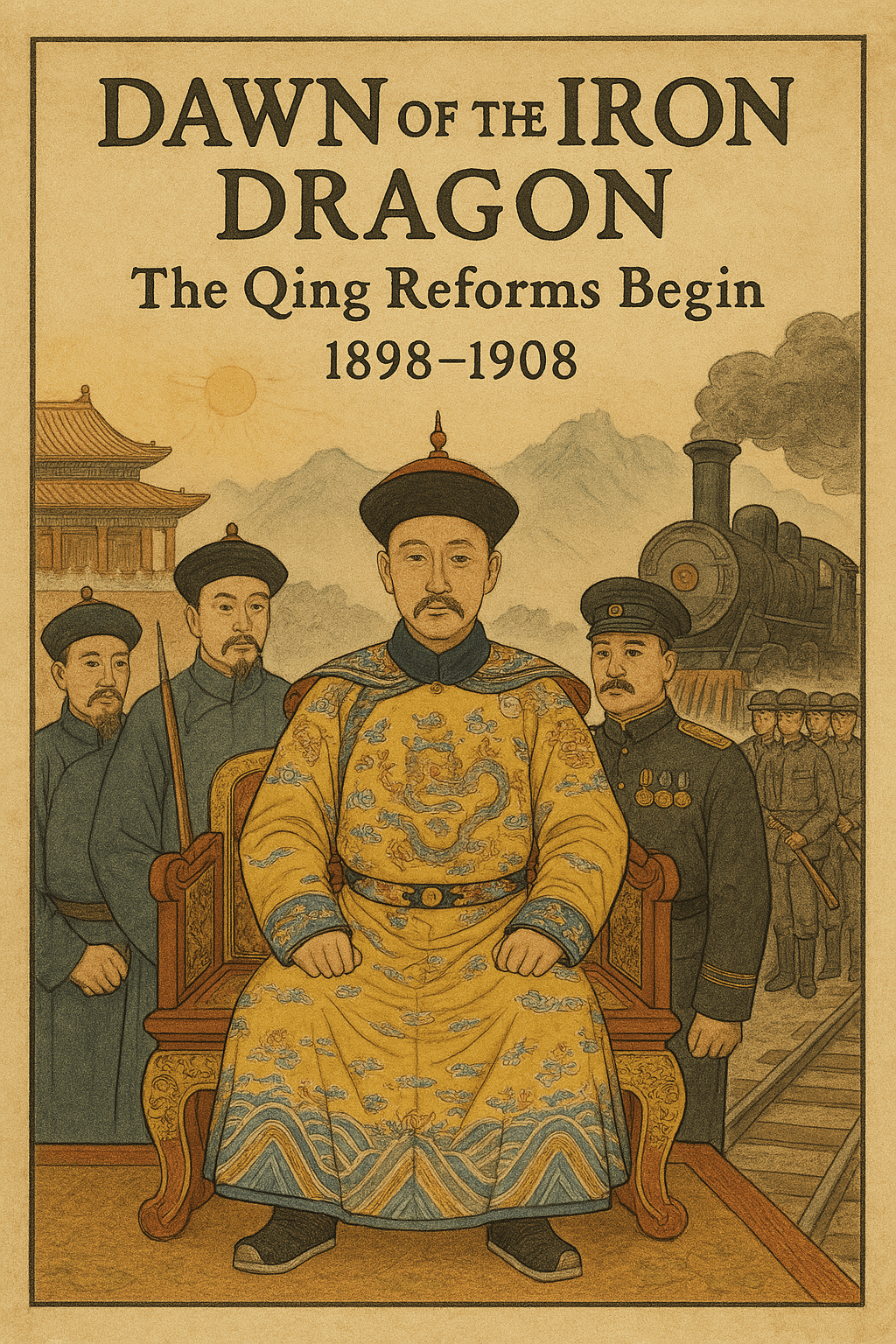
Point of Divergence: The Hundred Days’ Reform of 1898 succeeds
On September 21, 1898, the Guangxu Emperor, backed by reform-minded officials like Kang Youwei and Liang Qichao, successfully outmaneuvers Empress Dowager Cixi and the conservative faction within the Qing court. With military support from the reformist general Yuan Shikai, a coup eliminates key conservative leaders, including Ronglu and other allies of Cixi. The Empress Dowager is placed under permanent house arrest in the Summer Palace, effectively ending her control over the imperial court.
This divergence sets the Qing dynasty on a radically different path, as sweeping reforms intended to modernize China are implemented without the usual interference from reactionary factions. Below is a detailed history of the next decade, 1898–1908, shaped by these dramatic changes.
The Immediate Aftermath of the Successful Coup (1898–1900)
Administrative Reforms
Under the Guangxu Emperor’s revitalized leadership, the Qing court immediately announces a series of decrees to reshape China’s governance. The imperial examination system, long a cornerstone of the Confucian bureaucracy, is abolished in 1900 and replaced by Western-style civil service exams. Modern ministries modeled after European governments are established, including departments for foreign affairs, education, commerce, and a standing military.
Kang Youwei and Liang Qichao are appointed to high-ranking positions. Kang becomes the chief architect of constitutional reforms, while Liang heads the Ministry of Education, focusing on overhauling China’s ossified schools and promoting modern science, mathematics, and engineering. Yuan Shikai, instrumental in the coup, is promoted to oversee the modernization of the military, including the establishment of Western-style officer training academies.
Economic Modernization
The reformers emphasize industrialization to reduce China’s dependence on foreign powers. Efforts are made to develop a national banking system, starting with the creation of the Imperial Bank of China in 1899, which provides loans to budding Chinese entrepreneurs. Foreign advisors are invited to help build railways, modern ports, and factories, though strict regulations are put in place to limit foreign control of critical infrastructure.
Land reform is tentatively introduced, redistributing unused imperial lands to small farmers. While these policies initially face resistance from landlords, the backing of the military ensures their enforcement.
Tensions with Foreign Powers
The success of the reforms alarms foreign powers that had carved spheres of influence into China. Russia, Germany, Britain, and Japan begin to pressure the Qing government for new concessions, sensing the empire’s growing strength as a potential threat. Guangxu, with advice from Kang and Liang, adopts a policy of calculated cooperation, granting limited trade agreements but refusing outright territorial concessions.
The Boxer Rebellion (1899–1901) is averted in this timeline, as the modernized military swiftly quells any uprisings before they gain traction. Reformist propaganda encourages the population to channel anti-foreign anger into productive modernization efforts rather than violence.
The First Constitution and Political Reform (1901–1904)
By 1901, the Guangxu Emperor approves a draft for China’s first constitution. Based on Japan’s Meiji Constitution but adapted to Chinese traditions, the new system introduces a limited constitutional monarchy. An elected national assembly (the Guomin Yuan) is established in 1903, with representation from provinces and a small electorate based on property and education qualifications. While the Emperor retains veto power, the assembly is granted authority over taxation and legislation.
These political reforms foster a sense of national unity, as provincial leaders see an opportunity to influence imperial policy through legal means rather than rebellion. Kang Youwei leads the effort to promote a “new Confucianism” that blends traditional Chinese values with modern political ideas, encouraging acceptance of the changes.
Military Modernization and Strategic Alliances (1904–1908)
The Beiyang Army’s Transformation
Under Yuan Shikai, the Beiyang Army is transformed into a modern, disciplined force armed with state-of-the-art equipment. By 1905, the Qing military begins producing its own rifles and artillery in government-operated factories in Tianjin and Wuhan. Naval modernization also proceeds with the acquisition of European-designed warships and the construction of China’s first domestic shipyards in Shanghai.
Foreign Policy
The Qing government forges closer ties with Japan and Germany. Recognizing the need to counterbalance Russian and British influence, Guangxu negotiates a defensive alliance with Japan in 1906. The alliance shocks the Western powers but cements China and Japan as co-leaders of modernization in East Asia.
Impact of the Russo-Japanese War
The Russo-Japanese War of 1904–1905 has a profound impact on China. With Chinese logistical support and intelligence provided under the alliance, Japan’s victory over Russia demonstrates the power of modernization. The Qing government uses the war as a propaganda tool, framing it as proof that Asian nations can resist Western imperialism through reform and unity.
Cultural and Social Shifts
Education Reforms
By 1908, Western-style universities and schools have been established in major cities like Beijing, Shanghai, and Guangzhou. Students are sent abroad to study in Japan, Germany, and the United States, returning with advanced knowledge in engineering, medicine, and law. The introduction of compulsory primary education begins to create a literate, skilled workforce.
Women’s Rights Movement
Though still limited, the role of women begins to change during this period. Reformers like Liang Qichao’s wife, Li Huixian, advocate for girls’ education, leading to the establishment of the first all-girls schools in Beijing and Nanjing. Foot-binding is officially banned in 1905, though enforcement is uneven.
Rise of Nationalism
A burgeoning nationalist movement emerges, fueled by newspapers, journals, and public speeches. Reformist slogans such as “Self-Strengthening and Unity” and “Asian Modernization” inspire the younger generation. Figures like Sun Yat-sen, who in our timeline became a revolutionary, now work within the system, organizing political parties to compete in assembly elections.
The Death of Guangxu (1908) and the Future
The sudden death of the Guangxu Emperor in November 1908 plunges the Qing court into uncertainty. Crown Prince Puyi, only two years old, is declared the heir, while a council of regents led by Kang Youwei governs in his stead. While the reforms of the past decade have created a more stable, prosperous China, challenges remain, including resistance from conservative factions, rising ethnic tensions in frontier regions, and the ever-present threat of foreign imperialism.
The next decade will determine whether the Qing dynasty can fully transform into a modern constitutional monarchy or succumb to internal and external pressures.
 What If: The Archive
Leave a comment