
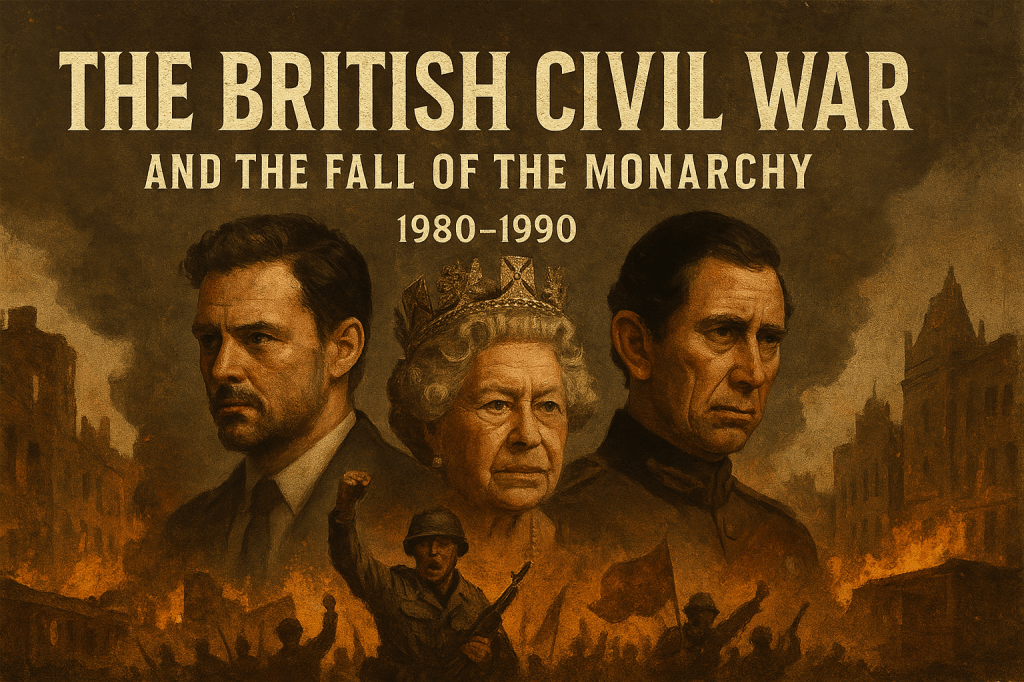
By 1980, Britain is no longer just a country in turmoil—it is a nation at war with itself. The struggle between Prince Charles, heir to the throne, and his illegitimate half-brother, David Windsor-Smith, has escalated beyond mere politics. It has become a violent, bloody conflict, splitting the nation between monarchists and revolutionaries.
With the government in collapse, the world watches as Britain faces its greatest crisis since the English Civil War.
1980–1983: Britain Burns
The Two Sides
By early 1980, Britain has fractured into two competing governments:
- The Royalist Regime (London) – Led by Prince Charles, supported by remaining parliamentary loyalists, MI5, and parts of the military. They control London, southern England, and major financial centers.
- The Pro-David Revolutionaries (Edinburgh & Manchester) – Led by David Windsor-Smith and a coalition of leftist radicals, republican intellectuals, and disillusioned veterans. They hold Scotland, parts of the North, and large working-class regions.
Wales and Northern Ireland are battlegrounds, contested between local factions and outside interests.
The First Battles (1980–1981)
- January 1980: The London Riots – Thousands of protesters storm Buckingham Palace, demanding an end to the monarchy. The Queen and Prince Philip evacuate to Canada under heavy security. Charles remains behind, declaring martial law.
- Spring 1980: The Siege of Manchester – The first true battle of the war. Royalist forces attempt to crush pro-David strongholds in the North. After three months of urban combat, Manchester becomes a revolutionary capital.
- Summer 1980: Foreign Powers Take Notice –
- The Soviet Union sees an opportunity to destabilize the West and secretly provides arms to David’s forces.
- The United States (led by President Reagan) backs Charles, fearing a radical leftist takeover of Britain.
- The European Community remains neutral but fears Britain will collapse entirely.
By 1981, Britain is unrecognizable. Cities are war zones, Parliament is non-functional, and the royal family is exiled.
The Assassination of Queen Elizabeth II (1981)
On June 21, 1981, Queen Elizabeth II is assassinated in Canada—her convoy bombed outside Ottawa. The perpetrators are unknown:
- Royalists blame David’s forces.
- Republicans blame MI5, claiming Charles wanted her out of the way.
- The CIA suspects Soviet involvement.
Her death radicalizes both sides, making compromise impossible.
1982–1985: The Fall of the House of Windsor
As the war intensifies, the once-mighty British monarchy begins to collapse.
David Windsor-Smith Declares a Republic (1982)
In January 1982, David declares the formation of the United Commonwealth of Britain (UCB), with Edinburgh as its capital. He proclaims himself “Protector of the Nation”, though he refuses the title of king.
However, not all republicans support him. Some see him as another royal tyrant trying to replace Charles rather than abolish the monarchy outright.
The Battle of London (1983)
The decisive battle comes in August 1983, when David’s forces, now backed by Irish and Scottish nationalists, launch a full-scale assault on London.
- Buckingham Palace is bombed and destroyed.
- Prince Charles is captured.
- The House of Lords is disbanded.
On August 28, 1983, David Windsor-Smith officially abolishes the monarchy.
The Trial and Execution of Prince Charles (1984)
Prince Charles, held as a prisoner in Edinburgh, stands trial for crimes against the people. The trial is broadcast worldwide, drawing comparisons to Louis XVI in the French Revolution.
On March 1, 1984, Charles is executed by firing squad.
The House of Windsor is no more.
1985–1990: The Aftermath – The Second British Republic
The United Commonwealth of Britain
With the monarchy gone, David Windsor-Smith establishes the Second British Republic, but his reign is far from peaceful.
- Internal divisions erupt. Radical leftists demand a fully socialist state, while moderates push for a democratic republic.
- The economy is in ruins. Years of war have destroyed Britain’s infrastructure.
- Commonwealth nations begin leaving. Without the monarchy, Australia and Canada declare themselves fully independent.
By 1990, David is facing his own rebellion. Former allies, now disillusioned, begin plotting his downfall.
What Comes Next?
With Britain in chaos, the question remains: Can David Windsor-Smith hold onto power, or will Britain collapse even further?
 What If: The Archive
Leave a comment