By the dawn of the 21st century, the United Commonwealth of Britain (UCB) was a failing, isolated Soviet puppet state, struggling under economic ruin, mass unrest, and a government that ruled through fear rather than legitimacy.
As the world moved into the era of globalization, the internet, and rapid economic growth, Britain remained stuck in Cold War-era stagnation, a relic of Soviet control. However, the 2000s would bring the ultimate reckoning for the UCB—a new revolution, a final war, and the complete collapse of the communist regime.
2000–2005: The UCB on the Brink
The early 2000s saw growing instability within Britain, as both economic failure and political resistance escalated to a breaking point.
The Economic Collapse Deepens
- By 2001, Britain’s GDP had fallen below that of Romania and Bulgaria.
- The planned economy had completely failed—factories shut down, agriculture collapsed, and the black market became the primary source of goods.
- Unemployment was at 40%, but official government figures were falsified.
- Mass starvation hit London and Manchester, with people rioting for bread.
Political Instability: David Windsor-Smith’s Decline
- David Windsor-Smith (Leader since 1983) had become increasingly paranoid.
- He purged rivals within the United Commonwealth Party, executing senior officials he suspected of “Western sympathies.”
- The secret police cracked down harder than ever, but resistance movements had grown too strong.
The Growing Armed Resistance (2002–2004)
- The Free Britain Front (FBF), an anti-communist paramilitary group, began launching bombings and assassinations against the government.
- Royalist remnants in exile (funded by Canada and Australia) began smuggling weapons and fighters into the country.
- University students, intellectuals, and trade unions began protesting in defiance of the state.
By 2004, mass demonstrations had erupted in London, Glasgow, and Birmingham. The UCB was on the verge of collapse.
2006–2008: The Second British Revolution
The Trigger: The London Massacre (April 2006)
On April 17, 2006, over 250,000 protesters gathered in London’s Trafalgar Square, demanding the resignation of Windsor-Smith and democratic elections.
- The UCB government ordered the army to open fire.
- Over 3,000 civilians were killed in what became known as “Red Sunday.”
- The massacre ignited a full-scale uprising, with police and army units defecting to the rebels.
The Uprising Becomes a Civil War (2006–2007)
- Protests turned into armed rebellions, with cities falling into chaos.
- The Free Britain Front launched an all-out assault on London, with defected military units joining them.
- Scotland declared independence in early 2007, cutting ties with the communist government.
- Soviet troops withdrew, as Moscow saw the UCB as a lost cause.
By late 2007, Windsor-Smith had lost control of most of Britain.
2008: The Fall of Windsor-Smith & The End of the UCB
On March 9, 2008, rebel forces stormed Edinburgh, where Windsor-Smith had been hiding.
- He attempted to flee to Moscow, but his plane was shot down by defecting UCB fighter jets.
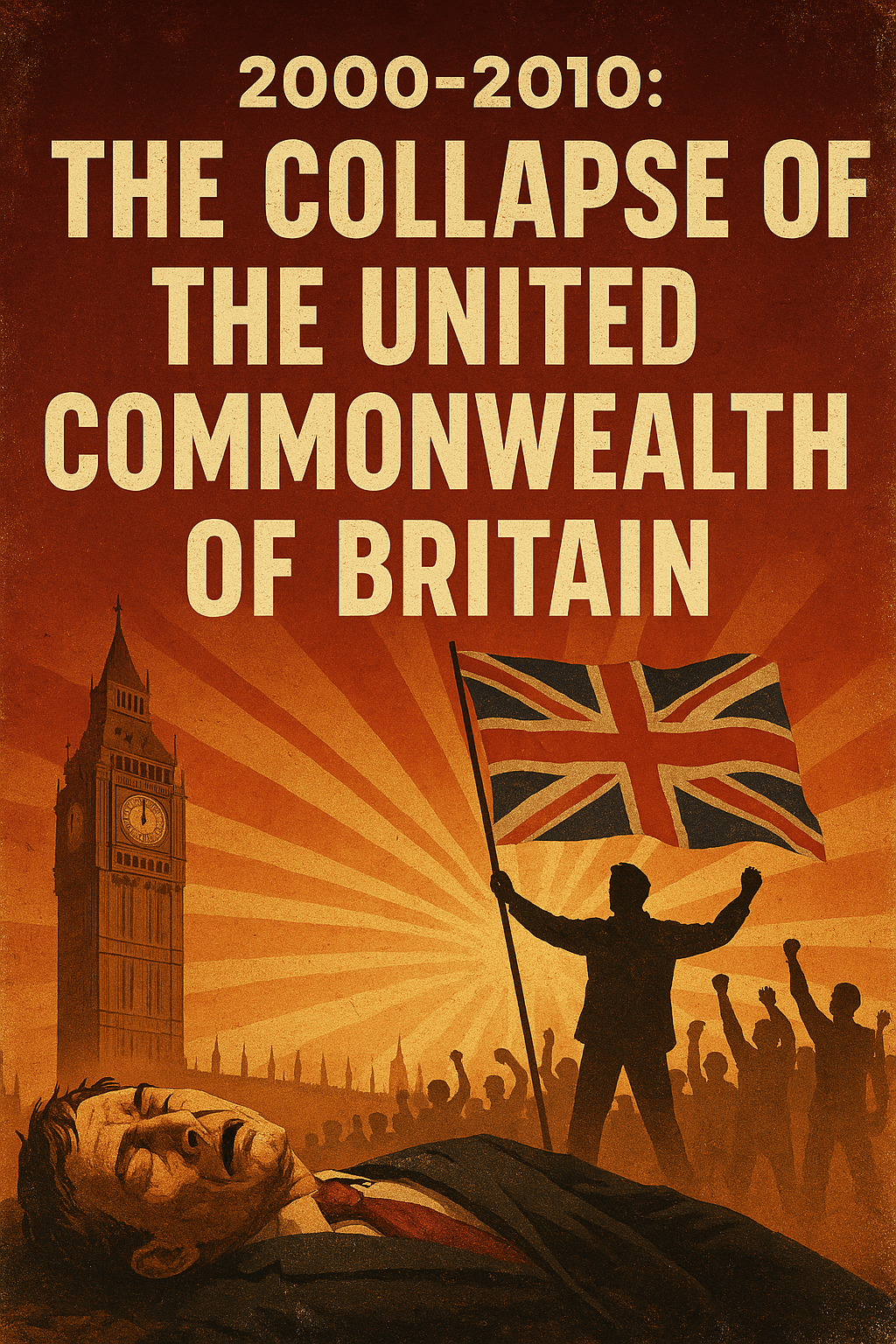
- On March 12, he was captured by rebels, dragged through the streets, and publicly executed in London.
- The United Commonwealth of Britain officially ceased to exist.
The flag of the old UK was raised over Westminster, as a new transitional government formed.
2008–2010: The Aftermath – A Broken Britain
The Royalists Return
- Prince William, now in his late 20s, was invited to take the throne, but he declined, saying Britain needed democracy.
- Instead, the new government declared the birth of the Third British Republic.
Economic and Social Disaster
- Britain had no functioning government, no economy, and no law enforcement.
- The black market controlled most trade, and foreign aid was slow to arrive.
- The United States and the European Union offered economic support, but full recovery seemed decades away.
Scotland & Ireland: Fragmentation
- Scotland refused to rejoin Britain, instead becoming an independent socialist republic.
- Northern Ireland voted to unify with the Republic of Ireland, ending decades of division.
By 2010, Britain was free—but completely broken.
 What If: The Archive
Leave a comment