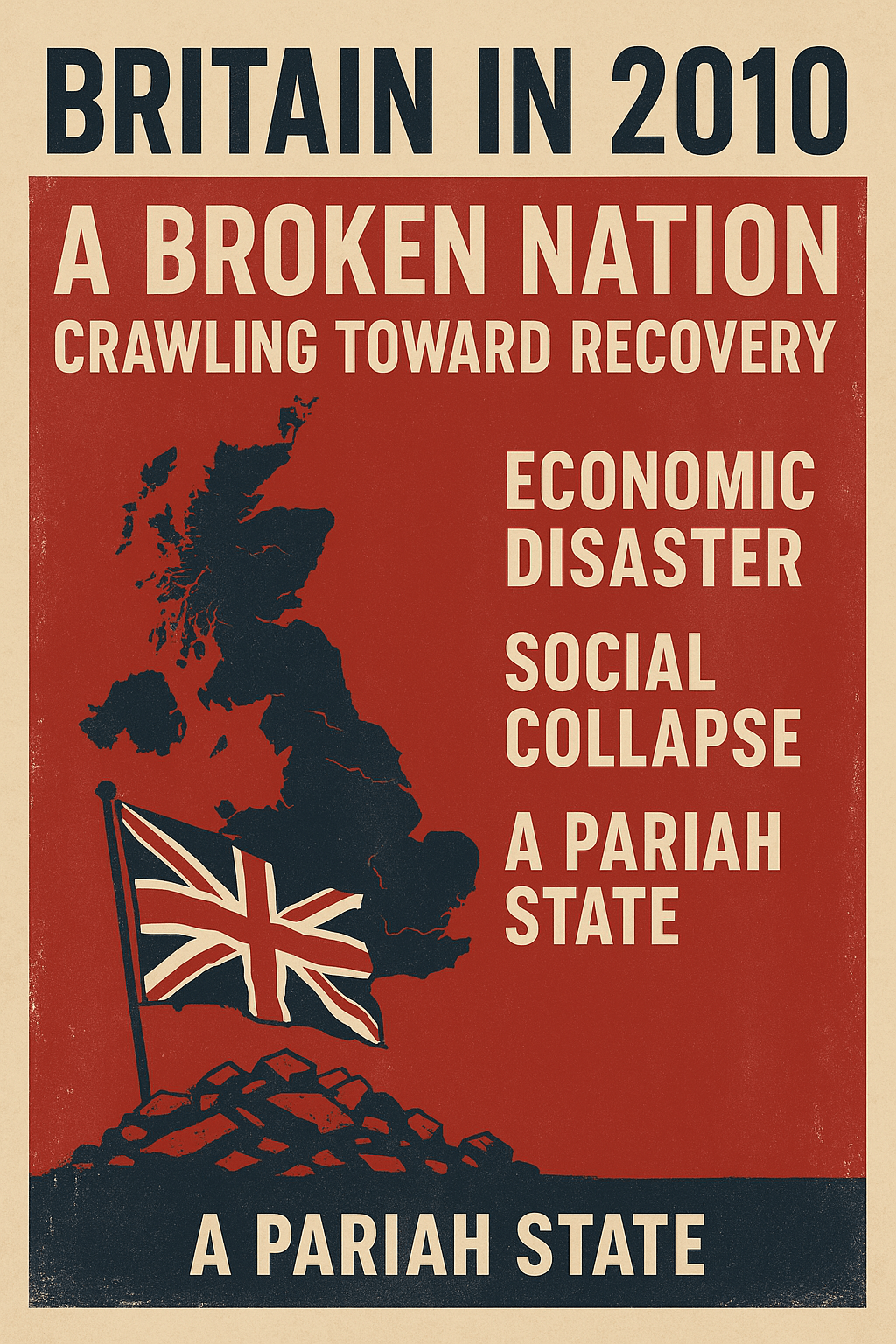
By 2010, Britain was finally free from communist rule, but the scars of nearly four decades of dictatorship, civil war, and economic devastation had left the country in ruins.
While other nations entered the high-tech, globalized economy of the 21st century, Britain was still dealing with food shortages, crumbling infrastructure, and mass unemployment. The world no longer saw it as a leading power—it was now a failed state struggling to rebuild.
📉 The Socio-Economic Conditions of Britain (2010)
1. Economic Disaster: The Price of Communist Rule
- GDP per capita in 2010: Lower than Ukraine, barely above Sudan.
- Currency collapse: The old Commonwealth Pound was worthless—Britain had to introduce a new currency backed by the EU and IMF.
- Unemployment: 55%—more than half of all Britons were jobless.
- Industry destroyed: No major British companies remained. The UCB’s command economy had eliminated private business, and the country now had to rely on foreign aid.
- Food and energy shortages: Britain was no longer self-sufficient—it imported nearly everything.
- Infrastructure crumbling: The motorways, train systems, and power grids were all decades behind the rest of Europe.
By 2010, Britain was one of the poorest countries in Europe, on par with post-war Bosnia or Moldova.
2. Social Collapse: A Nation of Trauma and Division
- A Lost Generation:
- People who grew up under the UCB’s Soviet-backed regime had never experienced democracy, free speech, or capitalism.
- Many Britons had never traveled outside the country or even seen a computer before the 2000s.
- Refugee Crisis in Reverse:
- Over 10 million Britons had fled since the 1980s, forming large exile communities in Canada, Australia, and Ireland.
- Now, some were returning to help rebuild, but many refused, believing Britain was beyond saving.
- Crime and Lawlessness:
- Decades of secret police rule and black-market survival had turned Britain into a violent, lawless society.
- Armed criminal gangs controlled London, Birmingham, and Glasgow, making some areas more dangerous than post-war Iraq.
- Education and Culture in Ruins:
- Under the communist regime, history had been rewritten, and critical thinking was suppressed.
- Generations had been raised on propaganda, making reintegration into the global world extremely difficult.
3. Foreign Relations: A Pariah State Begging for Aid
- Britain was no longer a global power.
- It was not yet a member of NATO or the EU, as both required political and economic stability.
- The U.S. and Canada offered humanitarian aid but refused military support.
- Russia was no longer communist but still had influence over ex-UCB elites, leading to fears of foreign interference.
- The European Union debated whether to integrate Britain—some wanted to help, while others saw Britain as a lost cause.
📜 How Did People View Historical Figures in 2010?
With decades of rewritten history, propaganda, and war, Britons had radically different views on historical figures.
🔵 The Monarchy: Controversial and Divisive
- Queen Elizabeth II (1926–1981) – Viewed as a tragic figure by exiles, but demonized in the UCB for decades.
- Some Britons saw her as a martyr, executed unjustly during the revolution.
- Others saw her as an outdated relic who failed to save the nation.
- Prince Charles (1948–1984) – Once the heir to the throne, executed by revolutionaries in 1984.
- Royalists saw him as a victim of communist terror.
- Others saw him as a failure who was too weak to stop the monarchy’s collapse.
- Prince William and Prince Harry – Lived in exile in Canada.
- By 2010, they were famous philanthropists but refused to return to politics.
- Many Britons hoped William would restore the monarchy, but he declined.
🔴 David Windsor-Smith (Leader of the UCB, 1983–2008)
- Once seen as a “hero of the people,” but by 2010, most viewed him as a dictator who ruined Britain.
- His policies caused economic collapse, mass starvation, and the deaths of millions.
- Some hardline communists still saw him as a visionary, but most considered him a Stalin-like figure.
- His public execution in 2008 was viewed as justice by some, but revenge by others.
🔨 The Soviet Union & Communist Leaders
- Joseph Stalin (1878–1953) – The UCB had glorified him for decades, but by 2010, most people saw him as a tyrant.
- Mikhail Gorbachev (Leader of USSR, 1985–1991) –
- Once seen as a betrayer for letting the Soviet Union collapse.
- Now seen as a missed opportunity—if he had reformed Britain earlier, maybe communism wouldn’t have failed so badly.
- Vladimir Putin (Leader of Russia, 2000–2010) –
- He was closely tied to former UCB elites, leading many to fear Russian influence in post-communist Britain.
⚽ Footballers & Pop Culture Figures
With the fall of communism, sports and culture were being rediscovered, but Britain had lost an entire generation of football legends and musicians due to the war.
- David Beckham (who grew up in exile) became a symbol of English football’s rebirth.
- Liverpool and Manchester United tried to rebuild, but many of their best players had spent their careers in exile.
- The Beatles had been banned under the UCB—by 2010, their music was being rediscovered.
📅 What Happens Next?
By 2010, Britain was free but still a broken country. The key questions were:
- Can Britain rejoin the world stage?
- Will the monarchy return, or will democracy survive?
- Will Britain integrate with Europe or remain isolated?
 What If: The Archive
Leave a comment