
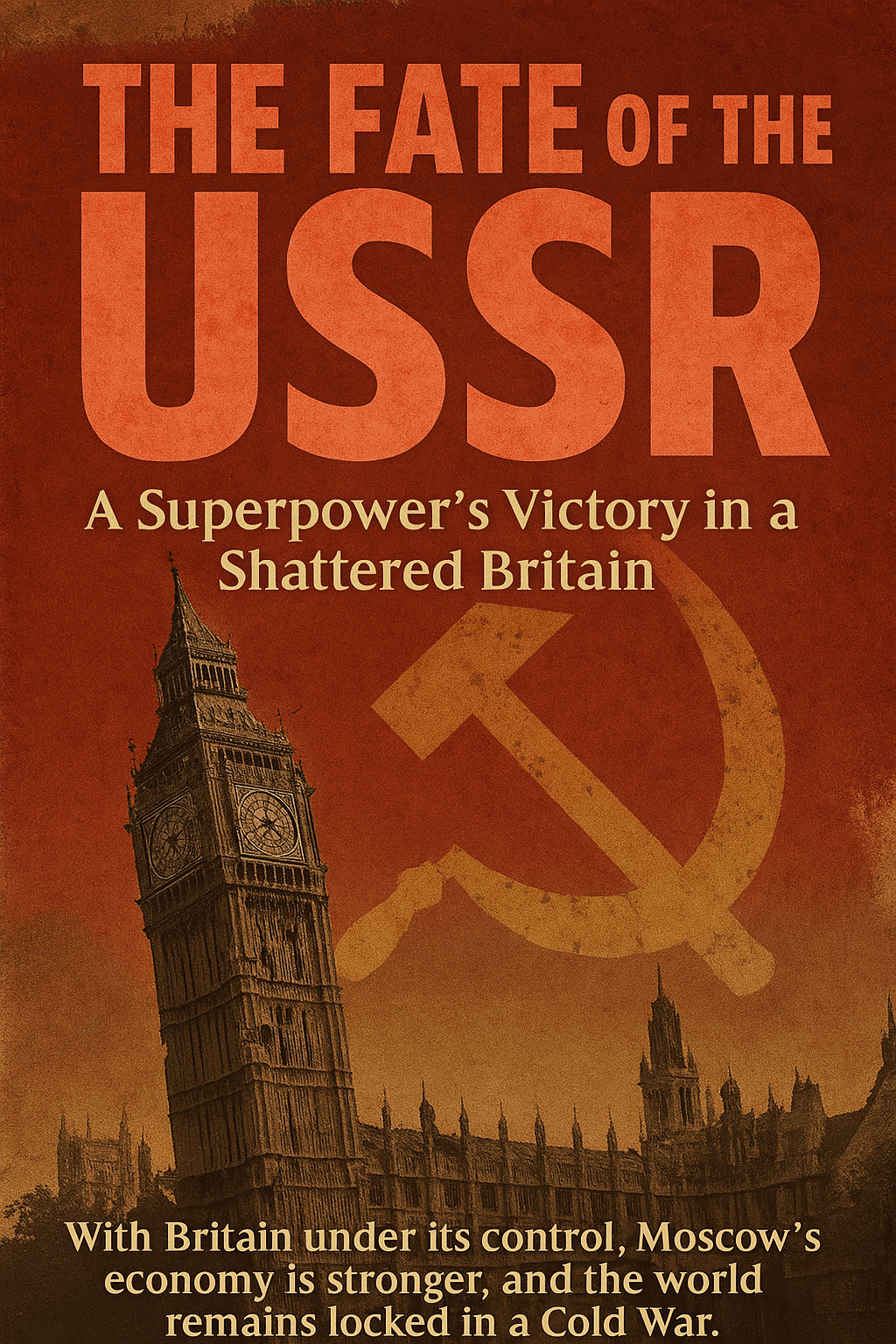
In this timeline, the Soviet Union does not collapse in 1991. In fact, the British Civil War of the 1980s accelerates the decline of the West while strengthening Moscow’s position. Without Britain as a stable NATO ally, the balance of power in the Cold War shifts in favor of the USSR, delaying or even preventing its dissolution.
Let’s examine how the Soviet Union survives and thrives while Britain burns.
1980s: The Soviet Gamble Pays Off
During the British Civil War, the Soviets played their cards masterfully, providing just enough support to David Windsor-Smith’s revolutionary forces without direct intervention. By doing so, they:
- Weakened NATO – Britain, once a pillar of Western defense, was too busy self-destructing to contribute to the Cold War.
- Divided the Western Bloc – The U.S. and Europe disagreed on how to handle Britain’s collapse, preventing a coordinated response.
- Propped Up Their Own Economy – While Britain’s economy imploded, the USSR expanded its influence in global markets, securing resources and allies.
1983–1985: The Warsaw Pact Holds Firm
In our timeline, the early 1980s saw major Soviet setbacks:
- Poland’s Solidarity movement (a pro-democracy uprising) challenged Soviet rule.
- The Soviet war in Afghanistan drained resources and morale.
- The U.S. under Reagan ramped up military spending, putting enormous pressure on the Soviet economy.
But in this timeline, things go differently:
- Britain’s collapse becomes a bigger crisis than Poland. Instead of a strong NATO supporting Polish dissidents, Europe is too distracted to aid anti-communists.
- The Soviet invasion of Afghanistan receives less international resistance. Without British diplomatic influence, Pakistan and the West provide fewer resources to the Afghan resistance.
- The KGB infiltrates Britain’s radical factions, ensuring that leftist republicans and anti-royalist forces remain aligned with Moscow.
By 1985, when Mikhail Gorbachev rises to power in the USSR, he faces a very different global situation—one where the West is weaker than before.
1986–1991: The USSR Exploits the British Collapse
The Soviets and David Windsor-Smith’s Britain
By the late 1980s, Britain is a shattered, dysfunctional state under David Windsor-Smith’s fragile republic. With no allies in the West, he turns to the only power willing to help: the Soviet Union.
- 1987: Britain Joins the Soviet Economic Bloc – Facing famine and economic ruin, the Windsor-Smith government signs a deal with Moscow, bringing British trade under Soviet economic influence.
- 1988: Soviet Troops Land in Britain – Officially “peacekeepers,” Soviet special forces and advisors deploy in Britain, securing naval bases and “assisting” with counter-insurgency operations.
- 1989: NATO Declares Britain a “Lost Cause” – The U.S. and Europe quietly abandon any plans to intervene in Britain, focusing instead on maintaining stability elsewhere.
Effectively, Britain has become a Soviet satellite state, much like East Germany or Czechoslovakia.
No Fall of the Berlin Wall in 1989
In our timeline, the Soviet Union collapsed in part because:
- Eastern European countries revolted in 1989, demanding democracy.
- The Berlin Wall fell, and Germany reunified.
- The Soviet economy was in terminal decline.
But in this timeline:
- The Soviets have a major victory in Britain, proving to their allies that the West is not invincible.
- The British Republic becomes an economic and military ally of Moscow, easing some of the USSR’s financial burdens.
- Eastern European rebellions are crushed. Seeing what happened in Britain, Warsaw Pact nations fear Western collapse more than Soviet rule.
Instead of collapsing in 1991, the USSR doubles down, reinforcing its grip over Eastern Europe.
The 1990s: A Cold War That Never Ends
By 1990, the world is more divided than ever:
- The United States is isolated, having lost Britain as an ally.
- The European Community (the precursor to the EU) is weaker, afraid of Soviet expansion.
- The Soviet Union is stronger, having turned Britain into a puppet state.
A New Iron Curtain
- The “Iron Curtain” no longer stops at Berlin—it extends across the English Channel.
- Britain is a communist-aligned state, ruled by David Windsor-Smith under heavy Soviet influence.
- The U.S. establishes military bases in Ireland, fearing Soviet expansion into Western Europe.
What About the Royal Family?
The House of Windsor is in exile in Canada, recognized as the “true” rulers of Britain by NATO. However, their influence is minimal—most Britons see them as relics of a failed past.
Does the Soviet Union Ever Collapse?
In our timeline, the USSR collapsed because of:
- A failed economy
- Losing Eastern Europe
- The Afghan War
But with Britain under its control, Moscow’s economy is stronger, and the world remains locked in a Cold War.
 What If: The Archive
Leave a comment