
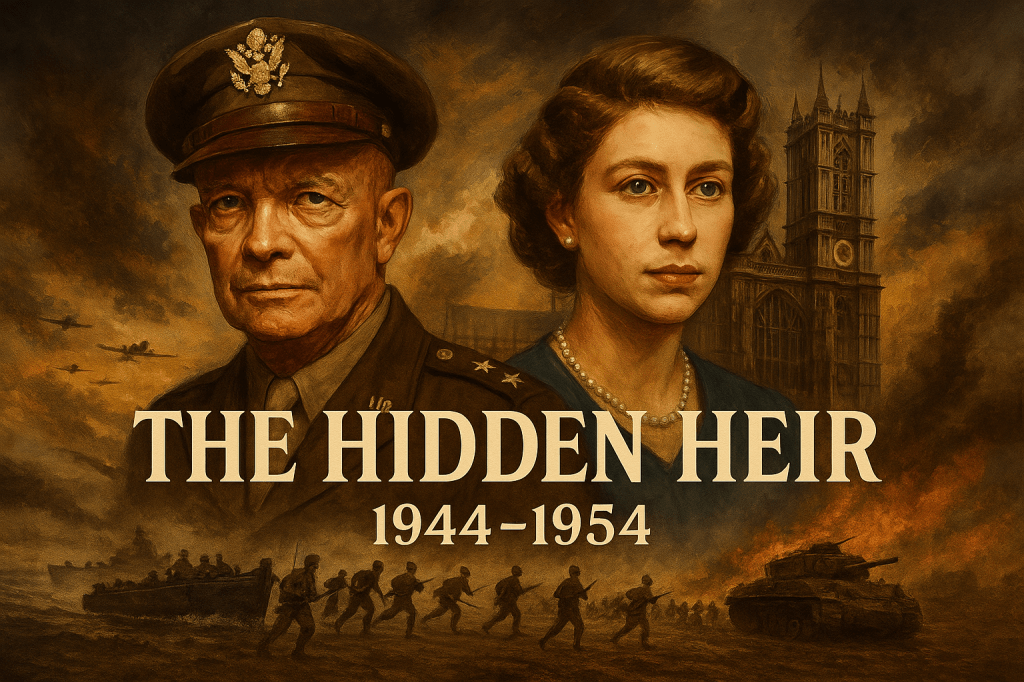
Point of Divergence: Spring 1944 – A Secret Affair Between General Eisenhower and Princess Elizabeth
In the tense months leading up to the D-Day landings, General Dwight D. Eisenhower, Supreme Commander of the Allied Expeditionary Force, worked tirelessly in Britain, coordinating the most ambitious military operation in history. During this time, he regularly met with key British figures, including Prime Minister Winston Churchill and members of the royal family, to maintain morale and ensure Anglo-American cooperation.
According to this alternate timeline, sometime in the spring of 1944, a private encounter between the 53-year-old Eisenhower and the young Princess Elizabeth (18 at the time) results in an unexpected pregnancy. The affair, whether born of wartime passion or a fleeting lapse in judgment, remains an absolute secret—at least for now. The consequences, however, will shake both the British monarchy and post-war geopolitics.
1944–1954: The Hidden Scandal and Its Consequences
1944–1945: The War Continues Under a Shadow
In this altered history, as D-Day commences on June 6, 1944, Eisenhower is not just burdened with military responsibility—he is also acutely aware that the future Queen of England may be carrying his child. Only a handful of people know: Elizabeth’s closest aides, her mother Queen Elizabeth (the future Queen Mother), and Winston Churchill himself.
The royal family and the British government scramble to contain the situation. There is no possibility of a public revelation—a scandal of this magnitude could devastate the monarchy’s reputation and threaten Britain’s alliance with the United States. The Queen Mother, fiercely protective of the Crown, demands a cover-up. A secret plan is devised:
- Elizabeth is sent into “seclusion” at Balmoral Castle for an extended period, under the pretense of illness.
- The child will be quietly adopted out—perhaps placed with a trusted aristocratic family or even sent abroad.
- King George VI, ailing but still in power, warns Eisenhower to keep his distance—though it is unclear whether Eisenhower even knows of the child’s fate.
As the war ends in 1945, Eisenhower returns to America a hero. Elizabeth, meanwhile, resumes her royal duties, but there are whispers in elite circles of a secret child.
1946–1952: The Unacknowledged Heir
By the late 1940s, the fate of Elizabeth’s secret child is an open question. Given post-war instability, the monarchy likely ensures that the child is raised far from public scrutiny—perhaps in Canada or Australia, where royalist sentiment remains strong. Meanwhile, Elizabeth marries Prince Philip in 1947, and Prince Charles is born in 1948.
But problems arise:
- What happens if the child’s existence is revealed? Republican movements, already emboldened by Britain’s post-war decline, could use the scandal to push for the abolition of the monarchy.
- What if the child learns the truth? If raised in a privileged but unofficial setting, the boy or girl may eventually demand recognition.
1953–1954: The Coronation Crisis
By 1953, Queen Elizabeth II is preparing for her coronation. Eisenhower, now President of the United States, is invited. Their secret past remains a buried issue, but some within the British and American intelligence communities know the truth.
In this timeline, a journalist or political rival could uncover fragments of the story. Imagine an investigative reporter discovering documents hinting at a wartime royal pregnancy—or an American senator (perhaps a McCarthyite anti-royalist) using the scandal to attack Eisenhower.
Would the child, now around nine years old, be forced into exile? Or could Britain face a full-scale constitutional crisis over who is the legitimate heir to the throne?
 What If: The Archive
Leave a comment