
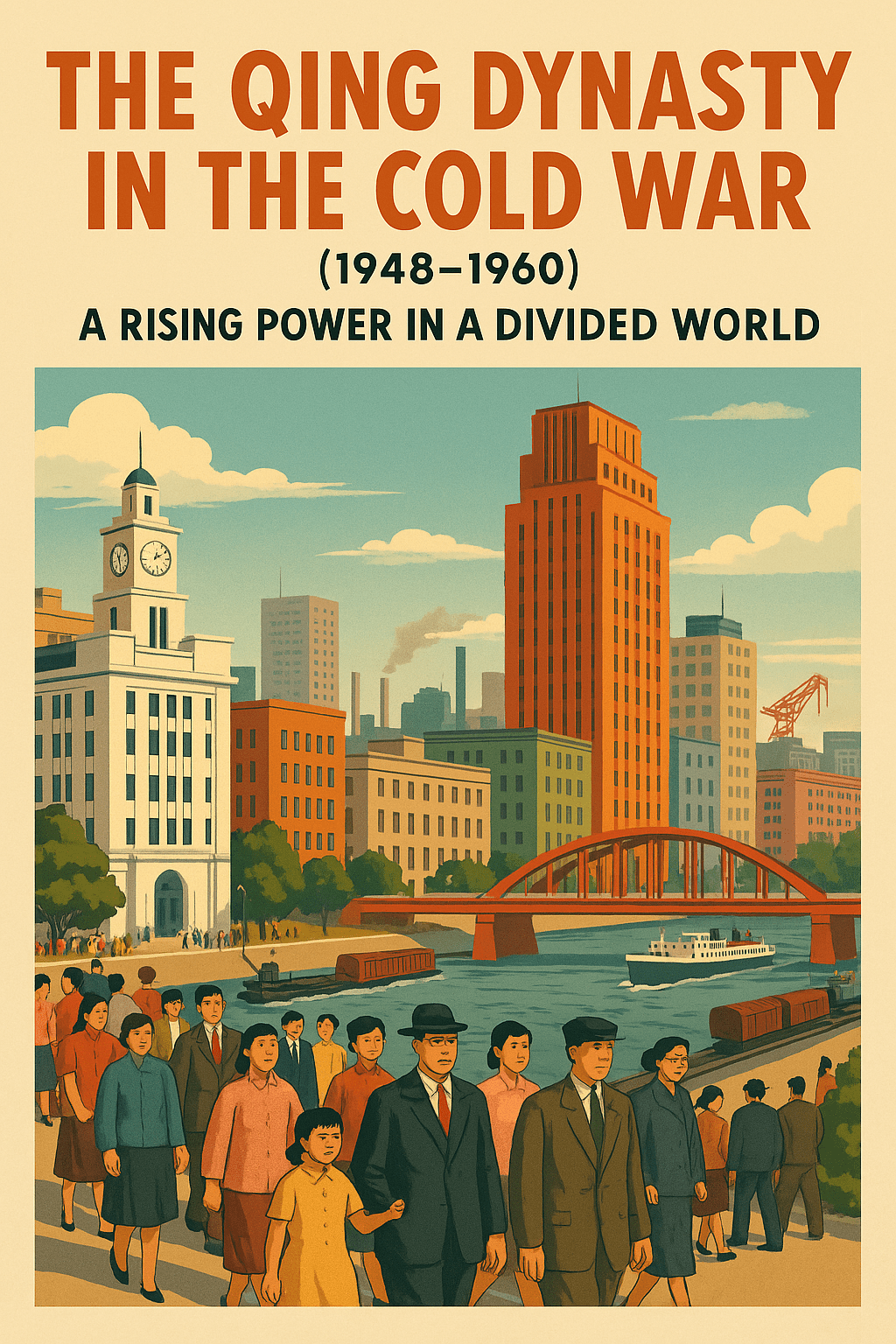
As the world enters the Cold War, the Qing Empire navigates the ideological and geopolitical struggles between the United States-led West and the Soviet Union-led Eastern bloc with remarkable skill. Under the continued leadership of the Xuantong Emperor and his government, China pursues a policy of non-alignment, positioning itself as a bridge between the capitalist and communist worlds. This strategy allows the Qing Empire to emerge as a leader among neutral nations, securing economic and political advantages while avoiding the direct hostilities that define this era.
Political Developments
The Emperor’s Role in the Cold War
The Xuantong Emperor, by now in his mid-40s, fully embodies his role as a constitutional monarch and global statesman. Known internationally as a mediator and symbol of stability, he hosts diplomatic conferences, delivers speeches emphasizing the importance of peace, and promotes Asian solidarity. His frequent travels to nations in Asia, Europe, and even North America bolster China’s prestige and solidify his image as a modern emperor.
Domestically, the Emperor continues to act as a unifying figure, mediating between factions in the Guomin Yuan (National Assembly) and encouraging reforms to strengthen the constitutional monarchy. His popularity among the people, combined with the efficiency of the government, ensures that republican movements remain marginalized.
The “Pan-Asian Bloc” (1949)
In 1949, the Qing government spearheads the creation of the Pan-Asian Bloc, an expansion of the Pan-Asian Cooperation League (PACL). Unlike the Western-backed NATO or the Soviet-led Warsaw Pact, the Pan-Asian Bloc focuses on economic and cultural collaboration rather than military alliances. Member nations include India, Siam (Thailand), the Philippines, Indonesia, and newly decolonized nations like Burma and Vietnam.
- Objectives: The bloc seeks to reduce Western and Soviet influence in Asia, promote regional trade, and ensure that Asia remains politically independent.
- Challenges: Though successful in fostering trade and unity, tensions with Japan—excluded due to its imperialist past—persist. Japan’s alliance with the United States complicates China’s ambitions to become Asia’s undisputed leader.
The Sino-Mongolian Accord (1953)
One of the Qing Empire’s most significant political achievements during the early Cold War is the Sino-Mongolian Accord of 1953. After years of negotiation, the Soviet Union agrees to withdraw its troops from Mongolia and recognize it as part of the Qing Empire in exchange for guarantees of Mongolian autonomy and Soviet economic privileges. The reintegration of Mongolia is hailed as a triumph of diplomacy and a symbolic end to the territorial losses of the “Century of Humiliation.”
Economic Developments
The “Second Great Leap” (1950–1960)
The Qing Empire’s industrial and economic modernization accelerates during the 1950s, fueled by Cold War-era trade opportunities and domestic reform. Key features of this period include:
- Heavy Industry and Technology: Chinese industries diversify, with major investments in steel production, chemical manufacturing, and electronics. By the late 1950s, China begins producing its first domestically designed automobiles and aircraft.
- Hydroelectric Power: The Yangtze River Dam Project, completed in 1956, becomes one of the largest hydroelectric plants in the world, powering industrial expansion and electrification efforts across southern China.
- Export-Oriented Growth: China leverages its neutrality to trade with both sides of the Cold War divide, exporting consumer goods to Western markets and raw materials to the Eastern bloc.
Agricultural Modernization
The Qing government continues to address rural inequality through large-scale investment in agricultural infrastructure. By the mid-1950s, mechanized farming and irrigation systems are widespread, leading to record-breaking harvests and the virtual elimination of famines. Land reform programs further reduce the influence of landlords, although tensions persist in certain provinces.
Economic Partnerships
China’s economic strategy during the Cold War focuses on forging partnerships with newly independent nations. Through the Pan-Asian Bloc, the Qing government provides technical expertise and loans to developing countries, cultivating goodwill and securing access to vital resources.
Foreign Relations
The Bandung Conference (1955)
In 1955, China plays a leading role in organizing the Bandung Conference in Indonesia, a landmark meeting of 29 African and Asian nations. The conference promotes decolonization, economic cooperation, and opposition to Cold War alliances. The Xuantong Emperor’s presence at the conference underscores China’s leadership in the non-aligned movement, and his calls for “Asian solidarity and self-reliance” become a rallying cry for the Global South.
Balancing Relations with the Superpowers
The Qing government’s neutrality requires careful balancing between the United States and the Soviet Union:
- With the West: China deepens economic ties with the United States and Western Europe, exporting consumer goods and raw materials in exchange for technology and capital. American companies establish factories in Shanghai and Guangzhou, making China a key player in the global economy.
- With the Soviet Union: China avoids joining the Eastern bloc but maintains cordial relations with Moscow. Soviet advisors assist with infrastructure projects, and the two nations sign a non-aggression pact in 1952 to prevent border conflicts.
Japanese Relations
While tensions with Japan remain high, the two nations begin cautious rapprochement in the late 1950s. Japanese companies invest in China’s industrial sector, and cultural exchanges are encouraged to reduce animosity. By 1960, trade between the two nations rivals that of Sino-American trade.
Military and Technological Developments
The Qing Empire’s Armed Neutrality
The Qing government adopts a policy of armed neutrality during the Cold War, maintaining a strong military to deter aggression without aligning with either superpower. Key developments include:
- Nuclear Energy and Defense: In 1954, the Qing Empire establishes the National Institute for Atomic Energy, with the goal of developing nuclear power and exploring nuclear weapons research. While China avoids building a nuclear arsenal, it becomes a leading advocate for nuclear disarmament in international forums.
- Modernizing the Military: The Imperial Armed Forces continue to modernize, acquiring advanced jet fighters and tanks from both the United States and Europe. By 1960, China boasts the largest standing army in Asia.
Space Exploration
In 1958, the Qing government launches its first satellite program, the Heavenly Dragon Project, in collaboration with German and American scientists. While primarily symbolic, the program highlights China’s growing technological prowess and positions it as a leader in Asian scientific advancement.
Social and Cultural Developments
The “Golden Decade” of Culture (1950–1960)
The 1950s see a flourishing of Chinese culture, often referred to as the “Golden Decade.” Modern and traditional art forms coexist, creating a uniquely Chinese cultural renaissance.
- Cinema: Chinese filmmakers produce acclaimed historical epics and contemporary dramas, some of which win awards at international film festivals.
- Architecture: Urban development combines modernist designs with traditional Chinese aesthetics, creating iconic cityscapes in Beijing and Nanjing.
- Philosophy: A new wave of thinkers, inspired by both Confucianism and Western liberalism, promotes a philosophy of ethical governance and social harmony.
Education and Women’s Rights
By 1960, China achieves near-universal literacy, a remarkable milestone. Women’s rights continue to advance, with women making up 20% of the Guomin Yuan and holding key positions in education, healthcare, and local government. Efforts to integrate women into the workforce further boost the economy.
Key Events
The Tibetan Reconciliation (1951)
After years of unrest, the Qing government signs the Lhasa Agreement with Tibetan leaders in 1951, granting the region extensive cultural and religious autonomy. The Dalai Lama becomes an official advisor to the Emperor, symbolizing unity between Han and Tibetan peoples.
The Taiwan Question
Taiwan remains a politically autonomous province under the Qing Empire but grows closer to the central government during the 1950s. The completion of high-speed ferry and air routes between Taiwan and the mainland in 1957 boosts economic integration, though full political unification remains elusive.
By 1960: The State of the Qing Empire
As the Cold War enters its second decade, the Qing Empire stands as a model of stability, modernization, and strategic neutrality. The dynasty’s success in balancing tradition and reform, as well as its leadership in the Pan-Asian Bloc, cements its status as a global power.
While challenges remain—ethnic tensions, border disputes with the Soviet Union, and the need for further economic development—the Qing dynasty enters the 1960s stronger than ever, poised to shape the emerging post-colonial world order.
 What If: The Archive
Leave a comment