
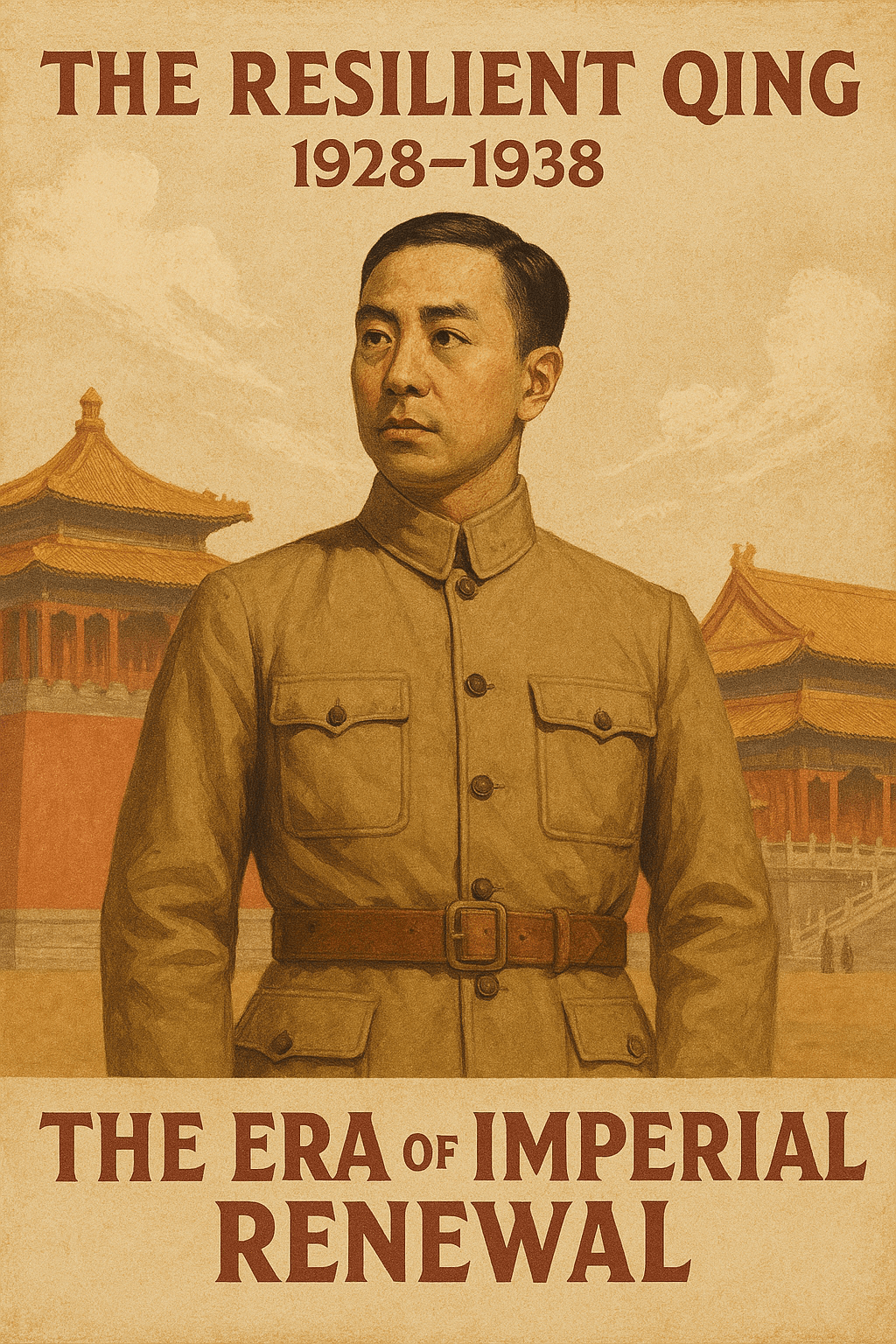
By 1928, the Qing dynasty stands at a crossroads. Nationalist sentiment, rural unrest, and foreign threats pose significant challenges to the monarchy’s survival. However, the young Xuantong Emperor and his advisors prove remarkably adept at navigating the turbulent political landscape. Through decisive reforms, the revitalization of the constitutional system, and strategic diplomacy, the Qing dynasty not only survives the 1930s but emerges stronger, ushering in what historians later call the “Era of Imperial Renewal.”
Political Developments
The Unity Act of 1929
In the aftermath of the Wuchang Incident, the Xuantong Emperor addresses the nation directly in a rare radio broadcast, calling for unity and compromise. His speech, carefully crafted by his reformist advisors, emphasizes the monarchy’s role as a stabilizing force amid political chaos. In 1929, the Unity Act is passed in the Guomin Yuan with support from moderates in both the Reformist and Nationalist camps.
The Unity Act reaffirms the constitutional monarchy, expands the powers of the elected assembly, and introduces new safeguards to prevent military interference in politics. It also establishes a Federal Council, granting provinces greater autonomy in local governance to placate regional leaders and ethnic minorities. While controversial, the act diffuses tensions and prevents further uprisings.
The Imperial Youth Movement
The Qing government invests heavily in fostering loyalty to the monarchy among the younger generation. The Imperial Youth Movement, launched in 1930, combines patriotic education, civic training, and military drills to instill a sense of national pride and loyalty to the Emperor. By the mid-1930s, the movement boasts millions of members, many of whom see the monarchy as a symbol of modernity and progress rather than an antiquated relic.
Economic Developments
The Great Leap of Modernization
In the early 1930s, the Qing government doubles down on industrialization. Led by reform-minded technocrats, the “Great Leap of Modernization” initiative focuses on developing heavy industries, expanding transportation networks, and promoting technological innovation. Key achievements include:
- The Trans-China Railway Project (1932–1938): A sprawling rail network linking the farthest reaches of the empire, including Tibet and Xinjiang, to coastal cities.
- Electrification of Cities: By 1935, Shanghai, Beijing, and Guangzhou are among the most electrified cities in Asia.
- State-Run Arms Industry: Factories in Wuhan and Tianjin produce advanced weaponry, reducing reliance on foreign imports.
While urban areas thrive, rural development remains uneven. To address this, the government establishes the Rural Reconstruction Bureau in 1933, which introduces agricultural cooperatives, modern farming techniques, and irrigation projects. By 1938, rural poverty begins to decline, though resistance from conservative landlords persists.
Social and Cultural Developments
Education and Literacy Boom
Education reforms initiated in the 1910s bear fruit in the 1930s. By 1935, literacy rates surpass 70% for men and 50% for women, a remarkable achievement for a nation that had been overwhelmingly illiterate just decades earlier. Universities expand their focus, with new schools of engineering, medicine, and social sciences producing a skilled workforce to drive modernization.
The Qing government promotes a hybrid national identity, blending Confucian values with modern ideals of democracy and industrial progress. Textbooks emphasize both the glory of China’s imperial past and its potential as a modern world power.
Women’s Rights and Social Reform
The status of women continues to improve under the Qing constitutional system. The Women’s Rights Act of 1932 grants women the right to vote in national elections, making China one of the first nations in Asia to achieve this milestone. Urban women begin to enter professions previously closed to them, such as law, medicine, and academia. However, patriarchal traditions remain strong in rural areas, where reform efforts proceed more slowly.
Foreign Relations
The Second Sino-Japanese Crisis (1932–1934)
Japan’s expansionist ambitions bring it into direct conflict with the Qing government in Manchuria. In 1931, Japan stages the Mukden Incident as a pretext for seizing control of Manchuria, establishing the puppet state of Manchukuo under Puyi, the former emperor who had been deposed in 1912 in the original timeline.
The Qing government, however, proves more prepared than in our timeline. Thanks to the modernized Beiyang Army and strong diplomatic ties with Britain and the United States, the Qing empire mobilizes a coordinated response. A series of border skirmishes erupts in 1932, culminating in the Battle of Mukden in 1933, where Chinese forces inflict a decisive defeat on Japanese troops.
The Qing government secures international support through the League of Nations, which condemns Japan’s aggression. By 1934, a negotiated settlement returns most of Manchuria to Qing control, though Japan retains limited economic privileges in the region.
Diplomatic Engagements
The Qing government deepens its ties with Western powers and Asian neighbors throughout the 1930s. Key developments include:
- The Sino-British Treaty of 1935: Britain agrees to gradually return treaty ports like Hong Kong and Shanghai to Chinese control, marking a significant step toward ending the unequal treaties.
- The Pan-Asian Conference (1936): Hosted in Beijing, this conference strengthens ties between China, Japan, and Southeast Asian nations, promoting trade and mutual defense against Western imperialism.
Military Modernization
The Imperial Armed Forces
The Beiyang Army evolves into the Imperial Armed Forces, a unified military capable of defending China’s sovereignty and projecting power abroad. By 1938, the Imperial Navy boasts modern destroyers and cruisers, while the Air Force, established in 1934, begins producing domestically designed fighter planes.
Border Security and Internal Stability
Ethnic unrest in frontier regions like Tibet, Xinjiang, and Inner Mongolia remains a challenge. The Qing government adopts a two-pronged approach, combining military suppression with development programs aimed at integrating these regions into the broader Chinese economy. In 1937, the Frontier Development Initiative establishes infrastructure and schools in these areas, though resistance persists among certain ethnic groups.
Key Events
The 1933 Constitutional Crisis
The death of Prime Minister Liang Qichao in 1933 sparks a political crisis, as rival factions within the Guomin Yuan vie for power. The young Xuantong Emperor, now in his late twenties, steps in to mediate, delivering a rare speech in which he emphasizes the monarchy’s role as a stabilizing force. His intervention diffuses the crisis and strengthens his personal authority, earning him the nickname “The Scholar Emperor” for his eloquence and vision.
The Beijing World’s Fair (1937)
In 1937, China hosts its first World’s Fair in Beijing, showcasing the nation’s rapid modernization. Pavilions from Britain, France, Japan, and the United States stand alongside Chinese exhibits highlighting advancements in industry, science, and culture. The fair is widely seen as a symbol of China’s emergence as a global power.
By 1938: The State of the Qing Empire
The Qing dynasty enters the late 1930s as a resurgent power. The constitutional monarchy, once viewed as an anachronism, is now seen as a model of stability and progress in a turbulent world. The Xuantong Emperor, having matured into a respected leader, balances tradition with modernity, embodying the aspirations of a nation on the rise.
However, challenges remain. Japan, though temporarily checked, remains a threat, and tensions with the Soviet Union over Mongolia are on the rise. Domestically, the growing divide between urban and rural China, as well as ethnic unrest in frontier regions, threatens to destabilize the fragile unity of the empire.
 What If: The Archive
Leave a comment