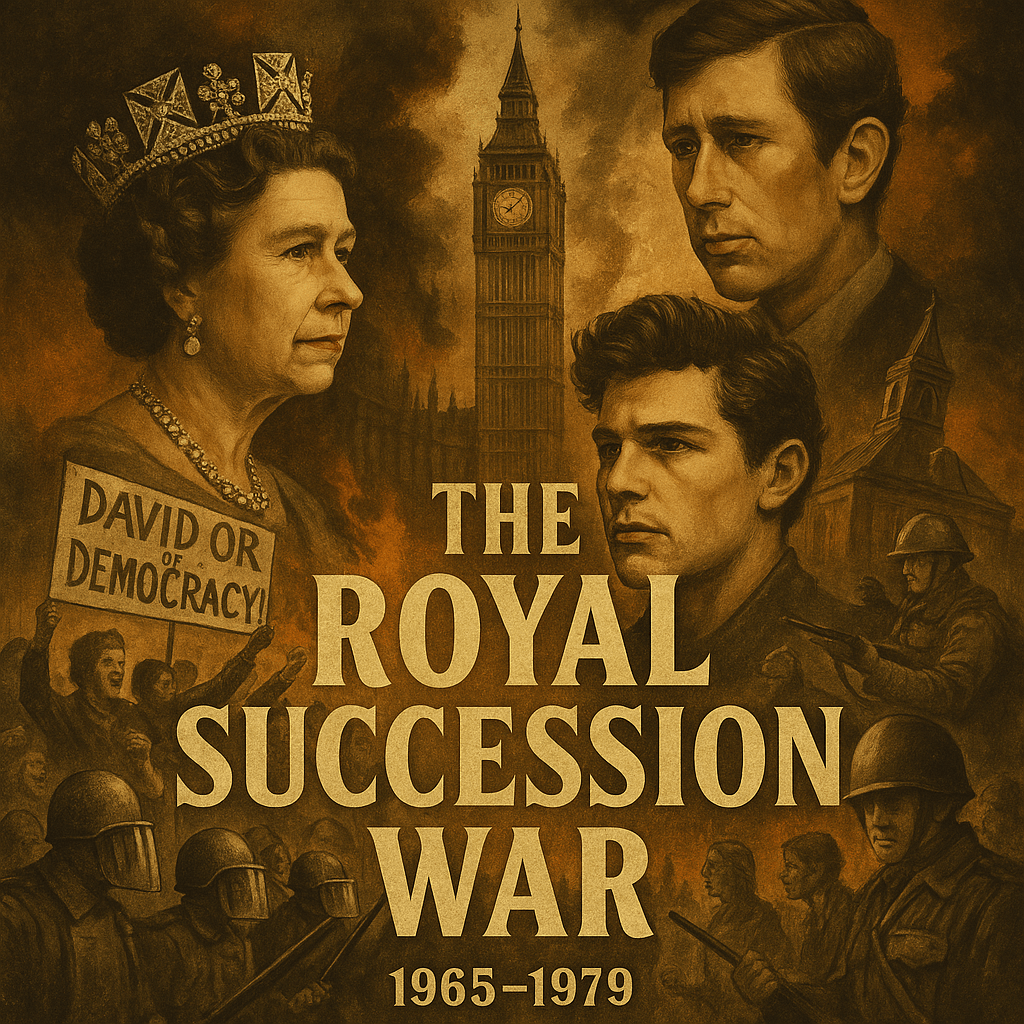
The revelation of Queen Elizabeth II’s illegitimate son, David Windsor-Smith, shatters the carefully curated image of the British monarchy. As the 1960s give way to the 1970s, Britain descends into a crisis unlike anything seen since the English Civil War. The battle for the throne is not just a legal dispute—it becomes a political, social, and even violent struggle for the soul of Britain.
1965–1968: The Rise of David Windsor-Smith
Despite Queen Elizabeth’s refusal to recognize him, David Windsor-Smith becomes a global sensation. Young, charismatic, and strikingly similar to his mother and his alleged father, Dwight Eisenhower, he captivates the British public.
The People’s Prince
- Youth movements rally around him. The swinging ‘60s are in full effect, and Britain’s younger generation, already disillusioned with aristocratic privilege, begins chanting his name at protests.
- The Press fuels the fire. While the BBC remains neutral, newspapers like The Daily Mirror and The Guardian start questioning whether Prince Charles should still be heir.
- The U.S. is divided. Many in America feel a strange pride that “one of theirs” might have royal blood. Others, particularly Cold War conservatives, fear that the crisis will destabilize Britain at a crucial time against the Soviets.
By 1967, David openly declares himself the rightful Prince of Wales. Buckingham Palace, horrified, issues a direct order for him to cease and desist, but it’s too late—the country is already choosing sides.
1969–1972: The Crown vs. The Challenger
On February 12, 1969, Queen Elizabeth officially confers the title of Prince of Wales upon Charles in a grand ceremony. The move is meant to end the controversy. Instead, it sparks a rebellion.
The Pro-David Movement Turns Militant
- A splinter group of Irish and Scottish republicans joins forces with radical leftist students to form the Free Britain League (FBL), arguing that David should abolish the monarchy entirely.
- Protests in London turn violent. Buckingham Palace is surrounded by demonstrators chanting “David or Democracy!”
- The police crack down brutally, leading to four deaths and hundreds of arrests.
David, despite being a royal claimant, denounces the violence. But the chaos is beyond his control now.
Prince Charles and the “Royal Purge”
By 1971, Prince Charles, now 23, moves to crush his half-brother’s movement. Though publicly seen as soft-spoken, Charles, under the guidance of hardline royalists, begins meeting with intelligence agencies and pushes for David to be neutralized.
- MI5 begins harassing pro-David activists.
- Royalist militias emerge, attacking Free Britain League strongholds.
- David’s closest allies are arrested or forced into exile.
Then, in May 1972, David Windsor-Smith disappears.
1973–1975: The Shadow War
Officially, Buckingham Palace claims David left Britain voluntarily. Unofficially, the rumor spreads that he was assassinated on royal orders.
But in early 1974, he resurfaces—not in Britain, but in America.
David in Exile
Now living in New York under U.S. protection, David denounces the British government and declares himself in open opposition to his family. His supporters, scattered but loyal, rally behind him from exile.
Meanwhile, back in Britain, Prince Charles consolidates power.
- Queen Elizabeth II steps back from public duties due to stress and illness.
- Charles takes full control over royal affairs, strengthening his position as heir apparent.
- Parliament debates abolishing the monarchy altogether, but Charles strikes a deal—if they recognize him as the undisputed heir, he will reform the monarchy to be more accountable.
For a time, it seems like the monarchy will survive. But in the shadows, David Windsor-Smith is preparing a return.
1976–1979: The Royalist Civil War
On July 4, 1976, in a dramatic televised address from Washington, David announces that he will return to Britain and reclaim his birthright. He calls upon his supporters to rise against the monarchy and demands a public referendum on the future of the Crown.
The response? Chaos.
Britain Splinters
- The Army is put on high alert. Pro-monarchy officers declare they will not allow a pretender to take the throne.
- The Free Britain League calls for a general strike, shutting down London and major cities.
- The government collapses. Prime Minister James Callaghan resigns, unable to handle the situation.
On November 5, 1977, David secretly returns to Britain, escorted by rogue factions within the military. Within days, cities explode into street battles between royalist paramilitaries and pro-David revolutionaries.
For the first time since the 1640s, Britain is at war with itself.
Who Will Win?
By 1979, the question is no longer about whether David Windsor-Smith is truly the Queen’s son. It’s about whether Britain should have a king at all.
- Will Charles crush the rebellion and ascend the throne, ruling over a more authoritarian Britain?
- Will David’s forces succeed, leading to the fall of the monarchy and a radical new Britain?
- Or will Parliament step in and abolish the monarchy entirely, ending the House of Windsor for good?
The fate of Britain hangs in the balance.
 What If: The Archive
Leave a comment