
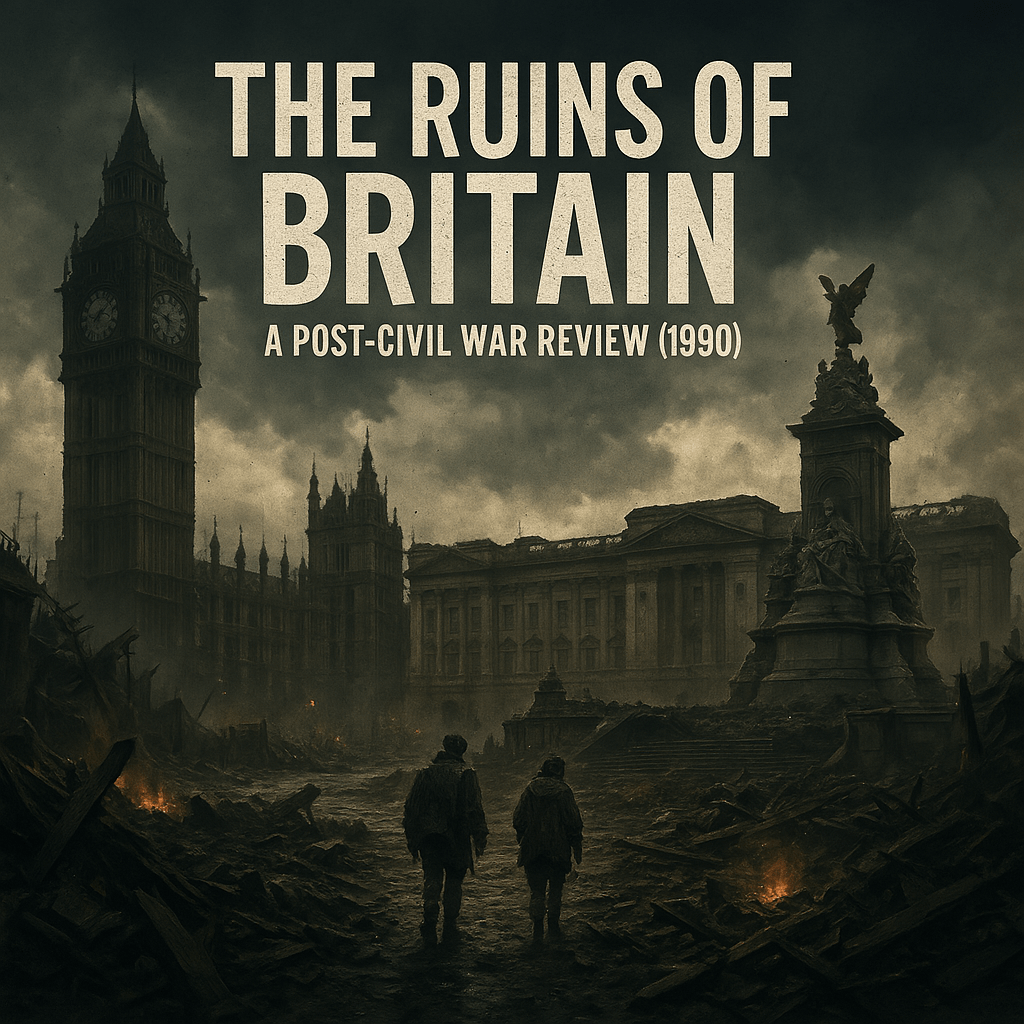
By 1990, the once-mighty United Kingdom lies in ruin—a shattered remnant of the empire that once ruled the world. The British Civil War (1976–1983), ignited by the revelation of David Windsor-Smith’s royal lineage, has left behind a devastated nation, torn by years of political violence, economic collapse, and social fragmentation.
What was once a global superpower has now become a failed state struggling to rebuild from the ashes.
1. The Physical Destruction: Cities in Ruin
The war’s urban combat, bombings, and prolonged sieges turned Britain’s major cities into smoldering battlegrounds.
London: The Ghost Capital
- Buckingham Palace: Destroyed in 1983. The heart of the British monarchy is now a ruin, its once-grand halls reduced to rubble.
- The Houses of Parliament: Gutted by fire in 1982. What remains is an abandoned, crumbling shell, a grim reminder of Britain’s lost democracy.
- The Tower of London: Bombed in 1981. The Crown Jewels were evacuated to Canada before the war, but the historic site is now little more than a wreck.
- The Thames: A Poisoned River. Chemical spills, bomb damage, and neglect have turned the once-iconic waterway into a stagnant cesspool.
London, once a center of world finance and culture, is now a lawless, depopulated husk, ruled by local warlords and criminal gangs.
Manchester & Liverpool: The Northern Wastelands
- Manchester, site of the 1980 uprising, is a ruin. The Royalist army carpet-bombed the city during its siege, leaving entire districts uninhabitable.
- Liverpool’s docks are abandoned. The city, once a global trade hub, is now a ghost town filled with rusting ships and wrecked piers.
Birmingham & Glasgow: The Armed Cities
Unlike London and Manchester, Birmingham and Glasgow survived, but only by turning into fortresses. These cities became strongholds for warlords and rogue militias, their streets lined with barricades and burnt-out vehicles.
- Glasgow remains a Scottish nationalist stronghold, barely recognizing the authority of David Windsor-Smith’s fragile government.
- Birmingham is controlled by the remnants of the Royal Army, now operating as a mercenary force for hire.
Smaller Towns: Abandoned or Annihilated
- Coventry and Bristol were destroyed by artillery strikes.
- Newcastle is under military occupation.
- Leeds is an anarchist commune, run by radical leftist survivors of the war.
2. The Economic Collapse: A Nation Reduced to Rations and Ruins
The war completely destroyed Britain’s economy. Once the financial capital of the world, Britain is now one of the poorest countries in Europe.
Hyperinflation and Starvation
- The British pound collapsed in 1982, replaced by a barter economy in most of the country.
- Food shortages have led to mass starvation, particularly in London and the war-torn Midlands.
- The welfare state no longer exists—medical care, pensions, and education are privatized or nonexistent.
Industry and Trade: A Dead Sector
- The automotive and steel industries are gone. Factories in the Midlands were bombed, looted, or abandoned.
- The financial sector is destroyed. With the Bank of England burned and global confidence shattered, international investors pulled out of Britain entirely.
- Energy is unreliable. Oil refineries and power plants were primary targets in the war. Blackouts are common, and fuel is scarce.
The Black Market Economy
With no stable government, Britain’s real economy now operates through war profiteers, smugglers, and crime syndicates.
- The Glasgow underworld controls fuel smuggling.
- Birmingham is home to weapons manufacturers, selling arms to the highest bidder.
- The Irish Republican Army (IRA) profits from drug smuggling and extortion.
With no effective state oversight, human trafficking and slavery have re-emerged in parts of the country.
3. The Human Cost: A Broken Nation
The death toll of the British Civil War is staggering.
- Casualties: 2.5 to 3 million dead. Most were civilians, killed by bombings, starvation, or executions.
- Refugees: 10 million fled abroad. Nearly a quarter of Britain’s population has evacuated to Canada, Australia, or the United States.
- Orphans and Lost Generations. Thousands of war orphans roam the streets, surviving in gangs or child labor camps.
Mental Trauma and the Collapse of Society
- PTSD and suicide rates are at an all-time high.
- Crime is rampant. Kidnapping, looting, and murder are daily occurrences.
- No functioning police force remains.
4. Britain’s Place in the World: A Humiliated Former Power
The Commonwealth Is Dead
With the fall of the monarchy, Canada, Australia, New Zealand, and the rest of the Commonwealth fully severed ties with Britain.
- Canada and Australia refuse to accept Britain’s refugees beyond a strict quota.
- India, Pakistan, and South Africa no longer recognize Britain as an authority on anything.
Europe Seals Britain Off
- The European Community (EC) refuses to allow British refugees in large numbers for fear of destabilization.
- France militarized the English Channel in 1985 to prevent desperate Britons from fleeing in boats.
- Spain, Portugal, and Germany have sent troops to secure British ports from piracy.
The United States: An Uneasy Ally
- The U.S. initially supported Prince Charles, but after his execution, Reagan’s administration cut ties with Britain entirely.
- American troops occupied parts of Wales and Scotland to prevent Soviet influence.
- By 1990, Britain is a rogue state, unrecognized by Washington.
The Soviet Union: The Real Winner
- The USSR secretly funded the anti-monarchy movement, hoping to destabilize the West.
- By 1988, Britain is under heavy Soviet political influence, though it remains technically independent.
- Some suspect that David Windsor-Smith is a puppet of Moscow.
5. The Future: Is Britain Salvageable?
As 1990 begins, Britain is no longer a nation—it is a wrecked battlefield.
Three Possible Futures:
- David Windsor-Smith Attempts to Rebuild – As the leader of the United Commonwealth, he could try to stabilize Britain. But with rebels and foreign interference, will he survive long enough?
- The Second Civil War Begins – With multiple factions vying for power, Britain could descend into an even bloodier conflict, fracturing into independent city-states.
- A Foreign Takeover – Will NATO or the USSR invade and establish a puppet government to restore order?
The Britain of Churchill, Elizabeth II, and the British Empire is gone. What comes next is uncertain.
 What If: The Archive
Leave a comment