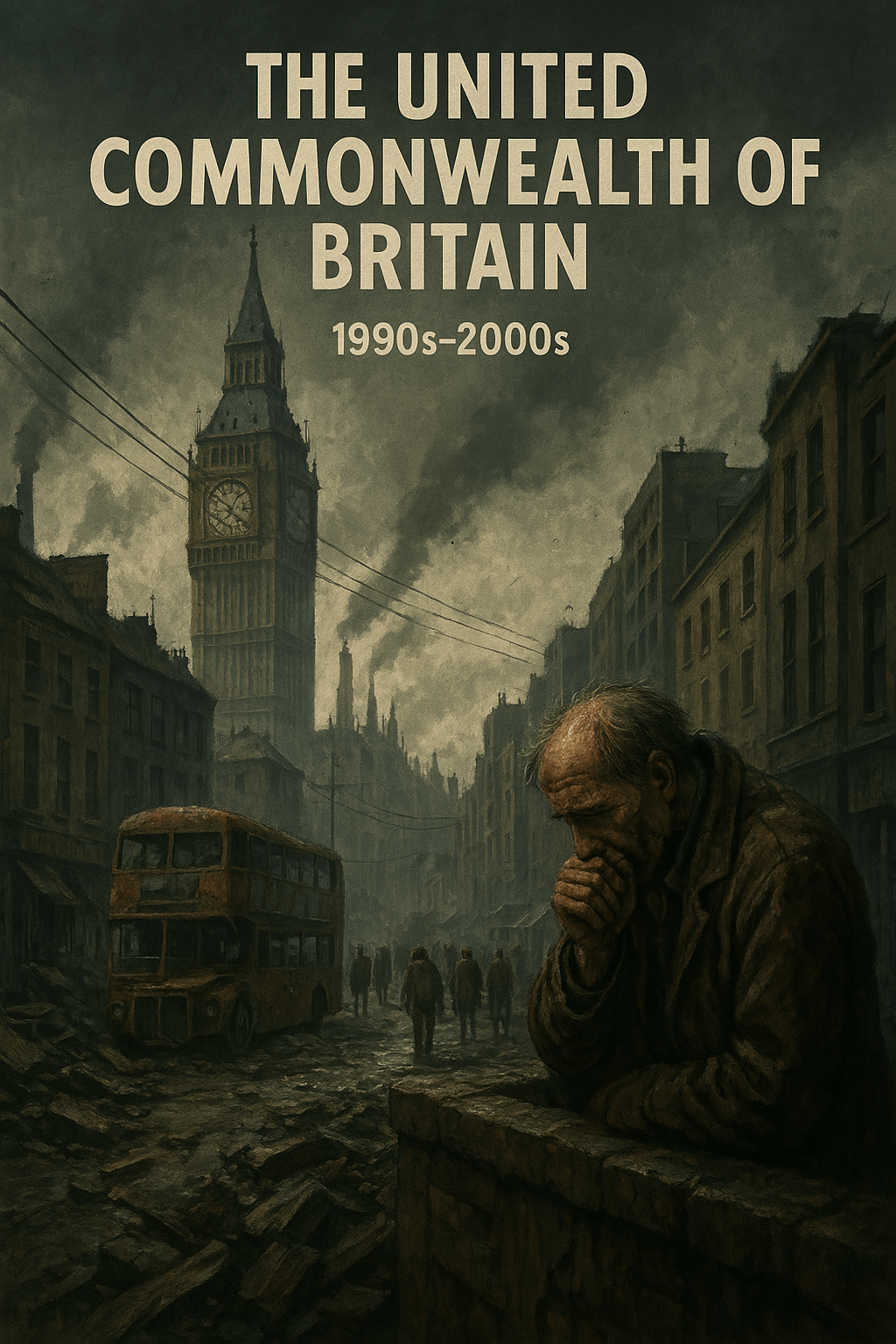
By the 1990s, the United Commonwealth of Britain (UCB) had solidified itself as a Soviet-aligned socialist state, rising from the ashes of the British Civil War (1976–1983). The old United Kingdom was gone, replaced by a one-party communist state under heavy Soviet influence.
The new system was meant to be a “workers’ republic,” but in reality, it became a fragile dictatorship, plagued by economic failure, political infighting, and growing unrest.
🛑 Political System: A Soviet Puppet State with British Characteristics
The United Commonwealth Party (UCP) – The Only Legal Party
- Formed in 1984, the UCP was a fusion of radical leftist factions, militant republicans, and Soviet-backed communists.
- David Windsor-Smith (the illegitimate son of Queen Elizabeth and Eisenhower) became the first “Protector of the People”—essentially, Britain’s dictator.
- The government followed a Soviet-style structure, with Windsor-Smith as General Secretary and a Central Committee controlling all decisions.
Branches of Government
- The People’s Assembly (Rubber-Stamp Parliament)
- Replaced the old House of Commons and House of Lords.
- Only UCP-approved candidates could run.
- Political opposition was illegal—royalists, capitalists, and conservatives were either executed, jailed, or exiled.
- The Ministry of Internal Security (Secret Police)
- Modeled after the Soviet KGB, the secret police monitored dissidents, cracked down on protests, and enforced censorship.
- Thousands of royalists and political opponents disappeared in the late 1980s.
- Regional Councils (Controlled by Party Officials)
- Britain was divided into “People’s Administrative Zones”, each ruled by a local UCP official.
- Local councils had no real power—all decisions came from Edinburgh, the new capital.
Soviet Influence: How Much Control Did Moscow Have?
- The UCB was not officially part of the USSR but was heavily dependent on Soviet aid, military presence, and economic planning.
- Soviet “advisors” were embedded in every government department, ensuring compliance.
- The UCB had a puppet status similar to East Germany—technically independent, but in reality, under Soviet rule.
Political Repression & Resistance
- The government crushed all royalist resistance by 1986, executing Prince Charles and banning all mention of the monarchy.
- By the 1990s, a growing underground movement (The Free Britain Front) began planning to overthrow Windsor-Smith.
- Scotland, Wales, and Northern England had major unrest, as people resisted the Soviet-backed government.
💰 Economic System: A Broken Communist Experiment
The UCB attempted to transition to a socialist planned economy, but decades of war, economic collapse, and Soviet mismanagement turned Britain into a third-world nation.
Key Features of the Economy
- The End of Private Property
- All major industries, banks, and businesses were nationalized under state control.
- Former aristocrats and business owners were stripped of their wealth, with many executed or exiled.
- Small-scale private trade was banned, though a black market thrived.
- State-Controlled Heavy Industry (But No Consumer Goods)
- The government prioritized coal, steel, and manufacturing—all for export to the USSR.
- Consumer goods (food, clothes, electronics) were in extreme shortage.
- The economy became heavily militarized, producing weapons for the Soviet bloc instead of improving daily life.
- Collectivized Agriculture (Leading to Famine)
- All farms were seized and turned into “People’s Agricultural Cooperatives.”
- Soviet-style quotas led to food shortages, rationing, and starvation—especially in cities.
- Illegal backyard farms became common, as people tried to avoid starvation.
- The Black Market Economy Thrived
- The government’s planned economy failed to meet basic needs, leading to a massive underground economy.
- Luxury goods, food, and foreign currency were smuggled in from Ireland, France, and the U.S.
- Organized crime syndicates (often run by former royalists) controlled much of the black market.
📉 Economic Collapse & Declining Living Standards (1990s–2000s)
Living Conditions
- Electricity blackouts were common.
- Public housing was overcrowded and crumbling.
- Medical care was underfunded, with hospitals relying on outdated Soviet equipment.
- Education was heavily censored, focusing on communist ideology instead of practical skills.
GDP Shrinks: Britain Becomes a Third-World Country
- In 1970, Britain was one of the richest countries in the world.
- By 1995, the UCB had a GDP smaller than Spain or Poland.
- Mass poverty, malnutrition, and disease spread, as the economy failed to recover from war.
Workers’ Revolts & Economic Riots (1993–1997)
- The coal miners’ rebellion of 1993 was the first major strike against the government.
- Factory workers, farmers, and dockworkers protested the failing economy—many were executed or imprisoned.
🌍 Britain’s Place in the World: A Soviet Satellite with No Influence
Foreign Relations
- Not Recognized by NATO – The U.S., Canada, and most of Western Europe refused to recognize the UCB.
- Rejected from the European Community – Britain was once a global trade hub; now it was cut off from European markets.
- Dependent on Soviet Trade – All exports went to the USSR, but the Soviet economy was also struggling.
Commonwealth Nations Left for Good
- Canada, Australia, and New Zealand completely cut ties with Britain.
- The British exiles in Canada still claimed to be the “true” government, but their influence faded over time.
- India, South Africa, and other former colonies ignored the UCB, seeing it as irrelevant.
🤔 The Big Question: Could the UCB Survive the 21st Century?
By 1999, the United Commonwealth of Britain was on the brink of collapse.
Three Possible Futures:
- The People Revolt & Overthrow Communism
- Economic failure and political repression might lead to a popular uprising.
- Would Windsor-Smith be executed like Ceausescu in Romania?
- A Military Coup
- The military might turn against Windsor-Smith, replacing him with a “reformist” dictator.
- Would Britain transition to a Chinese-style socialist state?
- The USSR Collapses, and the UCB Falls With It
- If the Soviet Union collapses, Britain could be left isolated, leading to total economic and social breakdown.
- Would NATO invade and restore democracy?
🏴☠️ Final Thought: Is Britain a Lost Cause?
The UCB was once a proud empire—now it was a Soviet puppet state, starving and isolated.
 What If: The Archive
Leave a comment