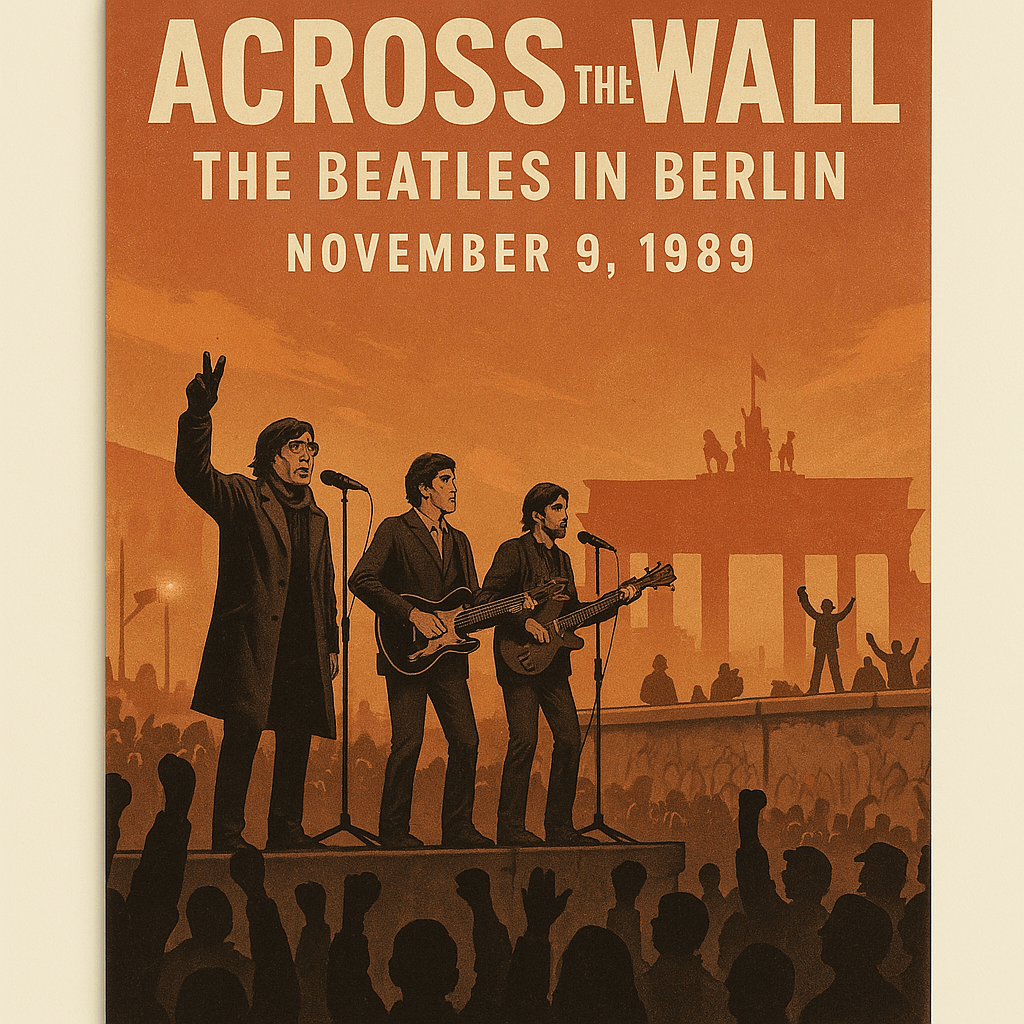
Berlin. Thursday. November 9, 1989.
It started cold, gray, and ordinary.
But by nightfall, the air buzzed like a plucked guitar string. The kind of tension you only felt when something impossible was about to happen.
Nobody could have guessed exactly what.
Checkpoint Charlie, 4:17 PM
A rumor had been spreading through Berlin like wildfire:
John Lennon and Paul McCartney are in the city.
No, really.
They’re playing—tonight. Somewhere near the Wall.
The authorities didn’t believe it. Too absurd. The Beatles were history, weren’t they? Even if they had reunited for that one-off in ’88, they weren’t going to play here. Not now.
But the organizers knew.
A local peace collective, half-official, half-outlaw, had been working quietly with a few expats, dissidents, and old friends of Lennon’s. A makeshift stage had been set up on the western side of the Wall near the Brandenburg Gate. Nothing fancy—just scaffolding, a generator, two mics, a keyboard, and a drum kit.
If the government stopped them, they’d play anyway.
If no one showed up, they’d play anyway.
But someone showed up.
Thousands of someones.
Backstage: 6:03 PM
John wore a battered coat and fingerless gloves. The kind of thing that made him look less like a legend and more like a man. Paul was tuning his bass, humming the melody to Blackbird under his breath.
George Harrison sat cross-legged on a flight case, sipping peppermint tea like he wasn’t about to help shake the world.
Ringo was late. Of course.
“I told you,” John muttered, pacing. “He’s gonna show up five minutes before we go on and say he couldn’t find his snare.”
Paul glanced out from behind the curtain. “They’re everywhere, John. West Berliners, East Berliners—hell, even some border guards are standing around like they’re waiting for a sign.”
“We’re not the bloody sign,” George said. “Let’s not delude ourselves.”
John turned to him, serious now. “Maybe not. But we’re a sound they remember. A sound from before the wall. Before the lies.”
They all fell quiet.
Then came Ringo, breathless and grinning. “Told you I’d make it.”
On the Wall – 7:02 PM
No spotlights. No introduction.
Just a figure in a long coat, walking up to the mic.
John.
“Evening,” he said. “We’re not here to start a riot. We’re here to remind you what freedom sounds like.”
The crowd roared.
Paul stepped forward, bass in hand.
George slung on his guitar. Ringo sat behind a modest kit, cracked cymbal and all.
No tracks. No backing singers. Just them.
The Setlist (partial, reconstructed from eyewitness accounts):
- Come Together – slower, bluesier than the studio cut. The crowd clapped in time. John’s voice had gravel now—age and truth.
- Imagine – John alone on piano. As he sang “You may say I’m a dreamer…”, a group of East Berliners on a rooftop across the Wall raised candles in silent salute.
- Let It Be – Paul’s turn to lead. The crowd sang along. Everyone. Even the guards, some of whom had tears streaming down their faces.
- Blackbird – dedicated to “those whose voices were never allowed to sing.” John and George harmonized quietly behind Paul. The wall seemed to soften in the night air.
- Together Again – the reunion song, sung now with deeper purpose. “We took the long road back / But we’re together again / One voice, one track…”
- The Wall Is Weak (new, unreleased) – an impromptu bluesy number John wrote that morning. He snarled into the mic:
“You can paint it red, white, and black / But the wall still cracks / When the people push back.”
The Turning Point: 8:43 PM
As they finished The Wall Is Weak, a crackle came over police radios. Border checkpoints were losing control. Crowds were surging. Something was happening.
And then—live on East German state TV, during a confusing, poorly translated press conference, an official accidentally said the borders were open.
And people took him at his word.
The Flood Begins
Crowds surged toward the wall.
East met West.
A young woman climbed the scaffolding and hugged John. He laughed, caught completely off guard.
Paul reached out and helped an elderly man onto the stage—he’d come from the East, through the crumbling checkpoint, just to hear them.
And then the crowd began climbing the Wall.
Guards didn’t stop them. They watched, awestruck, as citizens from both sides helped one another over concrete and barbed wire.
As the first East Berliners crossed fully into the West, The Beatles launched into “All You Need Is Love.”
It was chaos. Magic. History.
The Final Image
The four of them, bathed in floodlights and candlelight, standing shoulder to shoulder.
John raised a peace sign. Paul raised his bass. George smiled wryly. Ringo tossed a drumstick into the crowd.
Behind them, the Berlin Wall no longer felt permanent.
It felt like a prop waiting to be torn down.
They didn’t plan it that way. They didn’t know the Wall would fall that night. But as John later said in an interview:
“We didn’t bring the Wall down. But we gave it a soundtrack while it fell.”
 What If: The Archive
Leave a comment