
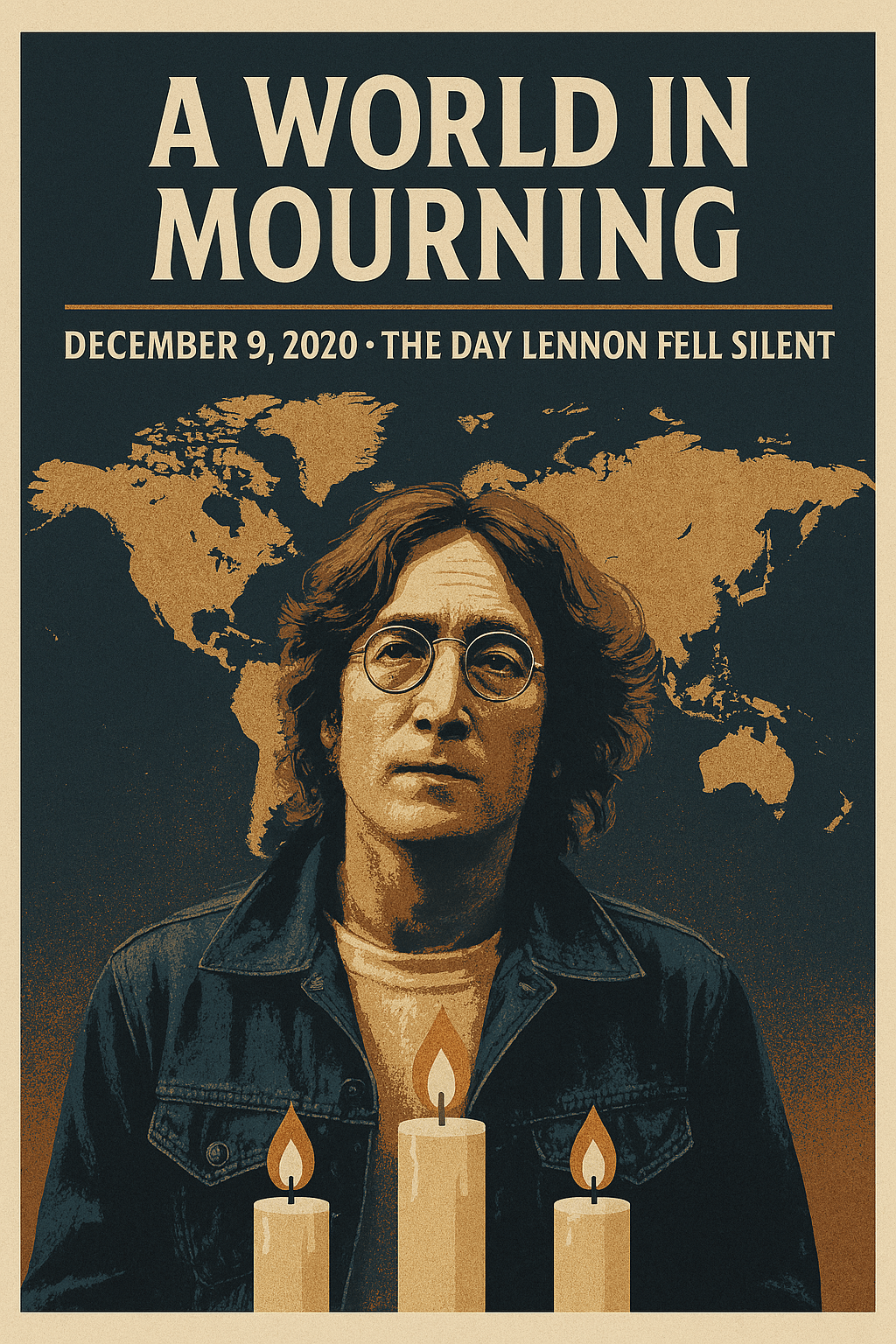
A World in Mourning – December 9, 2020: The Day Lennon Fell Silent
(An international media retrospective)
🇬🇧 United Kingdom – BBC News, 6:00 AM GMT
“Sir John Winston Lennon, 80, has passed away peacefully in New York. Flags will be flown at half-mast across Liverpool today…”
The British coverage was personal, like mourning a son gone abroad who never quite came home.
BBC presenters wore black. The Royal Philharmonic Orchestra played Imagine live in a solemn tribute at Westminster Abbey.
Tabloids ran front pages screaming “THE WORLD LOSES A BEATLE – AND A VOICE.”
But it was the Liverpool Echo that spoke for most:
“We lent him to the world. The world gave him back as a legend.”
Children placed flowers at Strawberry Field. An impromptu singalong broke out on Penny Lane.
🇺🇸 United States – The New York Times, 1:00 AM EST
“John Lennon, who challenged America with peace, changed it with music, and never stopped speaking truth to power, has died at 80.”
The American media carried a tone of deep respect—and reflection.
CNN aired a 12-hour retrospective, interviewing figures from civil rights leaders to presidents.
Fox News, often critical of Lennon’s politics, still ran a surprisingly gracious segment:
“We disagreed with him. He made us think anyway. That’s the mark of a giant.”
President Alexandria Ocasio-Cortez issued a statement:
“John Lennon helped define what it meant to dissent with dignity.”
Outside the Dakota Building in New York, a sea of candles flickered. Someone taped a sign to the gate:
“You lived. So we dared.”
🇨🇳 China – CCTV News, 7:00 PM CST
“Renowned British musician and artist John Lennon has passed away. He was 80.”
Official coverage was muted, controlled, and carefully worded. His political activism—especially his 1989 visit—was not mentioned.
However, within hours, Weibo was flooded with messages:
“The man who sang for Tiananmen.”
“My father met him. He sang us hope.”
Bootleg footage of Lennon’s press conference in Beijing quietly resurfaced online. His censored song Tanks and Dreams briefly trended before being scrubbed.
Still, a single image went viral: Lennon, holding hands with students, grainy and pixelated. The caption:
“You never left.”
🇷🇺 Russia – RT News, 9:00 AM MSK
“John Lennon: musician, thinker, and voice of a world that changed. Russia joins the globe in mourning.”
The tone was respectful, nationalistic, strangely admiring.
RT aired a documentary on Lennon’s 1987 “unofficial” visit to Moscow, when he met with underground artists and intellectuals. He had supported perestroika—without endorsing capitalism.
“He saw us not as enemies,” one aging Russian poet said, “but as people looking for freedom, in our own way.”
Old Soviet bootlegs of Imagine—once traded in whispers—now played publicly in Red Square.
🇿🇦 South Africa – SABC News, 8:00 AM SAST
“We remember the man who sang against apartheid—who came not for cameras, but for justice.”
In South Africa, Lennon was remembered as an activist first, artist second.
Archival footage showed his surprise 1986 performance at the Freedom for Mandela concert, and his deep friendship with Miriam Makeba.
“He didn’t just sing with us,” Bishop Desmond Tutu said, “he marched with us.”
At Vilakazi Street, Soweto, schoolchildren lit candles and sang Power to the People in isiZulu.
🇨🇺 Cuba – Granma, 9:00 AM CDT
“Comrade Lennon, rebel spirit of the working class, has died.”
In Cuba, Lennon had a strange legacy: once banned, then embraced.
Fidel had unveiled a statue of him in Havana in 2000. Now, flowers appeared around it, and a handwritten note was found taped to his bronze feet:
“They feared you. Then they heard you.”
Though the state paper emphasized his “anti-imperialism,” the people mourned the dreamer, not the ideologue.
One old man said on state radio:
“He taught us that peace was not surrender—but defiance without violence.”
🇯🇵 Japan – NHK World, 3:00 PM JST
“Beloved artist and peace advocate John Lennon, longtime resident of New York and frequent visitor to Japan, has passed away.”
In Tokyo, the tone was intimate, familial.
Yoko Ono gave a rare, tearful statement from their countryside retreat in Karuizawa:
“He was still singing to me this morning. I will hear him always.”
Temples across the country held silent prayer vigils. In Kyoto, a group of monks rang bells in his honor. In Harajuku, teenagers lit candles under a mural that read simply:
“All you need is love.”
🇩🇪 Germany – ZDF, 7:00 AM CET
“He sang at the Wall. And it fell. Germany bows its head.”
In Germany, gratitude dominated the airwaves.
His 1989 concert at the Berlin Wall was replayed in full—again and again—on every channel. Even Merkel, retired for years by 2020, made a public appearance:
“That night, he gave us more than a performance. He gave us belief.”
In Berlin, tens of thousands gathered at the Brandenburg Gate. Someone climbed the Lennon statue and draped a scarf across his neck. A speaker played the live version of The Wall Is Weak.
A sign in the crowd read:
“He didn’t tear the Wall down. But he made us remember why we had to.”
And Everywhere Else…
- In India, sitar players held a dawn tribute in Rishikesh.
- In Nigeria, Afrobeat musicians said, “He stood with us when the oil barons didn’t.”
- In South Korea, students left origami cranes under his image.
- In Brazil, samba bands played All You Need Is Love in full procession.
Closing: One World, One Voice
Across time zones and borders, ideologies and histories, the world mourned him in a thousand different languages—but always with the same music.
John Lennon had been many things to many people:
- A troublemaker to some.
- A prophet to others.
- A Beatle to all.
But on December 9, 2020, in the silence that followed his final breath, the world remembered him as he wanted:
A dreamer.
A voice.
A soul that believed peace was louder than war.
 What If: The Archive
Leave a comment