🔵🔴 Without Johan Cruyff, does Barcelona ever become a global superpower?
⚽ Who leads them in the 80s, 90s, and 2000s?
🛠️ Do they develop their own football identity, or remain in Real Madrid’s shadow?
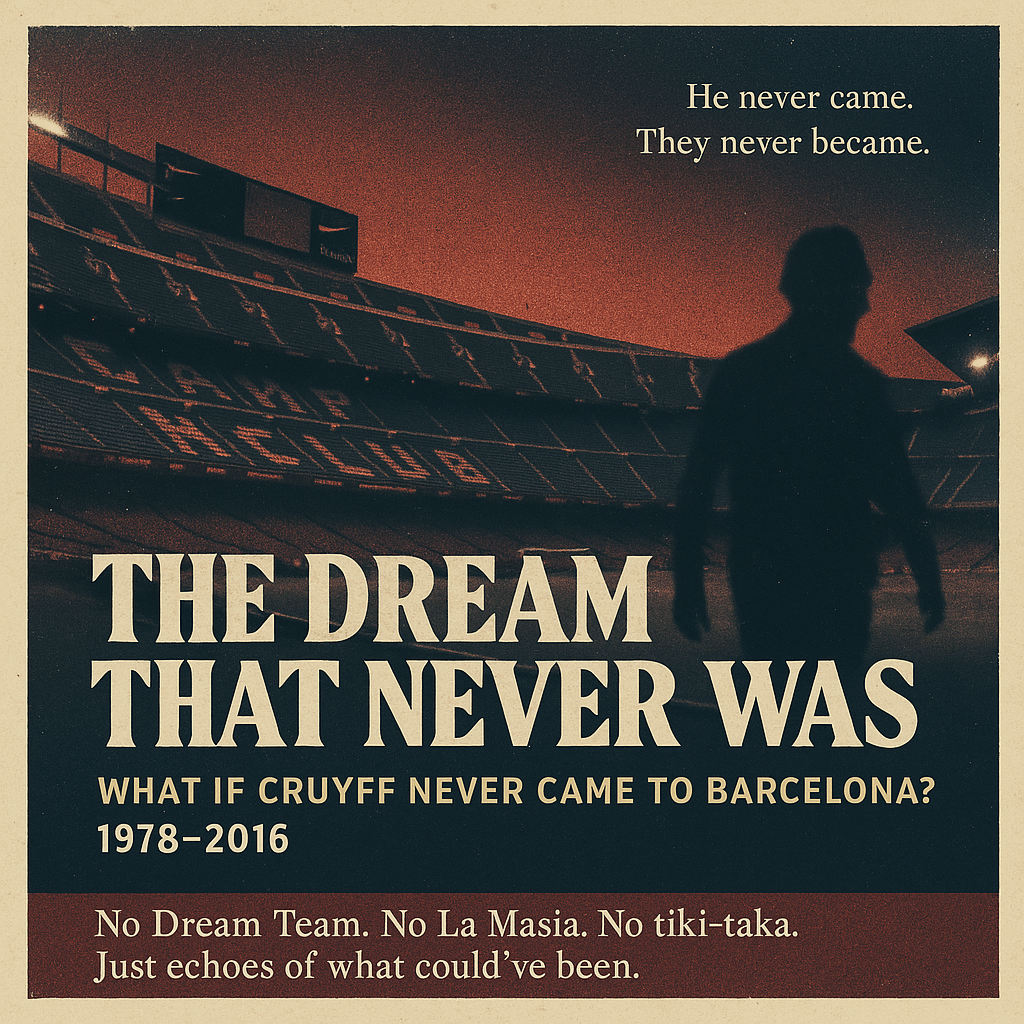
Since Johan Cruyff never played for Barcelona in this timeline, their entire history is different. In real life, Cruyff transformed Barcelona twice—first as a player in the 70s, and then as a manager in the late 80s, where he built the “Dream Team” and La Masia.
Without Cruyff’s influence, does Barcelona still become the footballing giant we know today? Or do they struggle to define their identity?
Let’s find out.
🔵 1978-1990: Barcelona Without Cruyff – Stuck in Madrid’s Shadow
In real history, Barcelona signed Johan Cruyff as a player in 1973, and he led them to a league title, humiliating Real Madrid 5-0 at the Bernabéu. This moment helped turn Barcelona into a club with an attacking, possession-based identity.
📌 But in this timeline?
- Cruyff is at Arsenal.
- Barcelona never builds its identity around Total Football.
- Real Madrid remain dominant in Spain.
📌 1980s: The Dark Years – No Clear Identity
📌 Key Events:
- Real Madrid dominate La Liga, winning multiple titles under Butragueño & the Quinta del Buitre.
- Barcelona struggle to define their style. They sign Diego Maradona in 1982, but without a clear system, he fails to thrive and leaves for Napoli in 1984.
- Managers come and go—Luis Aragonés, Terry Venables, and César Luis Menotti all fail to build something lasting.
🚨 Verdict: Barcelona remain a good club, but not a European superpower.
⚔️ 1990s: Who Becomes Barcelona’s “Cruyff”?
In real history, Johan Cruyff returned as Barcelona’s manager in 1988 and created the legendary Dream Team—which won four La Liga titles and the club’s first Champions League in 1992.
📌 But without Cruyff?
- Barcelona never builds La Masia (or at least, not as we know it).
- No possession-based revolution.
- No Dream Team of Guardiola, Laudrup, Romário, Stoichkov.
Instead, they go in a completely different direction.
🚨 1992: Instead of Cruyff, Barcelona hires Fabio Capello!
🔴 Barcelona under Capello (1992-1996)
- Tactically disciplined, defensive-minded football.
- Physicality & structure instead of free-flowing attack.
- Rivalry with Real Madrid remains, but no clear Barcelona “style.”
📌 Key Players:
- Ronald Koeman (defensive leader).
- Hristo Stoichkov (aggressive forward, but frustrated with defensive tactics).
- Romário (brilliant but leaves after one season).
🔥 1994 Champions League Final: Barcelona reach the final but are destroyed 4-0 by AC Milan.
🚨 Verdict: Without Cruyff, Barcelona never builds an attacking identity.
💰 2000s: The Galáctico War – Can Barcelona Compete with Madrid?
In real history, by 2003, Barcelona had completely reinvented themselves under Frank Rijkaard, and later, Pep Guardiola, by developing a possession-based, pressing style from Cruyff’s teachings.
📌 But in this timeline?
- No Total Football influence.
- No La Masia core of Xavi, Iniesta, and Messi.
- Barcelona must rely on big signings to compete.
🚨 2003: Real Madrid’s Galácticos dominate La Liga.
- Zidane, Ronaldo, Figo, and Beckham make Madrid the most marketable team in the world.
- Barcelona, desperate to keep up, go all-in on big-money signings instead of an academy-based philosophy.
📌 2004-2008: Barcelona Becomes “Real Madrid 2.0”
Without Cruyff’s tactical influence, Barcelona does not develop tiki-taka. Instead, they try to copy Madrid’s strategy:
📌 Key Transfers:
- Ronaldinho (2003, €30M from PSG) – Becomes the face of Barcelona.
- Deco (2004, €21M from Porto) – Playmaker, but no structured system.
- Samuel Eto’o (2004, €24M from Mallorca) – Powerful, direct striker.
📌 Tactical Style:
- Fast attacking play, but no structured pressing or possession-based dominance.
- Less patience, more individual brilliance.
- Defense remains a weakness.
🚨 2006 Champions League Final: Barcelona vs. Arsenal (Wenger’s Arsenal at their peak)
⚔️ Ronaldinho & Eto’o vs. Henry & Fabregas
🔥 Final Score: Arsenal 2-1 Barcelona
📌 Verdict: Barcelona are a great team, but not a dynasty.
2010s: The Messi Era – But Without Tiki-Taka?
Without Cruyff’s influence, La Masia is never developed into a world-class academy. This means:
❌ No Guardiola coaching philosophy.
❌ No Xavi-Iniesta midfield dominance.
❌ No structured system for Messi to thrive in.
📌 2010 Barcelona Starting XI:
(Still talented, but lacks a defined style.)
GK: Victor Valdés
RB: Dani Alves
CB: Puyol
CB: Piqué
LB: Abidal
CM: Yaya Touré
CM: Deco
CAM: Ronaldinho
RW: Messi
ST: Zlatan Ibrahimović
LW: David Villa
🔥 2011 Champions League Final: Barcelona vs. Manchester United
- In real history, Guardiola’s Barcelona dominated and won 3-1.
- In this timeline, Barcelona plays a more direct, counter-attacking style.
📌 Final Score: Manchester United 2-1 Barcelona
🚨 Verdict: Messi is still great, but Barcelona are no longer the world’s dominant club.
📖 Barcelona’s Alternate History Without Cruyff (Summary)
✅ Barcelona remain a top club but never develop tiki-taka.
✅ They become a Galáctico-style team, relying on big-name signings instead of youth development.
✅ They win some La Liga titles but never dominate world football like in real history.
❌ No historic Guardiola team in 2009-2015.
❌ Real Madrid’s Galácticos overshadow them for most of the 2000s.
🚨 By 2016, Barcelona is still a great club, but lacks identity.
 What If: The Archive
Leave a comment