
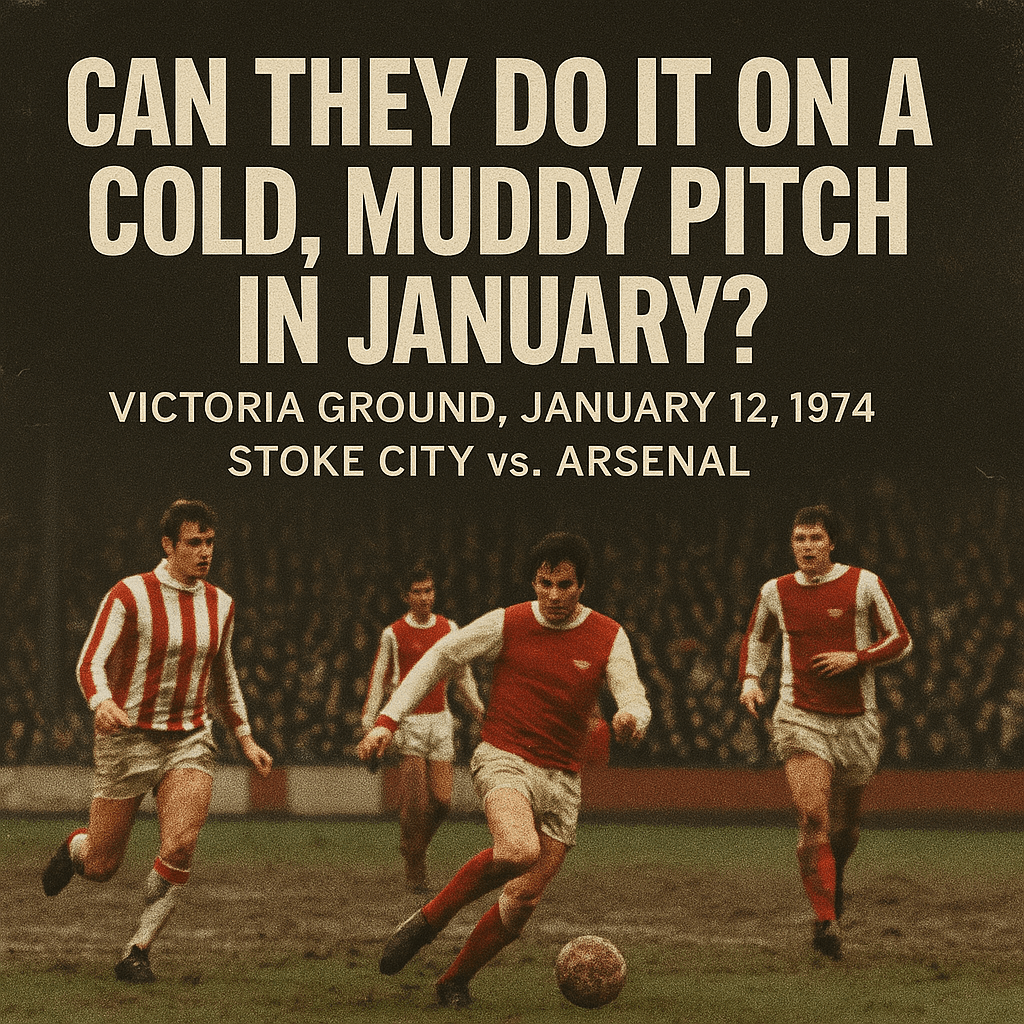
January 12, 1974 – The Ultimate Test: Arsenal’s Total Football vs. the English Winter
🔴 Match: Stoke City vs. Arsenal
📍 Venue: Victoria Ground, Stoke-on-Trent
🌧️ Conditions: Heavy rain, mud-covered pitch, freezing winds
🏆 Final Score: Stoke City 1-2 Arsenal
“Can They Do It on a Cold, Muddy Pitch in January?”
By January 1974, Arsenal’s Total Football revolution was already the talk of English football. Rinus Michels and Johan Cruyff had transformed the Gunners, turning them from a rigid, direct team into a fluid, positionally interchangeable side. They were third in the league, playing breathtaking football, and had already dismantled traditional powerhouses like Manchester United and Everton.
But there was still one big question hanging over them—could this style survive the brutal reality of English winter football?
That question would be answered at Victoria Ground, home of Stoke City, a place where silky passing and delicate movement often went to die. The muddy, uneven pitch, the cold, the physicality of Tony Waddington’s Stoke side—it was the perfect setting for English football’s traditionalists to prove their point.
For many in the press, this was the moment where Arsenal’s revolution would be exposed as nothing more than a Dutch fantasy.
The First Half: Total Football Meets Total Chaos
From the first whistle, it was clear that this wasn’t Highbury. The pitch was a battlefield of waterlogged puddles and torn-up turf. Every pass Arsenal attempted skidded to a stop in the mud or bounced awkwardly off the uneven ground.
Stoke, sensing an opportunity, launched into Arsenal with full force. No high pressing, no intricate tactics—just pure English grit. Long balls rained down from the skies, with the 6’2″ John Ritchie and Denis Smith challenging Arsenal’s backline at every turn. Arsenal’s usual game—quick passing, fluid movement—was being suffocated by mud and muscle.
In the 17th minute, Stoke took the lead. A long throw-in from Terry Conroy—a classic English weapon—caused chaos in the box. Arsenal’s defenders, so used to playing the ball out from the back, hesitated. Stoke’s Jimmy Greenhoff was not hesitant. He smashed the ball past Bob Wilson, and Victoria Ground erupted.
The Stoke fans loved every second of it. They had heard all the talk about Cruyff, Michels, and “Total Football.” But in their eyes, this was real football. This was English football.
And right now, Arsenal were losing at it.
Cruyff Fights the Mud and the Critics
Johan Cruyff, usually the coolest man on the pitch, was frustrated. Every time he received the ball, a Stoke defender was there kicking lumps out of him. The mud made his usual movement sluggish. His flicks and feints didn’t work when the ball barely moved through the sticky ground.
At one point in the 33rd minute, Cruyff attempted to spin past his marker, only for his foot to get stuck in the mud. He tumbled down face-first into the muck. The Stoke fans roared with laughter.
“Welcome to England, Johan!” shouted a fan from the stands.
At halftime, Arsenal walked off the pitch soaked, battered, and behind on the scoreboard. The critics watching in the press box were already sharpening their pens.
“See?” one journalist muttered. “This is why Total Football won’t work in England.”
But the match wasn’t over.
The Second Half: Arsenal Adapt, Arsenal Overcome
As Arsenal returned for the second half, Michels made a crucial tactical adjustment. Instead of forcing short passes through the mud, he instructed his players to use wider areas, where the pitch was slightly better. He also encouraged more vertical movement, with midfielders running beyond the Stoke defense instead of just passing through them.
Cruyff, ever the genius, figured it out instantly.
In the 57th minute, he stopped dropping deep into the mud-logged midfield and instead drifted to the right flank, where the pitch was firmer. From there, he started to dictate the game, using long diagonal passes to switch the play, dragging Stoke’s defenders out of shape.
Then came the equalizer.
In the 68th minute, Arsenal finally broke through. Charlie George, Arsenal’s English star who had initially struggled with Total Football, proved why he was still invaluable. Receiving a clever pass from Cruyff on the edge of the box, he fired a stunning shot that somehow stayed true through the wet conditions. The ball nestled into the bottom corner.
1-1.
Now, the mood had shifted. Arsenal weren’t trying to force their style onto the game anymore. They had adapted. The players were now moving more pragmatically, still using their technical skills but without trying to pass through the swamp in midfield.
In the 81st minute, the moment of genius arrived.
Cruyff, fed up with being kicked, decided to finish the match himself.
He received the ball 30 yards from goal, danced past two Stoke defenders, and with the outside of his boot, curled a perfect shot into the top corner. The goalkeeper had no chance.
2-1 to Arsenal.
The Aftermath: The Critics Are Silenced (For Now)
As the final whistle blew, Arsenal’s Dutch revolution had passed its biggest test yet.
The victory sent a message across England: this wasn’t just pretty football for nice conditions—this was football that could win anywhere.
In the post-match interviews, Cruyff was quick to fire back at the critics:
🔴 Cruyff: “Football is not about conditions. It is about intelligence. You play with your feet, yes, but more importantly, you play with your brain.”
🔴 Michels: “A great team does not complain about the pitch. A great team finds a way to win.”
The media’s response was mixed.
📰 The Guardian: “Arsenal have proven that their football is more than just spectacle. This was not an easy game, but they adapted, they fought, and they conquered.”
📰 The Daily Mail: “Total Football survives the mud—this time. But will it survive the bruising tests still to come?”
📰 The Sun: “Alright, maybe they can do it on a cold night in Stoke. But let’s see how they handle Leeds next week!”
Final Thoughts: A Turning Point for English Football
This victory was more than just three points. It was the moment when English football began to accept that there was something special happening at Arsenal. The doubters still existed, but they could no longer simply dismiss Total Football as a passing fad.
Arsenal had shown they could play beautiful football—but they could also win ugly when needed.
And that, more than anything, is what made them truly dangerous.
 What If: The Archive
Leave a comment