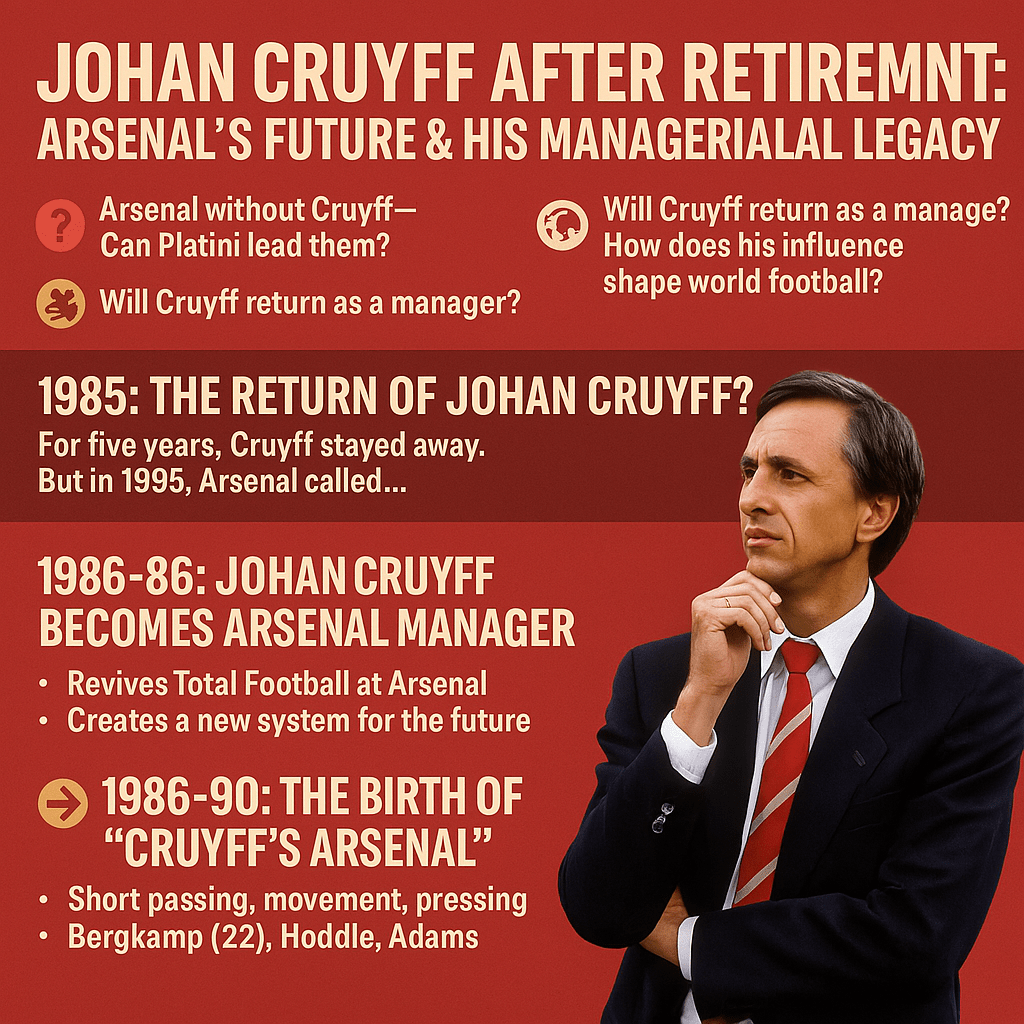
🔴 Arsenal without Cruyff—Can Platini lead them?
🧠 Will Cruyff return as a manager?
🌍 How does his influence shape world football?
With Johan Cruyff retiring in 1979, football did not lose him completely—it just transitioned him from the field to the mind of the game.
In real life, Cruyff revolutionized Barcelona as a manager, creating La Masia, the foundation for tiki-taka and Guardiola’s teams.
But now, in this timeline, the question is:
Does he do this at Arsenal instead?
🔴 Arsenal’s New Era (1979-1984) – The Platini Years
With Cruyff gone, Arsenal turned to Michel Platini as the new leader of the team. The French playmaker, signed in 1976 as Cruyff’s heir, was now expected to carry Arsenal forward.
🏆 1979-80 Season: Arsenal Adjusts
- Manager: Rinus Michels still at the helm.
- Squad Leaders: Platini (24), Brady (23), Sansom (21).
- Biggest Challenge: Could they win without Cruyff?
📊 Final Standings – 1979-80 First Division
🥇 1st – Liverpool (Champions, 61 points)
🥈 2nd – Arsenal (58 points)
🥉 3rd – Nottingham Forest (55 points)
💔 Arsenal finish second, just behind Liverpool.
🔥 Platini wins PFA Player of the Year – proving he is ready to lead.
📌 European Cup 1979-80:
- Arsenal reach the semi-finals but lose to Hamburg.
✅ Verdict: Arsenal are still elite, but the Cruyff magic is missing.
⚔️ 1980-84: Arsenal’s Rise & Fall
Michels leaves Arsenal in 1981, replaced by Terry Neill. Arsenal win the league in 1982 but struggle in Europe.
📌 Key Moments:
- 1982 – Arsenal wins the First Division (Led by Platini & Brady).
- 1983 – Platini leaves for Juventus (his real-life club), feeling Arsenal lacks direction.
- 1984 – Arsenal fall behind Liverpool & Manchester United in England.
💭 Arsenal’s total football identity starts fading. The team desperately needs direction.
🚨 They need a new manager.
🧠 1985: The Return of Johan Cruyff?
For five years, Cruyff had stayed away from football, spending time in the Netherlands and Spain. But he had been watching. He saw what Platini started, but also how Arsenal lacked vision after Michels left.
Then, in 1985, the call came.
📞 Arsenal chairman Peter Hill-Wood: “Johan, come home.”
Would he accept?
🚨 1985-86: Johan Cruyff Becomes Arsenal Manager
At age 38, Cruyff returned to Highbury as manager.
His mission:
🔴 Revive Total Football at Arsenal.
⚽ Create a system that would define the next generation.
🔄 Cruyff’s First Transfers (1985):
✅ Dennis Bergkamp (Ajax, 16 years old, future legend)
✅ Paul Merson (Arsenal youth, promoted to first team)
✅ Glenn Hoddle (Tottenham, Arsenal poach him to complete the midfield)
🏆 1985-86 Season: Arsenal finish 3rd as Cruyff rebuilds the team.
🌍 1986-90: The Birth of “Cruyff’s Arsenal”
By the late 1980s, Arsenal had a new identity under Cruyff.
📌 Tactics:
- Short passing, movement, pressing – The predecessor to tiki-taka.
- Total Football reborn, but adapted to English football.
📌 Key Players:
🔥 Bergkamp (22) becomes Arsenal’s leader in attack.
⚽ Hoddle runs the midfield like Xavi would in real life.
🛡️ Tony Adams (homegrown) becomes Arsenal’s defensive leader.
🏆 1988-89: The Season That Changes Everything
🔥 Arsenal win the league on the final day at Anfield, beating Liverpool!
⚽ Last-minute goal by Bergkamp!
🚀 Cruyff’s Arsenal have arrived.
🌍 1990s: Cruyff’s Impact Spreads Beyond England
By staying at Arsenal, Cruyff’s influence changed global football differently than in real life.
📌 Key Differences from Reality:
✅ Arsenal becomes the Barcelona of England – Home of Total Football.
✅ Bergkamp stays at Arsenal for his whole career (no Inter Milan).
✅ English football develops a passing style earlier, influencing the national team.
By 1995, Arsenal’s academy is producing players in Cruyff’s mold—years before Wenger’s arrival.
⚡ 1996: Arsenal promote a young Patrick Vieira and Thierry Henry—trained in the “Cruyff system.”
 What If: The Archive
Leave a comment