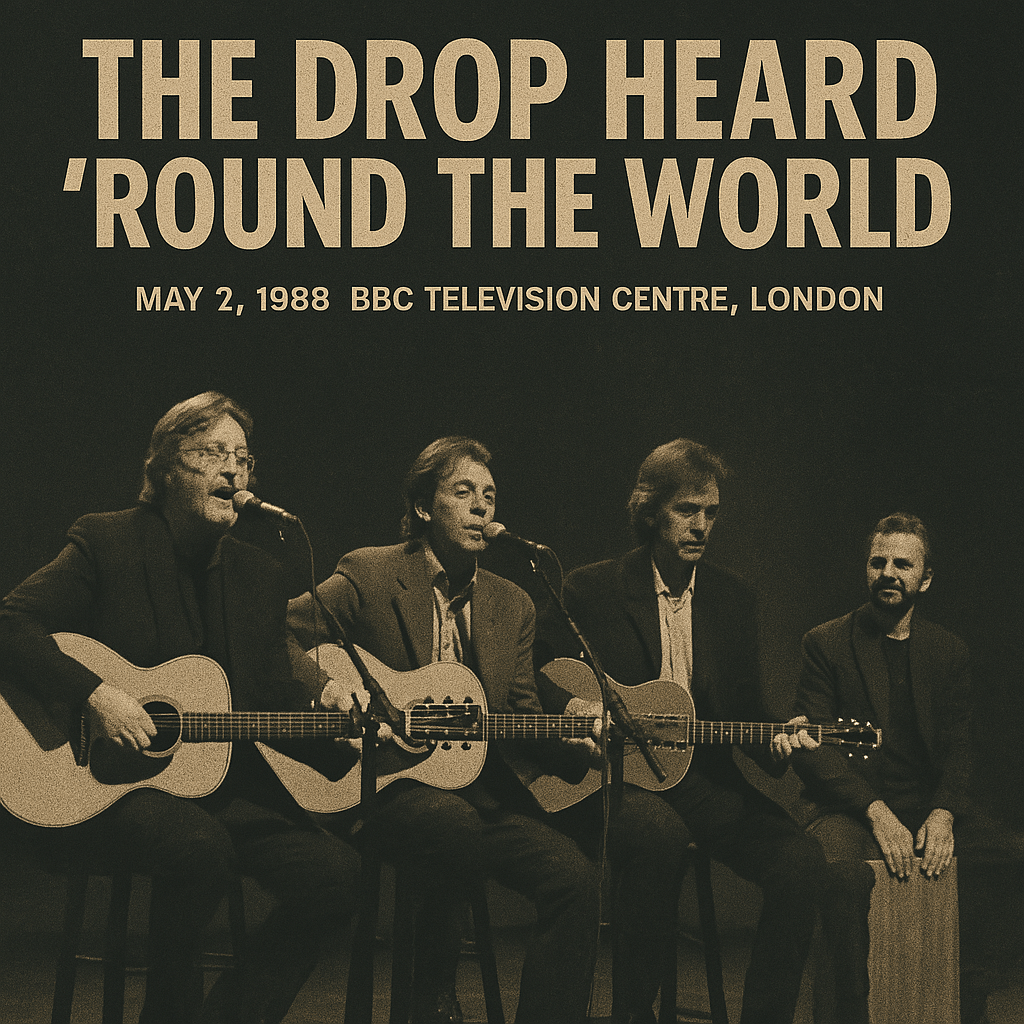
May 2, 1988
BBC Television Centre, London
6:59 PM GMT
No one knew.
Not the BBC host. Not the producers. Not even the network execs.
The program was World Artists for Peace—a mildly ambitious charity broadcast featuring Sting, Tracy Chapman, Peter Gabriel, and a rotating cast of morally upright rockers doing acoustic sets and talking about nuclear disarmament.
But at 6:59 PM, with only thirty seconds left before the next segment, something unexpected happened.
The house band’s feed cut out.
The lights dimmed.
And then: four men walked quietly onto the small studio stage.
There were no graphics. No fanfare. No announcement.
Just a single acoustic guitar strum.
Then that voice—low, weathered, unmistakable.
“People say we’ve said all we had to say. But some things… are worth repeating.”
John Lennon.
The camera operator stumbled, refocused.
Next to him, Paul. Beside Paul, George. Behind them, Ringo, tapping a cajón with a faint smile.
The silence was deafening.
Then came the first chords of “Together Again”—the song they had quietly written the year before, during those first hushed, tea-sipping, absurdly awkward sessions. It wasn’t flashy. No orchestras, no gimmicks. Just tight harmonies. Just truth.
When they hit the chorus—
“We took the long road back / But we’re together again / Just four friends, one track / Singin’ it like then…”
—millions of television sets across the UK, then the world, suddenly had full attention.
The Chaos After
Newsrooms exploded.
Radio stations began replaying the performance before the broadcast even ended. DJs on the BBC and Capital FM openly wept on air. A producer from CBS London threw her headset and screamed “What the hell was that!?” into a stunned control room.
Within the hour, the world knew:
The Beatles were back.
Well—sort of. There was no album, no tour, no press release. Just a song. Just a moment. And it had hit the public like a thunderclap from the past.
Inside the Storm: Lennon, Post-Broadcast
Backstage, Lennon lit a cigarette he wasn’t supposed to have.
“Think they noticed?” he smirked.
Paul shook his head, shell-shocked. “John, we just hijacked the BBC.”
“Hijacked’s a bit strong,” Ringo offered. “Borrowed.”
George was already sipping tea. “They’ll be fine. What are they gonna do? Sue us for saving the bloody planet with harmony?”
Paul laughed nervously. “We didn’t even tell them.”
“That’s the point,” John said. “No PR machine, no announcement. Just the music. Like we were never gone.”
But even John, for all his cool detachment, felt the air had changed.
The World Responds
By the next morning, newspapers across the globe were printing the same phrase in different languages:
“The Beatles are back.”
The New York Times ran a black-and-white still of the performance on the front page.
Rolling Stone immediately went to press with a special issue, printing only four words in red:
“TOGETHER AGAIN. JOHN. PAUL. GEORGE. RINGO.”
The Vatican issued a statement calling it “a beautiful moment of unity in fractured times.”
MTV ran the clip every hour. By nightfall, the performance had become the most-watched broadcast of 1988 globally.
But the public was left with questions. Was there an album? A tour? Was this real, or a one-off?
John answered, in typical Lennon fashion, by scrawling a message on his front door with chalk the next morning:
“We’re not back. We were never gone. -J”
Behind the Scenes: Their Pact
What few knew—and what the press would only piece together months later—was that the performance had been deliberately unannounced. A pact, made between the four of them in George’s kitchen, over cold tea and an unfinished verse.
“If we’re going to do it,” Paul had said, “let’s not sell it like soap.”
“No circus,” George added. “No Apple Records board meetings. Just one song. Then we decide.”
They’d chosen World Artists for Peace because it was the right message. Because it was low-stakes. Because it was about something bigger than record sales.
And because it was live. Uneditable. Uncensorable. Unstoppable.
Aftermath: The Waiting Game
Over the following months, demand hit a fever pitch.
- A million letters poured into the BBC.
- Capitol Records offered the highest advance in history for a new Beatles record—$35 million.
- McCartney’s manager fielded calls from Japan, Argentina, the USSR.
- Lennon refused all interviews. “Let the song talk,” he told Yoko.
- Bootlegs of the broadcast sold in back alleys in Hong Kong and Moscow.
The band members met in secret—twice—in a farmhouse studio in Wiltshire. But they told no one what they were planning. If anything.
Even their families didn’t know.
Legacy of the Reveal
To this day, “Together Again” is remembered not only as the Beatles’ comeback song—but as a cultural rupture. The moment the past shook hands with the present. It didn’t feel like a marketing campaign. It felt like a miracle.
Because for one fleeting night, four older men—scarred, softened, surviving—stood under the lights once again and reminded the world that music could still mean something. That maybe the 1960s hadn’t entirely died. That maybe it was okay to believe.
 What If: The Archive
Leave a comment