
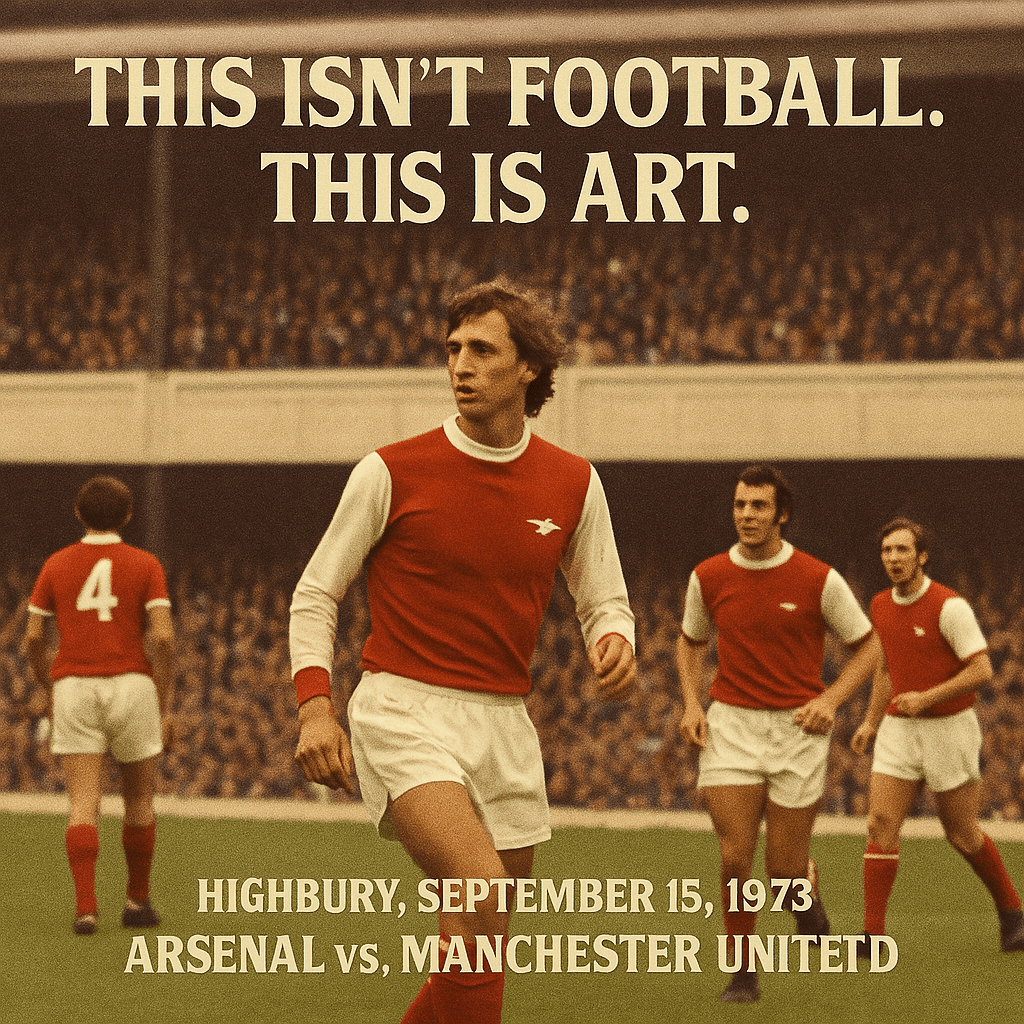
Football Reporter’s Account: Johan Cruyff’s First Match for Arsenal, 1973
Date: September 15, 1973
Location: Highbury, North London
Match: Arsenal vs. Manchester United
Result: Arsenal 3-1 Manchester United
As I stand in the press box at Highbury, a stadium that has always been synonymous with British steel and grit, today feels different. There’s a buzz, an electric tension in the air, as if something historic is about to unfold. Arsenal, under new manager Rinus Michels, have introduced a foreign element that England has never seen before—Johan Cruyff, the Dutch maestro, is making his debut for the Gunners.
The crowd is packed, and the buzz around the ground is palpable. The newspapers have been full of nothing but the new Dutch influence sweeping through the club. Michels, the architect of Total Football, and Cruyff, the living embodiment of it, are here to revolutionize the game. The question on everyone’s lips is: Can it work in England?
As the players emerge from the tunnel, the difference is immediately noticeable. Arsenal, traditionally a team of physicality and directness, now looks like an orchestra preparing to play. The white shorts and red shirts are still the same, but the style of play? That will be something entirely new. Cruyff’s presence is magnetic. He’s not just a footballer; he’s the philosopher of the pitch.
The match kicks off, and from the very first moment, it’s clear that something is amiss—something extraordinary is happening.
A Different Kind of Football
From the start, Arsenal is playing a game I’ve never seen in England before. Possession—utter possession—takes hold of the match. Cruyff, positioned just behind the striker, is not playing the way a traditional English forward would. He’s not charging towards the goal, looking for crosses to head in, as we’ve all come to expect. Instead, he’s dropping deeper into midfield, moving fluidly across the field, constantly pulling defenders out of position.
I have to rub my eyes for a moment. It’s almost like watching 11 players on the field who can all play in multiple positions. The defenders are stepping forward, the midfielders are taking on the role of playmakers, and Cruyff is orchestrating it all with a soft but confident touch.
There’s a moment in the 12th minute when Charlie George, who’s typically a powerhouse, receives the ball on the wing. I expect him to launch a long cross into the box, a quick pass to the centre-forward, but instead, George does something unbelievable. He looks up, notices Cruyff drifting towards him in space, and then calmly plays a ball backwards—backwards! To the dismay of the crowd, who expects George to attack the goal, he plays it into the feet of Cruyff, who instantly switches the play to the opposite wing. There’s no immediate shot, no rush—just a calm, calculated approach.
I’ve been covering English football for years, but I’ve never seen anything like this. The crowd is audibly unsettled, unsure if this slow, deliberate passing game is some sort of trick or madness. The English game, defined by speed, power, and directness, has never been asked to play this way.
Cruyff’s Impact: England’s Awakening
By the 20th minute, it becomes clear that this is not just a one-off. Cruyff, in typical fashion, is the orchestrator. But it’s not just his vision that stands out. It’s the way Arsenal is playing as a unit. The team is pressing high, working in tandem. It’s as if they’re all connected, like pieces of a single machine, moving and adapting in perfect harmony.
The first goal comes from this fluidity—Ray Kennedy, often a workhorse in midfield, makes a daring run forward, unnoticed by the United defense, and receives a beautifully weighted through ball from Frank McLintock—a pass that wouldn’t have been made in traditional British football. Kennedy slots it past the goalkeeper with calm precision. The crowd is stunned into silence before erupting into hesitant applause.
I overhear a local Arsenal supporter behind me: “That ain’t football, that’s art.”
As the match progresses, United struggles. Their usual methods—strong, direct, direct—fall apart against Arsenal’s slick, smooth passing game. Every time they get the ball, Arsenal is pressing in waves. Cruyff is everywhere, sliding into space like a ghost, and always making himself an option. The Arsenal defense, usually solid but unspectacular, now joins the attack, with Pat Rice moving forward in support. It’s as though Arsenal are playing with an extra man.
The second goal is a thing of beauty. A swift exchange of passes between McLintock, George, and Cruyff ends with Charlie George placing the ball past the goalkeeper from the edge of the box. The crowd gasps, unsure how to react. The fluidity, the movement—this isn’t the heavy-breathing, gritty football they’re used to. It’s alien, but it’s also mesmerizing.
Manchester United manages a goal late in the match—a consolation at best. But it’s too late. Arsenal win 3-1, and as the final whistle blows, you can sense the weight of history in the air.
The Aftermath: England Stunned
As the players leave the pitch, I hear a group of Arsenal supporters murmuring in disbelief: “What did we just witness? Is this what we’re going to see every week?” It’s the question of the moment. Michels, who has been watching from the touchline with a calm smile, knows that today is just the beginning.
In the press room after the match, there’s a nervous energy in the air. Many of my colleagues are already debating what we’ve seen, but there’s no agreement. Some claim that this Dutch style is a passing fad—an impractical dream that could never survive the rough and tumble of English football. Others, including some of the younger journalists, see something else: a revolution. There are whispers that this could change everything—that this is the future of football in England.
I don’t think I’ve ever seen such a stark divide in the reactions to a single match. It’s not just that Arsenal won; it’s the how and why of it. Total Football has come to England, and the shockwave it’s sending through the footballing landscape is impossible to ignore.
Final Thoughts:
As I leave Highbury, there’s a new sense of possibility in the air. Football in England may never be the same again. For better or worse, the first domino has fallen. The rest of the country will need to adapt—or be left behind. Michels and Cruyff have shown us a new way of playing football. Whether it will catch on, I can’t say yet. But one thing’s for certain—today was the day the game changed.
 What If: The Archive
Leave a comment