
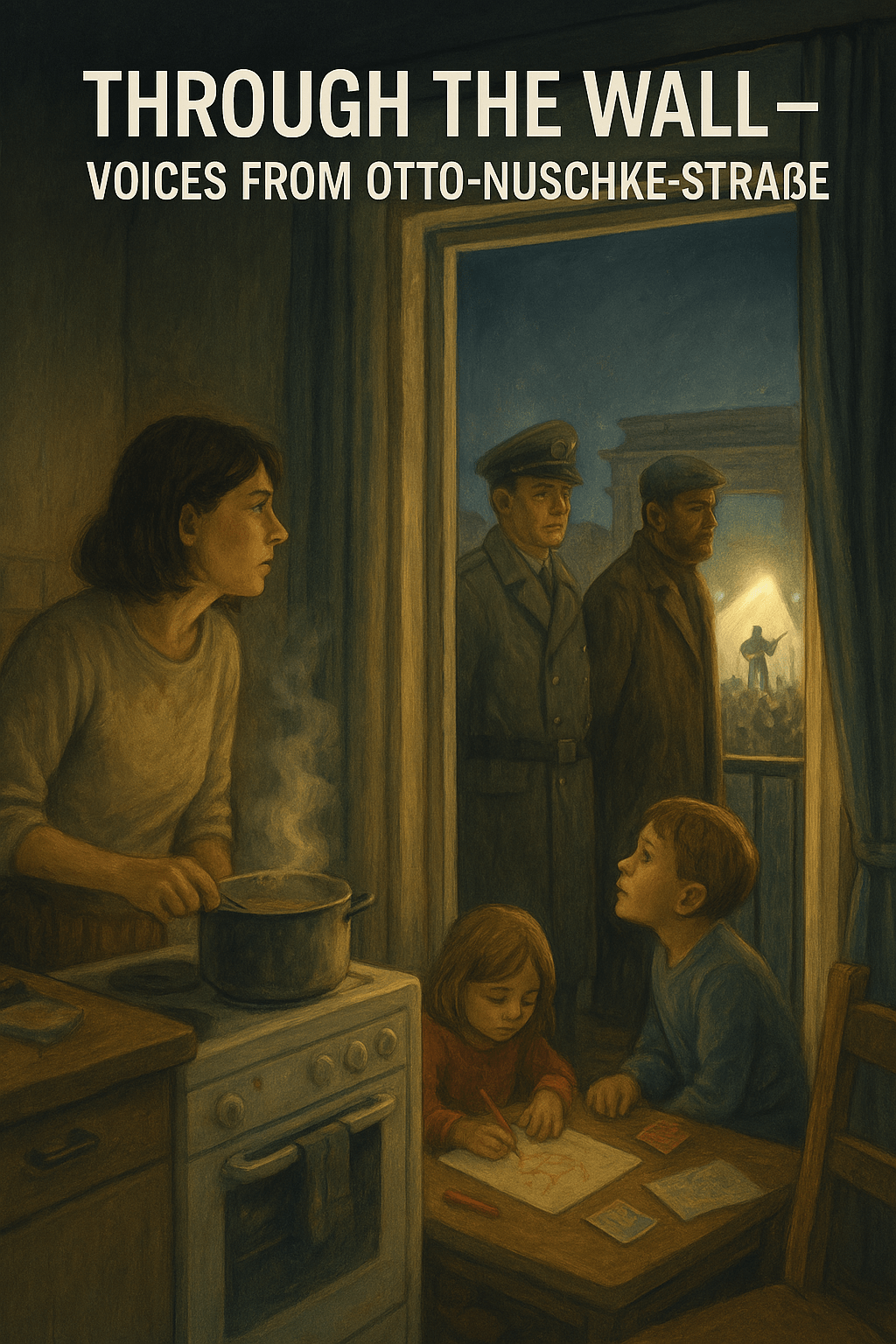
Berlin, East Sector – November 9, 1989
Narrated by Klara Weber, 39, mother of two, wife of a Party member
I.
The night it happened, I was boiling potatoes.
That’s how it always starts, doesn’t it? Not with a revolution, but with something ordinary. Grey water, salt, steam. The children were fighting again—Katrin wanted the red pencil, and Emil wouldn’t give it up. Erich, my husband, was due home late. Meetings. Always meetings.
I didn’t ask questions.
Not anymore.
We lived in a five-story Plattenbau on Otto-Nuschke-Straße, not far from the border strip. If you leaned far enough out the balcony, you could almost glimpse the West. Not the people—just the glow. They had color over there. You could feel it in the light. Ours was cold, uniform, efficient. Proper.
I was a good citizen. I taught literature. I volunteered for the school committee. I kept my thoughts in the pages of books with pages I’d never tear.
But that night… something broke.
II.
The sound came just after 7. Low at first. A kind of murmur that vibrated through the concrete. I thought it was a malfunctioning radio. Maybe a neighbor with a smuggled cassette.
But then it grew.
I opened the balcony door, the cold biting through my cardigan, and stepped into the dark.
And I heard it.
A guitar. A crowd.
A voice I hadn’t heard in years—not legally anyway.
“Imagine there’s no heaven…”
Lennon.
John Lennon.
Singing. Live.
III.
I froze.
It was coming from across the Wall. From West Berlin. Somewhere near the Brandenburg Gate. Close enough that the sound carried like wind, skipping across the no-man’s-land and into our lives like a ghost.
Behind me, Katrin peeked through the curtains.
“Mama, who is that singing?”
I didn’t answer.
Not yet.
IV.
We weren’t supposed to listen to them. The Beatles were decadent, capitalist tools. That’s what the Party said. We were taught they distracted the people with love songs while the imperialists bombed poor countries.
But I had heard them. Years ago, on a trip to Hungary, through someone’s cousin’s cousin’s stereo. The tape was worn thin, but Yesterday made me cry in a hostel bed in Pécs.
Erich never knew. I never told him. I never wanted him to choose between his career and my heart.
But that night, he came home early.
And he heard it too.
V.
He didn’t speak. Just took off his cap, his heavy coat. The Stasi pin on his lapel caught the kitchen light.
He stood next to me on the balcony, arms crossed.
“They’re performing near the Wall,” I said softly.
He nodded. “I know. The State Council’s in chaos. No one knows what’s real anymore.”
I studied his face. Lines deeper than last year. Eyes tired, not from watching—but from being watched.
“You hate them,” I said.
“No,” he said quietly. “I envy them.”
VI.
We stood there for half an hour. Katrin fell asleep on the floor with a crayon in her hand. Emil crawled into my lap, asking why people were cheering.
“They’re singing,” I told him. “That’s all.”
But I knew it was more.
Then came Let It Be.
Paul’s voice, carrying like prayer across the barbed wire and concrete.
“There will be an answer…”
The neighbors began to open windows. One by one.
Someone on the second floor whistled.
Another clapped, tentatively.
We were still scared. Still waiting for the boot, the knock, the denial of our senses.
But that song…
It was a key in a lock we’d forgotten was there.
VII.
Erich looked at me.
“I’ve spent my life keeping things in order,” he said. “Telling people what to think. Now I don’t even know what I believe anymore.”
I didn’t answer.
Instead, I took his hand.
I didn’t care who was watching.
VIII.
We heard the crowd roar. Louder than anything we’d ever heard.
Not like a concert. Like a dam breaking.
That night, the borders opened.
That night, strangers kissed in the streets.
That night, the Wall began to fall—not with sledgehammers, but with songs.
IX.
It is thirty-six years later.
Erich passed in 2011. He never quite found peace, but he found gentleness. He found music. He listened to Across the Universe every Sunday, sipping coffee, staring at the garden he never thought he’d have.
Katrin now teaches art in Hamburg. Emil plays piano.
And me?
I still live here. In the same flat. The Wall’s gone, of course. But sometimes, when I lean out far enough, I remember the way the West sounded that night.
And I remember this:
That we weren’t free, not really.
But we were ready.
The Beatles didn’t give us freedom.
But they reminded us what it sounded like.
 What If: The Archive
Leave a comment