
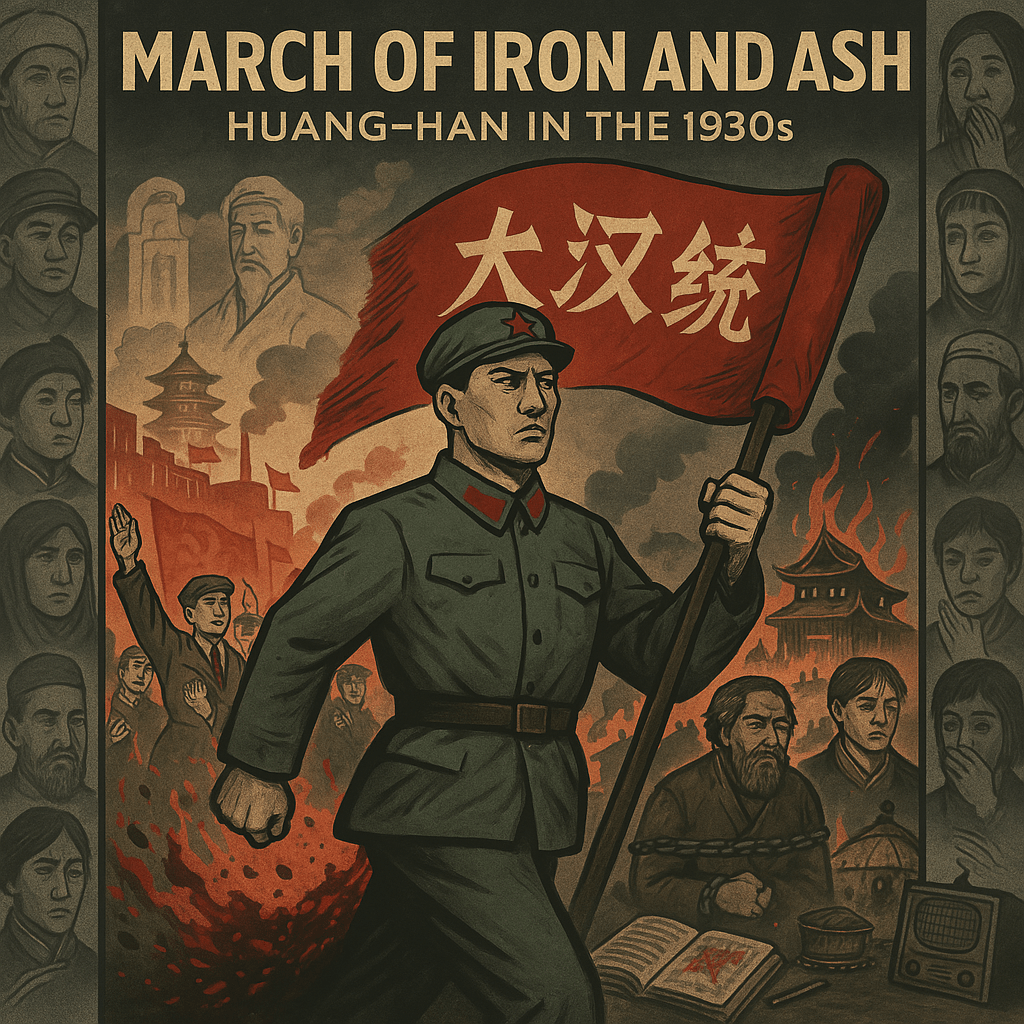
By the 1930s, Huang-Han China has evolved into a fully authoritarian, ethnonationalist state dominated by Han supremacist ideology. However, this period also marks the height of its internal contradictions and external pressures, which increasingly threaten the regime’s fragile unity. The government pursues aggressive policies of Han cultural assimilation, repression of minorities, and military expansion, but its increasingly totalitarian nature alienates large segments of the population and invites conflict with both domestic and foreign powers.
The decade is defined by four major trends: domestic oppression, militarization and expansion, international isolation, and the rise of resistance movements.
1. Domestic Oppression: A High-Pressure Han Supremacist State
Ethnic Cleansing and Forced Assimilation
The Huang-Han regime doubles down on its policies of ethnic repression. The 1930s see an acceleration of efforts to “Hanify” regions with significant minority populations, including Manchuria, Inner Mongolia, Xinjiang, and Tibet. These policies include:
- Forced Relocations: Minority populations are expelled from cities and strategic areas. Uyghurs in Xinjiang are forced into labor camps, Tibetans face crackdowns on religious practices, and Mongols are displaced to make way for Han settlers.
- Cultural Erasure: Schools in minority regions are required to teach exclusively in Mandarin, with traditional languages, scripts, and cultural practices banned. Tibetan Buddhist monasteries are destroyed, Islamic mosques in the northwest are converted into government buildings, and Mongolian nomadic lifestyles are restricted.
- Han Colonization: Han Chinese settlers are incentivized to move into minority regions with promises of land and tax exemptions, leading to ethnic tension and violent clashes.
Economic Inequality
While the regime promotes the idea of “Han racial solidarity,” economic policies disproportionately favor the urban Han elite. The countryside—where the majority of the population lives—continues to suffer from grinding poverty, high taxes, and exploitative landlordism. In minority regions, the economic situation is even worse, as locals are often stripped of land and resources to benefit Han settlers.
Education as Indoctrination
Education becomes one of the primary tools of the Huang-Han state. History textbooks emphasize Han superiority, the inferiority of minorities, and the dangers of “foreign contamination.” Students are taught to view minorities as disloyal, uncivilized, and deserving of subjugation. Political loyalty to the state is emphasized over critical thinking, and children are encouraged to report “disloyal” behavior by their families or communities.
Suppression of Political Dissent
By the early 1930s, the Huang-Han government transitions into a one-party dictatorship under the Han Nationalist Party (汉民族党). Political opposition is systematically crushed:
- Crackdowns on Communists: The Communist Party of China (CPC), operating underground since the 1920s, becomes a major target of repression. Thousands of suspected communists and sympathizers are arrested, tortured, and executed.
- Silencing Moderates: Liberals and moderate republicans who advocate for political reforms or ethnic tolerance are branded as “traitors to the Han race” and purged.
- Mass Surveillance: The state establishes a vast surveillance apparatus, with informants embedded in communities and workplaces. Citizens live in fear of being reported for “anti-Han behavior.”
2. Militarization and Expansionism
Reclaiming “Lost Territories”
The Huang-Han government adopts a militaristic foreign policy aimed at reclaiming territories it views as historically Han. This includes:
- Manchuria: Although nominally under Chinese control, Manchuria is increasingly under Japanese influence. In 1931, Japan stages the Mukden Incident and establishes the puppet state of Manchukuo under the deposed Qing emperor Puyi. Huang-Han China launches guerrilla campaigns and minor skirmishes to undermine Japanese control but lacks the resources to wage a full-scale war.
- Mongolia: The Huang-Han government refuses to recognize the independence of Outer Mongolia (declared in 1911) and periodically clashes with Soviet-backed Mongolian forces along the border.
- Tibet and Xinjiang: Both regions are subjected to military campaigns to crush separatist uprisings. In Tibet, resistance from local monks and aristocrats leads to bloody conflicts, while in Xinjiang, Uyghur and Kazakh insurgents resist forced assimilation.
Strengthening the Military
The Huang-Han regime invests heavily in military modernization, seeing a strong army as essential to achieving its nationalist goals. Military parades, glorification of ancient Han warriors, and conscription campaigns are used to foster a militaristic culture. However, corruption and inefficiency undermine these efforts, and the army struggles to match the technological advancements of Japan or the Soviet Union.
3. International Isolation
Relations with Japan
- Japan, now under an increasingly militaristic government, views Huang-Han China’s anti-minority policies and ethnonationalism with some ideological sympathy but sees China as a competitor in East Asia. After the establishment of Manchukuo, relations between the two nations deteriorate into open hostility.
- Huang-Han propagandists portray Japan as a “new barbarian invader” and the “greatest threat to Han civilization.”
Relations with the West
- The Huang-Han regime’s anti-Western rhetoric and human rights abuses alienate Western powers. Missionary groups, whose work is increasingly restricted by the government, send reports of minority persecution to their home countries, causing public outrage.
- Trade relations with Western nations decline, leaving Huang-Han China economically dependent on domestic production and limited partnerships with Germany and Italy.
Collaboration with Fascist Powers
- By the mid-1930s, Huang-Han China forms tentative alliances with fascist Italy and Nazi Germany. Germany provides military advisors and arms in exchange for raw materials, while Italy offers diplomatic support. However, these relationships are strained by China’s anti-colonial rhetoric and Germany’s growing ties with Japan.
4. Rise of Resistance Movements
Communist Resistance
The Communist Party of China (CPC), heavily suppressed in the 1920s, begins to gain traction in rural areas, especially among poor peasants and persecuted minorities. Mao Zedong’s revolutionary strategy of building support in the countryside resonates with those disillusioned by the Huang-Han regime’s policies. The Jiangxi Soviet, established in 1931, becomes a base for communist activities and a symbol of resistance to the central government.
Minority Insurgencies
Oppression sparks widespread resistance among minorities:
- Uyghur and Kazakh Uprisings: In Xinjiang, guerrilla groups form to resist Han settlers and military forces. Some seek support from the Soviet Union, which views the region as a potential buffer zone.
- Tibetan Rebellion: In Tibet, monks and laypeople alike take up arms against attempts to destroy their monasteries and traditions. The 1934 military campaign in Tibet leads to significant bloodshed but fails to fully pacify the region.
- Mongolian Border Clashes: Soviet-backed Mongolian forces clash with Huang-Han troops along the border, further destabilizing the region.
Liberal and Intellectual Dissent
Though heavily suppressed, intellectuals and students in major cities like Beijing and Shanghai continue to criticize the Huang-Han regime. Secret literary societies and underground publications challenge the government’s narrative, advocating for a more inclusive vision of Chinese identity.
Key Events of the 1930s
- 1931: Japan establishes Manchukuo, intensifying the conflict in Manchuria.
- 1933: Huang-Han China launches the “Great Han Assimilation Campaign,” leading to widespread violence in minority regions.
- 1934: The Long March begins as Communist forces retreat from Jiangxi after being surrounded by Huang-Han troops, spreading communist ideals across the countryside.
- 1935: Anti-Japanese sentiment reaches a fever pitch as Japan expands its influence in northern China, leading to mass protests and calls for national unity.
- 1937: The Second Sino-Japanese War begins after the Marco Polo Bridge Incident, plunging Huang-Han China into a devastating conflict.
The Stage Is Set for Collapse and War
By the end of the 1930s, Huang-Han China’s aggressive policies have left it isolated, economically strained, and on the brink of collapse. The regime faces mounting challenges: minority uprisings, communist resistance, and an existential threat from Japanese imperialism. While the government clings to its vision of a “pure” Han nation, its inability to adapt to the realities of a multiethnic, geopolitically complex China leads to its steady unraveling.
 What If: The Archive
Leave a comment