
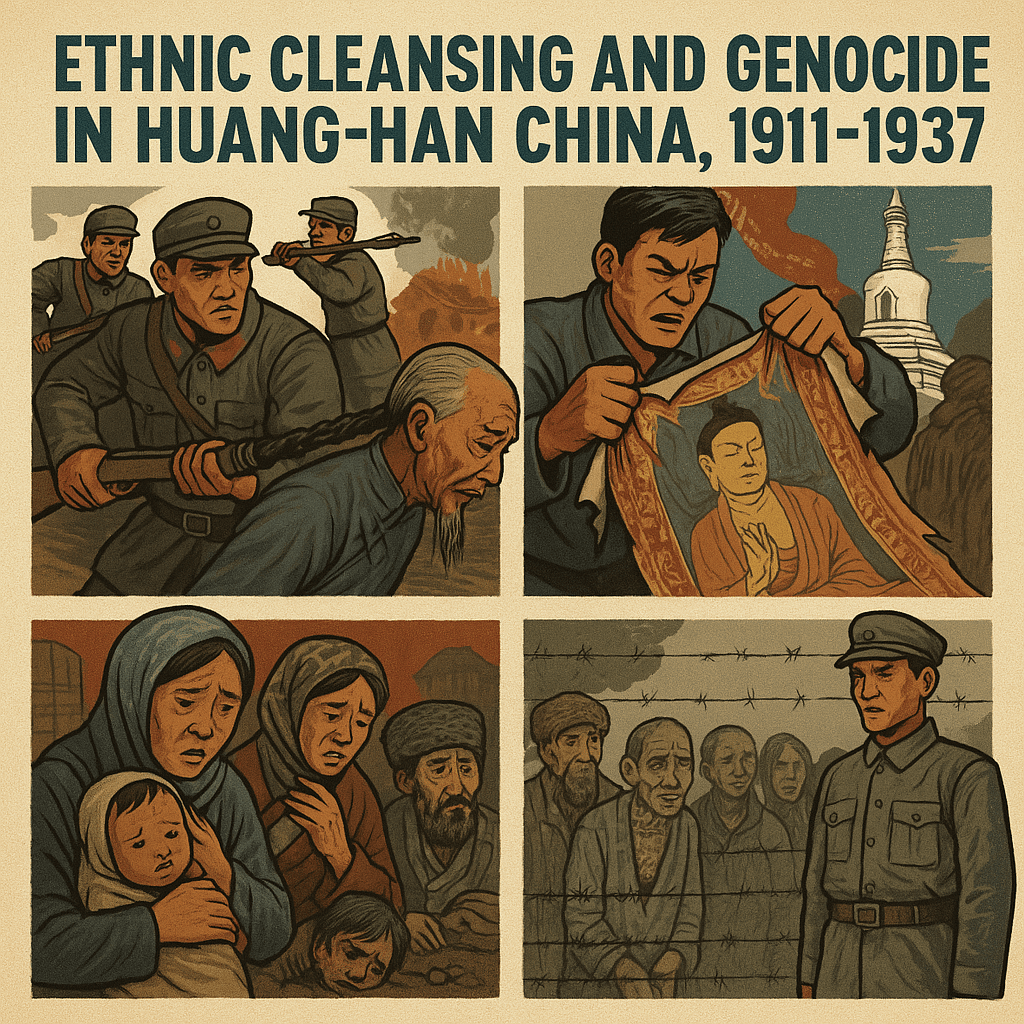
In this alternate timeline, the Huang-Han regime’s rise to power is marked by systematic ethnic cleansing, forced assimilation, and cultural genocide targeting non-Han ethnic groups within China’s borders. The Huang-Han state’s policies, motivated by Han supremacist ideology, escalate throughout the 1911–1937 period, with devastating effects on the minority populations. Below is a timeline of key events and data related to these acts of ethnic cleansing and genocide:
1911–1920: The Anti-Manchu Purge
1911–1912: Ethnic Violence Against Manchus
- Targets: Manchu populations living in urban areas across China.
- Events:
- In the aftermath of the Xinhai Revolution, anti-Manchu sentiment fueled mass violence. Han mobs, influenced by propaganda framing the Qing Dynasty as “foreign oppressors,” targeted Manchu communities.
- Cities like Nanjing, Wuhan, and Xi’an witnessed massacres of Manchu civilians.
- Estimated Deaths:
- Between 50,000 and 80,000 Manchus killed in the first six months of the revolution.
- Tens of thousands of Manchus fled their homes, many seeking refuge in Manchuria or Mongolia.
- Other Actions:
- Mass expulsion of Manchu communities from cities; confiscation of their property by revolutionary forces.
- Destruction of Manchu cultural and religious sites, including ancestral temples.
1913–1916: Continued Persecution of Manchus
- Policies:
- The Huang-Han regime implemented laws stripping Manchus of citizenship, barring them from government service, and redistributing their lands to Han settlers.
- “Manchu cleansing” campaigns targeted remaining Manchu villages for forced deportation or destruction.
- Estimated Deaths:
- An additional 30,000–50,000 Manchus died from violence, disease, or starvation due to forced relocations.
1920–1930: Escalation of Ethnic Cleansing Campaigns
1920–1925: Forced Assimilation of Mongols
- Region: Inner Mongolia.
- Policies:
- Han settlers were encouraged to move into traditional Mongolian grazing lands through land grants and subsidies.
- The government outlawed the use of the Mongolian language in schools and public offices, requiring all communication to be in Mandarin.
- Mongol nomadic lifestyles were restricted, with herders forced to settle in designated areas under Han administrative control.
- Effects:
- Displacement of 150,000–200,000 Mongols from grazing lands.
- Deaths from violence, starvation, and disease during relocations estimated at 20,000–30,000.
1923–1926: Crackdowns in Xinjiang (Uyghur Genocide Begins)
- Targets: Uyghur and Kazakh Muslim communities in Xinjiang.
- Policies:
- The Huang-Han government began framing Uyghurs as “disloyal” and “foreign elements” due to their religion and cultural ties to Central Asia.
- Mosques were destroyed, Islamic schools (madrassas) were banned, and Arabic-script Uyghur texts were confiscated.
- Violence:
- Military campaigns against suspected Uyghur resistance killed 10,000–20,000 people in southern Xinjiang.
- Uyghur intellectuals, religious leaders, and community organizers were arrested and executed.
- Other Effects:
- Mass migrations of Uyghur families to Soviet Central Asia seeking refuge.
1927–1930: Suppression of Tibetan Autonomy
- Region: Tibet.
- Policies:
- The Huang-Han government revoked Tibetan self-governance and began sending military forces into the region to enforce “Han unity.”
- Tibetan Buddhism was declared a “backward superstition,” leading to widespread destruction of monasteries and arrests of monks.
- Violence:
- 30,000–50,000 Tibetans were killed in military campaigns and anti-rebellion crackdowns.
- Monastic communities were targeted; an estimated 200 monasteries were destroyed.
- Other Effects:
- Thousands of Tibetans fled to India and Nepal, creating the first wave of Tibetan diaspora communities.
1930–1937: Intensified Genocide Under the “Great Han Assimilation Campaign”
1931–1935: The “Hanification” of Xinjiang
- Policies:
- The Huang-Han regime began the forced relocation of Han Chinese settlers to Xinjiang, aiming to reduce the Uyghur population to a minority.
- Uyghur communities were evicted from fertile agricultural lands, which were redistributed to Han settlers.
- Uyghur religious practices were banned, and Arabic and Persian cultural influences were suppressed.
- Violence:
- Government forces launched a series of campaigns against Uyghur resistance groups, leading to widespread massacres in cities like Kashgar and Hotan.
- An estimated 50,000–70,000 Uyghurs were killed during this period.
- Other Effects:
- By 1935, approximately 200,000 Han settlers had moved into Xinjiang, displacing tens of thousands of Uyghur families.
1932–1934: Tibetan Rebellions and Crackdowns
- Events:
- A major Tibetan uprising in 1932 was met with brutal retaliation by Huang-Han troops. Entire villages were burned, and suspected rebels were executed en masse.
- In eastern Tibet, government forces targeted nomadic tribes for collective punishment.
- Estimated Deaths:
- 40,000–60,000 Tibetans killed during the crackdowns.
- Thousands more died from starvation and disease as crops were destroyed during military campaigns.
- Other Actions:
- Systematic destruction of Tibetan cultural artifacts and sacred sites continued.
1933–1936: Inner Mongolia Suppression
- Policies:
- Remaining Mongolian nomadic communities were forcibly resettled into sedentary farming villages controlled by Han administrators.
- Mongolian leaders who resisted assimilation were arrested or executed.
- Estimated Deaths:
- 20,000–30,000 Mongols killed or died from forced relocations.
1934–1937: Hui Muslim Repression
- Region: Ningxia and Gansu provinces.
- Policies:
- Hui Muslims, once treated with some leniency due to their partial integration into Han society, became targets of increasing suspicion and repression. Accusations of “Pan-Islamic disloyalty” led to mass arrests of Hui leaders.
- Islamic schools were closed, and public prayers were banned in major cities.
- Violence:
- A series of massacres in 1935–1936 resulted in the deaths of 10,000–15,000 Hui Muslims.
- Hui communities in Ningxia and Gansu were subjected to forced relocations and labor conscription.
Overall Impact (1911–1937)
Death Toll
- Manchu: 80,000–130,000 killed, tens of thousands displaced.
- Mongols: 40,000–60,000 killed, over 200,000 displaced or forcibly assimilated.
- Uyghurs and Kazakhs: 100,000–150,000 killed, hundreds of thousands displaced or fled to the Soviet Union.
- Tibetans: 100,000–150,000 killed, destruction of over 400 monasteries.
- Hui Muslims: 20,000–30,000 killed, religious suppression widespread.
Cultural Loss
- The Huang-Han regime’s policies resulted in the systematic destruction of minority languages, religious sites, and cultural practices. By 1937, minority cultures were severely weakened, with much of their traditional way of life either destroyed or suppressed.
The Global Response
By the late 1930s, reports of ethnic cleansing and genocide in Huang-Han China began reaching international audiences, particularly through missionaries and exiled minority leaders. However, global attention was largely focused on the rise of fascism in Europe and Japanese aggression in East Asia. The League of Nations condemned some of China’s actions, but no concrete action was taken to intervene.
 What If: The Archive
Leave a comment