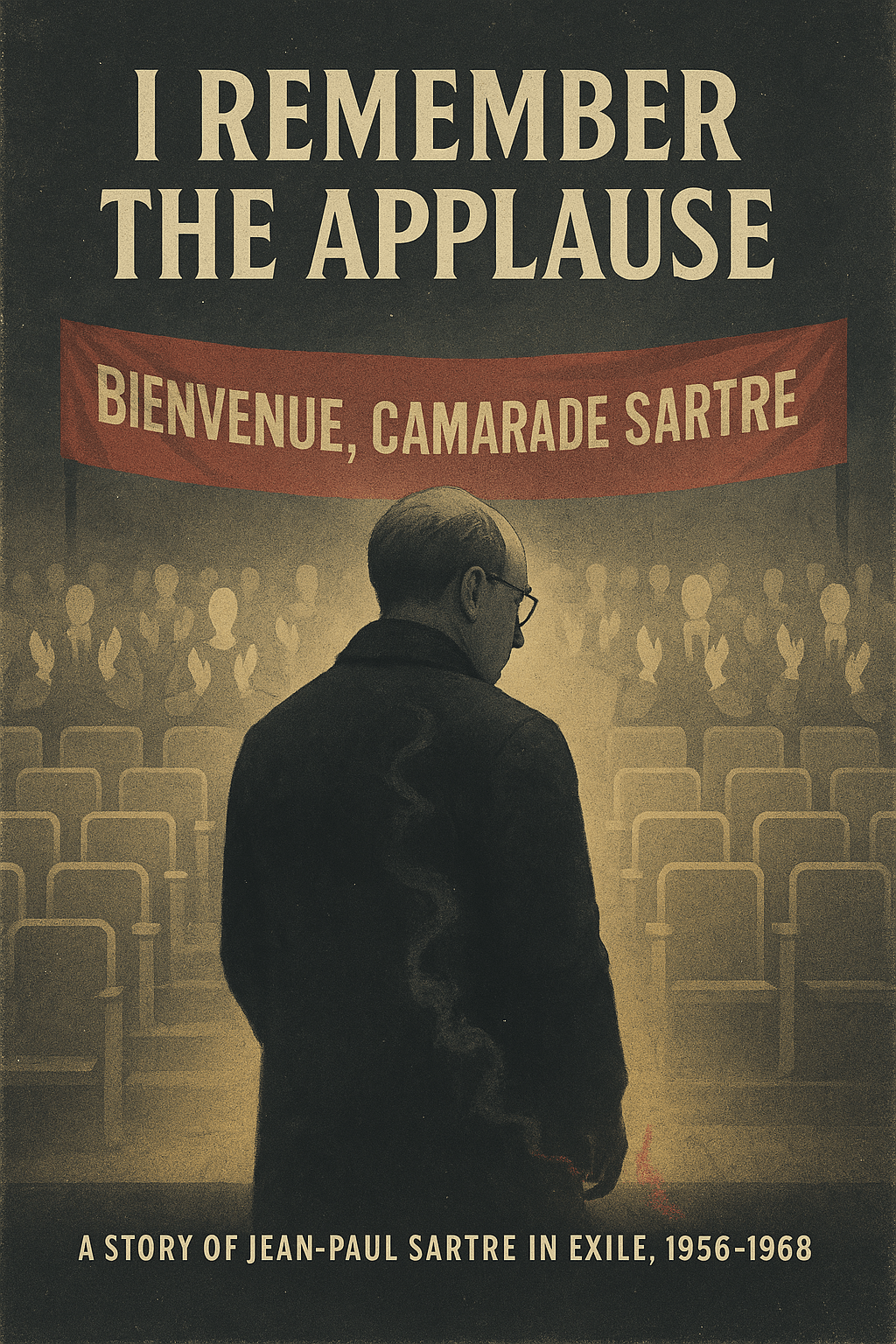
A fictional internal monologue of Jean-Paul Sartre, 1968, Prague
I remember the applause.
Not the kind of applause that warms a man, no. It was hollow, cautious—the clapping of hands that know they are being watched. But I convinced myself it was real. I needed it to be real.
When I stepped from the train in East Berlin in 1956, they held up signs with my name. Bienvenue, camarade Sartre. I was the West’s inconvenient conscience, their prize of conscience—sent here like a bone to a starving dog. I imagined myself Prometheus, bringing fire to the gray East.
I thought they would listen. That the fire of freedom, not just of revolution, would still be welcome among comrades.
But I was wrong. My fire meant nothing here.
They gave me lectures to deliver—but not to discuss. Students sat like rows of porcelain dolls, silent, wide-eyed. When I asked questions, no one answered. Once, a brave girl asked me about Kafka. The next week, she was gone.
I had left Paris to escape hypocrisy. But here, I found something worse than repression: obedience.
In Paris, I was feared. Here, I was tolerated—and that is the worst fate for a philosopher.
At first, I tried to reshape myself. I wrote of Marx, of struggle. I stripped my language of doubt, of ambiguity. I killed the “I” in my essays. But they did not publish them. They said I was too Western still. Too “individualist.” That word—they wielded it like a knife.
They asked: “Comrade Sartre, what is a man?”
I said: “He is what he makes of himself.”
They replied: “No. He is what the Party makes of him.”
And that was that.
There were years—gray years—where I wandered the university halls like a ghost in his own tomb. I was fed, housed, saluted. But my thoughts were starved. My questions were taken as threats. My presence, once a revolution, became a quiet scandal. I heard them whisper: “Why is he still here? Why hasn’t he returned?”
Because to return meant admitting defeat.
Because I believed, still, in some cracked corner of myself, that the revolution might evolve. That I might help midwife it.
Then came Prague.
I saw in those Czech boys and girls what I had not seen since 1945: hope without illusion.
They read me—not as an icon, but as a man. They questioned. God, how they questioned. I spoke of anguish, and they nodded. I spoke of moral freedom, and their eyes lit like the Seine at midnight.
And for the first time in twelve years, I felt real again.
Dubček said we could build socialism with a human face. I believed him. I believed me.
But the tanks came.
Not quietly, like censorship. Not slowly, like exile. They came loud, and fast, and final.
I watched a boy—a student, nineteen, I think—stand before a T-55 tank with a Czech flag in his hand. The tank did not slow. I turned away before the crunch of bones.
And I knew: they would win.
Again.
Now I sit in this room, its windows shuttered, my papers torn from me. No Simone. No readers. Just the echoes of words I can no longer say.
I am not a martyr. I am a fool.
I thought I could bring light to a system built on shadows. I thought they would tolerate dissent the way the West had—clumsily, angrily, but publicly.
But the East does not tolerate. It consumes.
They took my fire and snuffed it. They stripped me not of freedom, but of meaning. That is the real cruelty.
I do not fear death. But I fear that I have become irrelevant. Worse: complicit.
For what is a philosopher who cannot speak? A thinker who has become a symbol, emptied of thought?
A lie.
 What If: The Archive
Leave a comment