1980–1991 – A Western Revolutionary’s Life as a Soviet Housewife
Moscow, 1980 – The Quiet Choice
She met Yuri Sokolov at a grocery queue.
That was how everything began in Moscow—waiting. For milk, for bread, for permission. He offered her a cigarette and said, “You don’t look like you’re from around here.” She replied in flawless Russian: “I’ve been here long enough.”
He was a tram repairman, a widower, seven years her senior, with no interest in Marx or Hegel or Paris cafés. He liked fishing, Tarkovsky films, and a quiet dinner at home.
Claire married him in late 1981. No ceremony. No photograph. Her last surviving comrade from Jeunesse Révolutionnaire Sartre sent a postcard from Bucharest:
“So this is where the dialectic ends?”
She never replied.
1983–1986: The Soviet Housewife
Claire moved into Yuri’s Khrushchyovka flat in the outer ring of Moscow. She took his surname—Klára Sokolova—for the paperwork, for safety, for peace.
She worked part-time as a French tutor for privileged children of party officials. But mostly she cleaned. Cooked. Waited. Learned to buy toilet paper in bulk when it was available. Learned not to speak when state TV was on. Learned which neighbors to trust, and which to avoid.
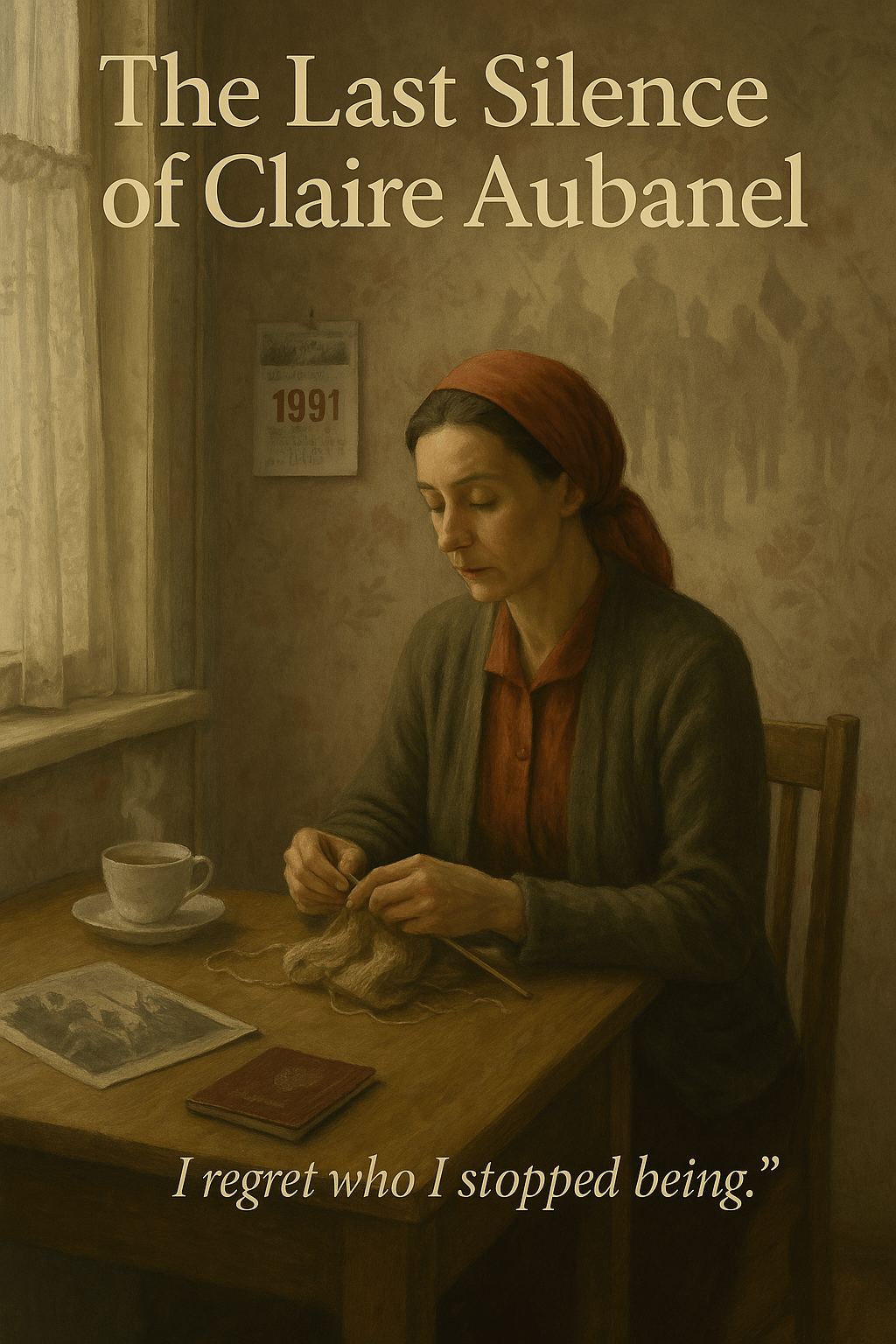
She knitted sweaters from old wool. She planted onions on the windowsill.
She was utterly, perfectly, invisible.
Sometimes, at night, she whispered Sartre’s old phrases to herself like prayers:
“Existence precedes essence.”
“Freedom is what you do with what’s been done to you.”
But even the words had lost their sharpness. They lay like dust on her tongue.
1987: Gorbachev’s Shadow
Glasnost and Perestroika brought voices back to the street. Dissident literature. Conversations in kitchens that weren’t whispered.
Claire didn’t join.
The local French embassy offered to help her repatriate. A minor cultural amnesty allowed for returnees under certain conditions. She met with a young attaché. He asked why she hadn’t come sooner.
She didn’t know what to say.
“I’ve been many things,” she finally said. “But never anything for long.”
She refused the offer. She couldn’t imagine Paris anymore. Its light would be too bright.
1989–1991: The Fall
On August 19, 1991, Yuri woke her before dawn. “There’s something on the radio. Tanks in Red Square.”
She made tea and watched the coup attempt on their flickering black-and-white television. She wasn’t afraid. She had seen real silence. This was just noise.
Three days later, Gorbachev returned. Yeltsin stood on a tank. The flag changed. The Party died.
Claire went to the balcony and watched her neighbors cheer. Someone sang an old French resistance song from a window. For a second, she felt young again.
And then, just as quickly, she felt nothing.
1991: The Last Reflection
She wrote a final letter to herself—never mailed, never signed.
I did not die for the cause. I did not flee from it. I simply lived.
I married a man who never read a page of Sartre, and he treated me better than the revolution ever did.
I don’t regret Moscow. I regret who I stopped being.
But perhaps all of us from that time became ghosts, whether we stayed or left.
We were not built for history. We were built for moments.
And my moment passed.
She folded the letter and placed it inside her old French passport, now expired, now useless.
She never became a symbol again.
 What If: The Archive
Leave a comment