
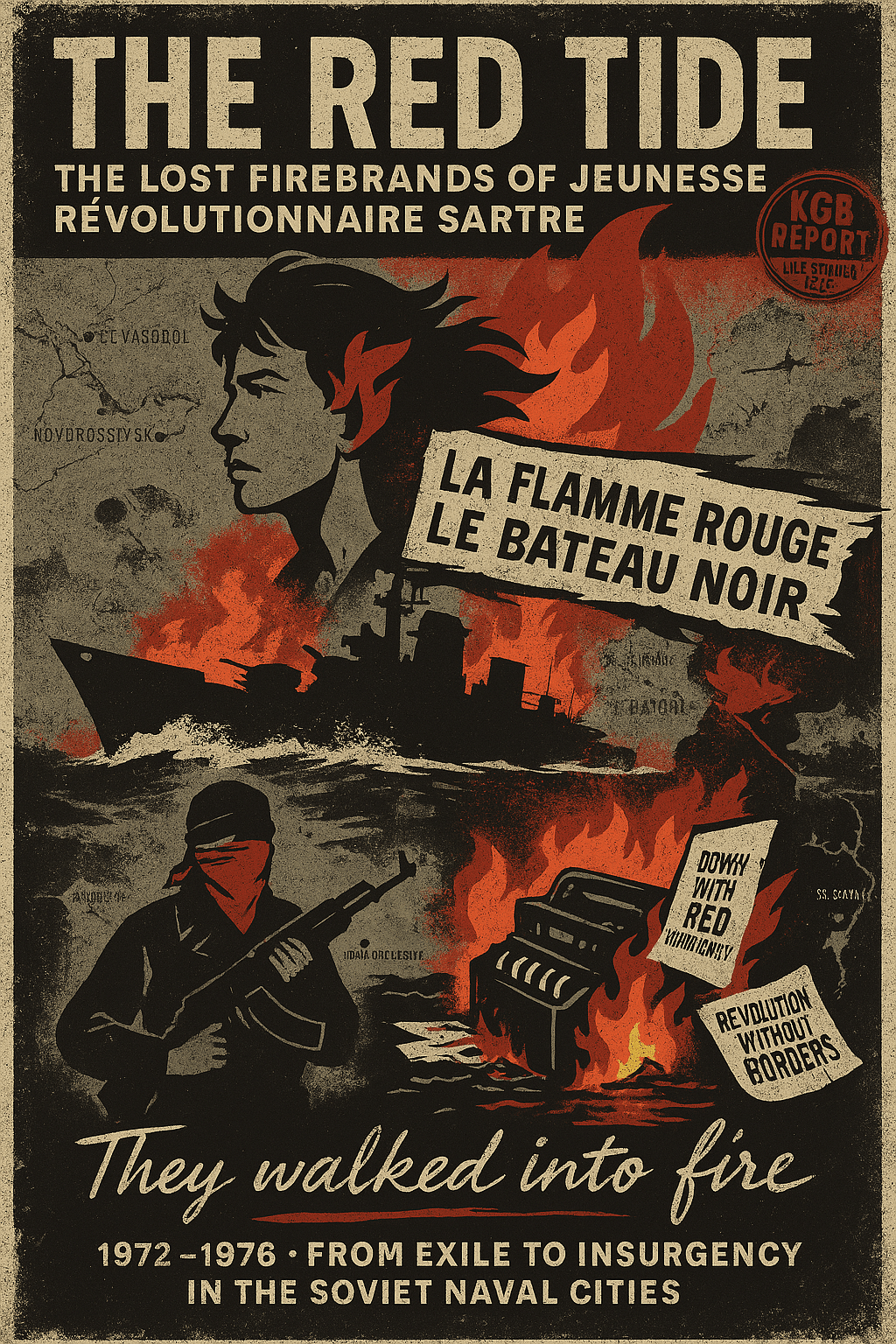
1972–1976 – From ideological exile to revolutionary insurgency in the Soviet naval cities
Background: The Seeds of Militancy
Of the original ten students exiled to Moscow in 1972, half attempted to assimilate like Claire Aubanel. But four members, led by the fiery and charismatic Camille Fleury, followed a darker trajectory.
By 1974, these exiles had been fully marginalized within Moscow academic life. Labeled “cosmopolitan deviationists” and denied publishing opportunities, the group retreated underground. Through contacts made at the Peoples’ Friendship University, they began communicating with radical students from the Global South—Angolans, Ethiopians, and Vietnamese disillusioned with Moscow’s stagnation.
Camille, now calling herself “Comrade Calypso”, became convinced that reform from within was impossible. In her diary (later recovered by Estonian archivists), she wrote:
“We thought we were entering the future. Instead, we entered a museum staffed by jailers. We will not wait for permission to breathe.”
1975: The Underground Awakens
The cell—now calling itself La Flamme Rouge—moved to Sevastopol, ostensibly to teach French to Soviet naval cadets. In reality, they embedded within the seething, underpaid, and disillusioned Black Sea Fleet garrison, where food shortages, hazing, and rising nationalist tensions (particularly among Ukrainians and Georgians) had created a powder keg.
Camille and her comrades—including Jules Moreau, a former literature student turned bomb-maker—began publishing an underground newsletter titled “Le Bateau Noir” (The Black Ship), denouncing the Soviet military as “a colonial apparatus in revolutionary costume.”
They smuggled in mimeographs and small arms with the help of sympathetic sailors and corrupt port officials.
1976: The Naval Rebellions
In March 1976, the Black Sea Fleet was rocked by three coordinated mutinies aboard destroyers and submarines stationed at Sevastopol, Novorossiysk, and Batumi.
The insurrection was unprecedented.
Led by junior sailors and fanned by La Flamme Rouge agitators, the mutineers demanded “worker control of the fleet,” denunciation of Brezhnev’s policies, and solidarity with liberation movements in Africa and Latin America.
On the deck of the Smetlivy, a destroyer anchored at Novorossiysk, a banner was raised:
“Long Live the Oceanic Commune! Down with Red Bureaucracy!”
For 48 hours, parts of the Black Sea Fleet were paralyzed. Two officers were executed by mutineers. One frigate attempted to flee into international waters before being intercepted and forced back.
Camille Fleury was reportedly aboard that ship. She was never seen again.
The Crackdown
The Soviet response was swift and merciless.
Spetsnaz units stormed the rebellious ships. Over 120 sailors were arrested; 38 were executed in secret tribunals. The entire French exile cell was declared “foreign provocateurs and Trotskyite saboteurs.”
Jules Moreau was captured near Sochi and died under interrogation.
Anna Régnier, the youngest of the group, reportedly took cyanide before arrest.
The Soviet press never acknowledged the events. Only in late 1990 did fragments of the rebellion emerge through leaked KGB documents during Glasnost.
Claire Aubanel’s Reaction
Claire learned of the rebellion only through whispers and coded letters. She recognized Camille’s words in Le Bateau Noir. In her journal, she wrote:
“They turned the page I could not. I walked into silence. They walked into fire.”
She never spoke of them publicly.
Legacy: The Myth of the Black Ship
Among dissidents and fringe leftist circles, the 1976 Naval Rebellions became legend—a symbol of revolutionary purity betrayed by both East and West.
In the early ’90s, young anarchist groups in Russia revived the image of the Black Ship, wearing pins with the red flame and Camille’s silhouette.
But in official histories, they remained a ghost movement—too radical for the West to celebrate, too embarrassing for the East to admit.
 What If: The Archive
Leave a comment