
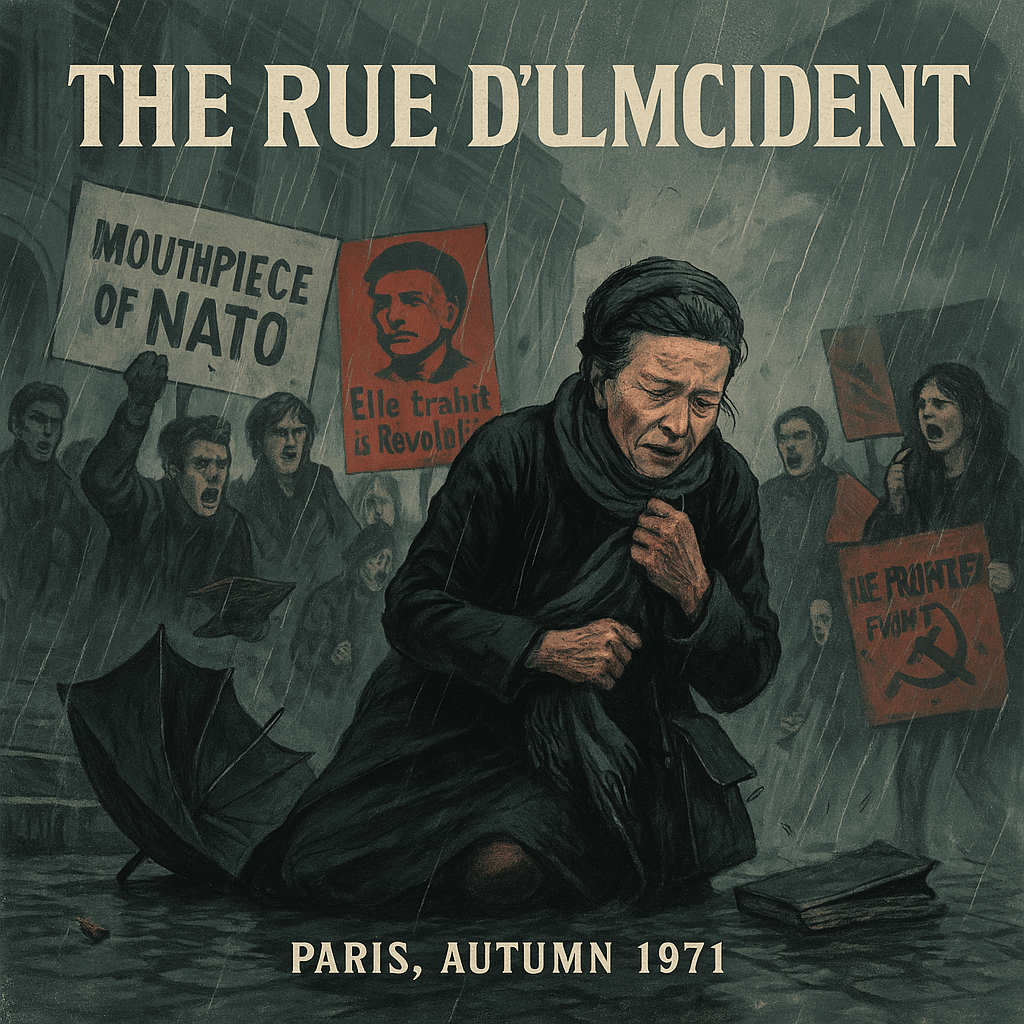
Here is a dramatized moment from 1971, in the streets of Paris—a turning point in Simone de Beauvoir’s personal and ideological isolation.
The October air was sharp with rain, the kind that clings to your coat and hair like accusation. Simone de Beauvoir clutched her umbrella tighter as she stepped onto the cobblestones outside the École Normale Supérieure, where a student group—Jeunesse Révolutionnaire Sartre—had invited her to speak. Or so they had claimed.
She wore a simple black dress, gray scarf wound tight, the same she had worn for weeks—part mourning, part armor.
As she reached the steps, she saw the signs.
Not welcoming ones.
“BEAUVOIR: MOUTHPIECE OF NATO”
“THE EAST IS RED—YOU PAINT IT BLACK”
“HE DIED FOR THE FUTURE. SHE PROFITS FROM THE PAST.”
Her feet faltered. Someone nearby hissed, “Fasciste!”
Another threw a crumpled leaflet at her chest—it bounced off, a tiny wet slap.
She stood still. For a moment, silence. Then someone in the crowd yelled:
“She’s no widow—she’s a traitor!”
And that was the match.
A sudden shove from behind. Her umbrella fell. A hand gripped her arm, another pushed her shoulder. She stumbled down the steps, knees scraping stone, glasses flying.
She looked up through blurred vision—raindrops or tears, she couldn’t tell. Students surrounded her. Children, she thought bitterly. Children who once quoted Sartre to her across café tables now shouted him at her like scripture.
A girl with sharp cheekbones screamed inches from her face:
“You couldn’t be the wife of a hero, so you tried to make him a victim!”
Someone threw a copy of Les Temps Modernes—the spine cracked against her side.
She cried out—not from pain, but from humiliation, raw and sudden. Not even in the war, not even under Vichy, had she felt so stripped of meaning.
“Je l’aimais!” she screamed back.
“Vous ne comprenez rien. Vous jouez aux révoltés avec des slogans pendant qu’il mourait seul!”
(“I loved him! You understand nothing. You play at revolution with slogans while he died alone!”)
Her voice cracked. She fell silent.
They didn’t stop. Some didn’t even hear.
They had already rewritten her into a villain in the story they needed to believe.
A sympathetic philosophy professor finally pushed through the crowd and helped her up. Blood darkened the fabric at her knee. She did not brush it away.
She did not cry again—not until later, in a taxi, where no one could see.
They needed him to be a martyr, she thought.
And they needed me to be the heretic.
She would publish the book anyway. Not out of vengeance, not even out of love anymore. But because if she didn’t, he would be turned into a monument of lies.
And Simone de Beauvoir had always preferred truth—no matter how cold—to myth.
 What If: The Archive
Leave a comment