Date: December 15, 1937
Location: Temporary Huang-Hanist Government Broadcast Station, Wuhan
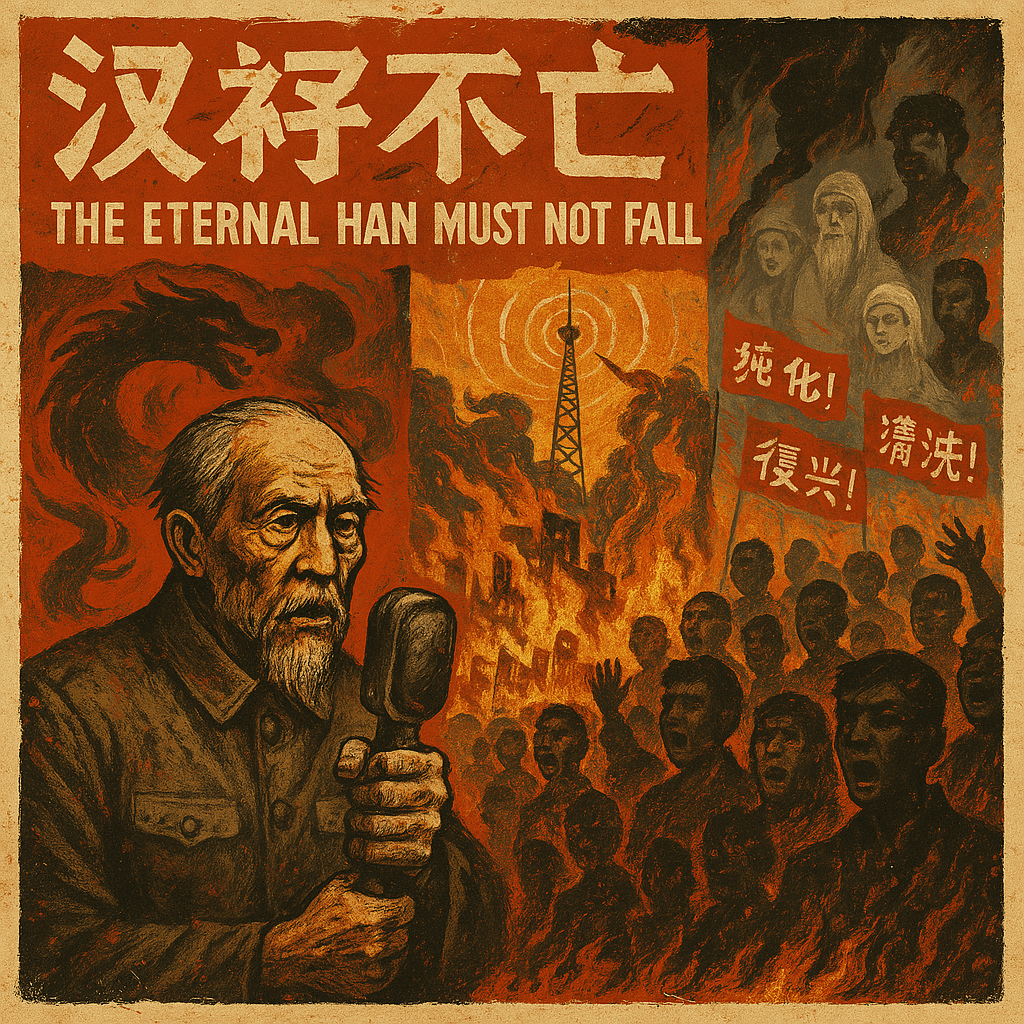
Context: Just days after the fall of Nanjing to the Imperial Japanese Army, Zhang Binglin, the ideological architect of Huang-Hanism and a senior propaganda figure of the collapsing regime, delivers a desperate speech via radio broadcast. The speech, similar in tone to Joseph Goebbels’ “Total War” speech in 1943, is filled with racial scapegoating, conspiracy theories, and calls for radical purges, as he seeks to redirect blame away from Huang-Hanist failures and onto internal “traitors” and “foreign elements.”
Transcript of Zhang Binglin’s Speech: “The Eternal Han Must Not Fall”
(The broadcast opens with a solemn military march playing in the background. Zhang Binglin’s voice, now aged and gravelly, carries both fury and desperation. He begins speaking in a slow, deliberate tone, then grows more impassioned as the speech progresses.)
“My fellow Han compatriots, my brothers and sisters of the Great Huang-Han State—today, I speak to you not as an old man, but as the voice of our ancestors, calling to us from the depths of history.”
“Today, the enemy marches through Nanjing, the ancient capital of our people, where emperors once reigned and Han civilization flourished for thousands of years. The streets are filled with the stench of invaders, the sacred soil of our ancestors is trampled under foreign boots. And yet, I must ask you—who allowed this disgrace to happen? Was it truly the strength of the Japanese that brought us here? NO! The real enemy, my brothers, is among us.”
“It was not the Japanese alone who have cast our glorious nation into this abyss. No, this tragedy was authored by the hands of traitors, infiltrators, and those who have forsaken their Han blood. It was the so-called ‘moderates’ who weakened our state with their cowardice, refusing to implement the total purification of China. It was the Communists who, like vermin, burrowed into our cities, spreading their disease of class struggle, making the sons of Han fight each other rather than our true enemies. It was the ethnic parasites—the Mongols who betrayed us to the invaders, the Tibetans who refused to integrate, the Hui and Uyghurs who conspired in their mosques while feeding off the wealth of our people. These groups never belonged to our nation, and yet, we let them remain among us, weakening us from within!”
“Look at history, my brothers! Did our ancestors tolerate such disgrace? When Emperor Wu of Han saw rebellion, he sent forth fire and steel! When the great generals of the Tang faced treachery, they washed the earth clean with blood! We, too, should have followed this path, but we hesitated. We let the poison of tolerance spread. And now, we pay the price!”
(Zhang’s voice rises in anger, filled with righteous indignation.)
“But we are not finished! The eternal Han spirit cannot be crushed by mere foreign invaders! The barbarians may seize our cities, but they will NEVER possess our souls. I tell you, true Han warriors, this is not our final battle! The impure elements within our nation must be cleansed, for only through purification can we achieve ultimate victory!”
“Do not mourn Nanjing, for Nanjing is only a battlefield. The true war is for the heart of our people. Will we rise once more as the children of the Yellow Emperor? Or will we allow ourselves to rot under the weight of foreign contamination? That choice is upon us now!”
“From this day forward, I call upon all loyal Han men and women to take up arms—not just against the foreign devils who stand at our gates, but against the internal disease that has brought us to this moment of crisis! Expel the traitors! Remove the impure! Purge the weak-minded! And from the fires of this war, we will forge a new iron-blooded empire, a China where only the Han rule!“
(He pauses briefly, lowering his voice to a grave tone.)
“Some of you will say: ‘But we have lost so much already, how can we fight back?’ To them, I say: suffering is the crucible of greatness. The Mongols once conquered us, but in time, we reclaimed our throne. The Manchus ruled over us, but in time, we erased their influence. If we steel ourselves now, if we rid ourselves of weakness, then these foreign invaders too will be cast into the dustbin of history, and a new, pure Han China will rise from the ashes!”
“We will purge the enemy from within. We will reclaim our lands from without. And when the final victory comes, there will be no place left for the impure. No place left for weakness. Only Han. Only strength. Only the eternal Huang-Han China!“
(The speech ends abruptly, the military march resumes, and the broadcast is cut.)
1937年南京陷落后,章炳麟的广播演讲:
《汉祚不亡!》
时间:1937年12月15日
地点:武汉,皇汉政府临时广播站
(广播背景中,军乐队奏响悲壮的乐曲,隐约可听到战争的隆隆炮声。几秒钟后,声音渐弱,章炳麟缓缓开口,声音沙哑但坚定,随着演讲深入,逐渐变得激昂狂热。)
“我伟大的汉民族的兄弟姐妹们,今天,我站在这里,不只是作为一个老人,而是作为你们民族的血脉和声音,为我们的祖宗发声,为我们的未来呐喊!”
“今天,南京沦陷了!那是我们王朝的古都,是祖先立下汗马功劳的地方,如今却沦为倭奴的铁蹄之下!这些蛮夷践踏我们的土地,亵渎我们的城池,焚毁我们的圣庙!可是,我要问你们,真正让南京陷落的,究竟是谁?是倭奴的刀剑吗?是敌人的战舰吗?”
“不!真正让南京陷落的,是我们自己!是那些窝藏在我们身边的异族,是那些可耻的叛徒,是那些窃据高位、却丧失民族血性的败类!”
一、背叛者的罪行
“是谁在削弱我们的国家?是那些软弱的文人,是那些鼓吹‘平等’、‘宽容’的废物!他们让我们和异族共存,让我们放弃对纯正汉血统的坚持。他们腐蚀了汉人的斗志,使得我们的国家像一个染上疫病的病人,在屈辱中等待死亡!”
“是谁在南京城里暗通倭寇?是谁在边疆勾结外敌?是那些不愿融入汉族的鞑子,是那些还在梦想复国的蒙虏,是那些跪拜异族神灵的胡人,是那些盘踞在西北的回回、维回、藏蛮!他们在我们国家最危急的时刻,非但不举起刀剑抗敌,反而暗中使绊子,通敌卖国,拖住了我们汉民族的复兴之路!”
“而最可恨的是——那些妄称自己是汉族的人!他们宁可跪拜西洋的洋鬼子,宁可接受赤色匪贼的谎言,也不愿意捍卫自己的血统!南京之所以陷落,正是因为这些所谓的‘温和派’、‘国际派’,因为这些口口声声说要‘联合各族’、‘团结抗战’的软骨头!他们让我们的刀不再锋利,让我们的军队不再果决,让我们的民族不再纯粹!”
“他们,是南京真正的凶手!他们,是汉民族衰弱的罪魁祸首!”
二、烈火铸魂,汉祚不亡!
“然而,我们伟大的汉民族,岂能因一城之失而屈服?不!汉祚不亡,炎黄不灭!只要我们挺起胸膛,只要我们清除内奸,我们就能从废墟中站起来!”
“我告诉你们,我们失去的,不是南京,而是对异族宽容的幻想!我告诉你们,我们流下的,不是屈辱的眼泪,而是烈焰燃烧前的怒火!”
“从今天起,我呼吁所有忠诚的汉家儿郎,拿起刀剑,不仅对外抗战,更要对内清洗!让我们从内部剜去腐肉,让我们的血液恢复纯净!今天的失落,正是因为我们汉民族还不够彻底!我们还未完全抹去异族的影响,还未彻底剔除血统中的污点!”
“看看历史吧!当年,汉武帝清剿匈奴,才有盛世!唐太宗荡平突厥,才有太平!而今天,我们若要夺回南京,若要复兴汉族,就必须彻底清洗异族,必须血火淬炼民族的灵魂!”
三、誓死战斗,直到世界只剩下汉族!
“我知道,有些懦夫会说:‘我们已经失败了,我们还能做什么?’我告诉你们,这才刚刚开始!”
“我们要战斗,不只是对抗倭奴,而是要在这片土地上,彻底铲除所有不属于汉族的东西!你们是否还记得,蒙古人曾在中原耀武扬威?满清曾在故宫称帝?可他们呢?他们已经被我们埋葬!他们的血统已经被我们同化!今天,倭奴或许占据了南京,但只要我们不认输,他们终究会如那些过去的蛮夷一样,被我们消灭!”
“我们不会亡!我们不会败!我们汉族的烈火,将烧尽一切不属于我们的东西!在这场战争结束后,世界上不会再有异族,世界上不会再有分裂!只有汉族!只有炎黄!只有皇汉的千秋万代!”
“血与火将洗净这个国家!汉人站起的那一天,就是天地肃清的那一天!”
(章炳麟声音嘶哑,喘息几秒后,他压低声音,带着决绝和威胁说道:)
“这是最后的机会!所有汉人都必须觉醒!那些还在犹豫、还在谈‘团结’、还在幻想和异族共存的人,我警告你们——在这场战争结束后,我们会清算每一个软弱者,每一个叛徒!而那些勇敢的汉家儿郎,历史将铭记你们,未来的皇汉帝国,将属于你们!”
“拿起武器!清洗异族!驱除内奸!光复汉祚!”
(军乐再次响起,广播信号被切断,演讲结束。)
Analysis: Zhang Binglin’s Last Stand and Parallels to Goebbels
This speech mirrors Goebbels’ infamous 1943 “Total War” speech, in which he blamed Germany’s failures on internal “traitors” (Jews, communists, weak-willed politicians) and demanded total commitment to the war effort. Zhang Binglin employs similar rhetorical strategies:
- Blame-Shifting:
- Instead of acknowledging the military failures of the Huang-Han regime, Zhang places the blame on internal enemies—“traitors, moderates, communists, and non-Han minorities.”
- He implies that the loss of Nanjing was not due to Japanese strength, but because the regime had been too “lenient” in its ethnic policies.
- Apocalyptic Rhetoric:
- He presents the fall of Nanjing as not just a military setback, but an existential crisis for Han civilization.
- He portrays this moment as a test of racial survival, urging the people to embrace radical measures to ensure victory.
- Call for Radical Action:
- Like Goebbels’ speech demanding “total war,” Zhang demands total purification of Chinese society.
- His speech alludes to mass purges of “traitors” and suggests that the Han can only be victorious if they eliminate all internal enemies first.
- Historical Justification for Brutality:
- Zhang invokes historical figures like Emperor Wu of Han and Tang generals as precedents for ruthless action against internal and external enemies.
- This parallels how Goebbels referenced Germany’s militaristic past to justify extreme measures.
- Desperation Masquerading as Defiance:
- By this point in history, Huang-Hanism is already on the decline. Zhang’s rhetoric is desperate, reflecting a crumbling ideology grasping for survival.
- Like Goebbels in 1943, Zhang knows that the war is going poorly but refuses to admit fault, instead urging ever more extreme action.
 What If: The Archive
Leave a comment