Act I: The End of the War and the Gathering Storm (1945–1946)
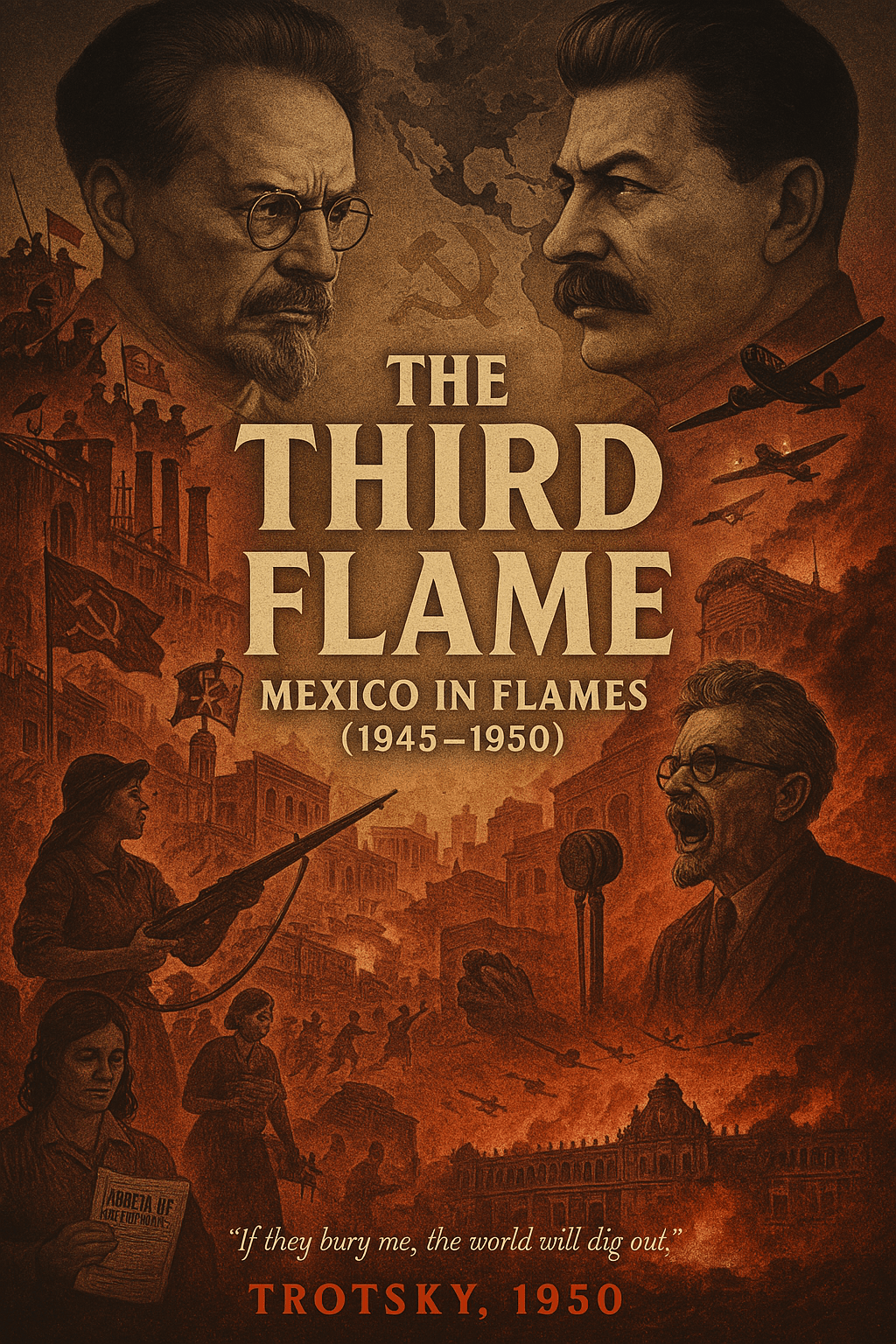
As the world celebrated the defeat of Nazi Germany in May 1945 and prepared for the surrender of Imperial Japan, Mexico stood as a revolutionary outpost—a living contradiction in the emerging Cold War. Neither aligned with Stalin’s USSR nor with the capitalist West, Leon Trotsky’s socialist Mexico was an anomaly that neither Washington nor Moscow could tolerate.
Trotsky’s Final Victory Over Stalin (1945–46)
For Joseph Stalin, Mexico was unfinished business.
The NKVD had failed to assassinate Trotsky in 1940, and now, the old revolutionary had turned Mexico into a hotbed of anti-Stalinist socialism. Soviet-backed Mexican Communist Party (PCM) hardliners plotted to overthrow Trotsky’s government, branding him a “counter-revolutionary” who had betrayed the workers. They found allies among discontented elements in Mexico’s military and intelligentsia.
In October 1945, Soviet-trained Mexican communists attempted a coup, launching simultaneous uprisings in Veracruz, Monterrey, and parts of Mexico City. Armed Soviet operatives smuggled into the country through Cuba coordinated the attacks. Trotsky, despite his age and frail health, personally directed the defense of Mexico City.
The battle for Mexico’s future came down to a single night, November 9, 1945, when PCM loyalists stormed the National Palace, expecting a quick victory. But Trotsky’s Red Militia, comprised of radicalized workers, Spanish Civil War veterans, and Indigenous rebels from Chiapas, fought back with ruthless intensity. Street fighting engulfed the capital for three days.
When the dust settled, the Stalinist plot was crushed. NKVD agents were executed in the streets. The Mexican Communist Party was outlawed, its leaders imprisoned or exiled. Stalin had lost. But Trotsky knew the real enemy was still watching from the north.
Act II: The Yankee Dagger—America Strikes (1946–1948)
Washington had been patient. Now, it was time to act.
The U.S. tolerated Trotskyist Mexico during the war, but with Japan defeated and the Cold War beginning, President Harry Truman would not allow a radical socialist state on America’s doorstep. The Mexican Revolution threatened U.S. economic interests, Western Hemisphere security, and the influence of American corporations.
In March 1946, the CIA (recently formed from the OSS) launched “Operation Condor”—a full-scale covert destabilization campaign.
- Economic Sabotage: U.S. agents infiltrated Mexican oil fields, blowing up refineries and derailing trains carrying industrial supplies.
- Political Subversion: The CIA funneled money to conservative Catholic groups and right-wing exiles, sparking riots in Guadalajara, Mérida, and northern industrial towns.
- Guerrilla War: Anti-communist insurgents, trained in Texas, slipped across the border, waging a brutal campaign of terror.
The “Crimson Terror” (1946–47): Trotsky’s Bloody Reign
Trotsky, now 67 years old, faced the greatest crisis of his life. Mexico was bleeding, and Washington wanted him dead.
- In response to the U.S. insurgency, Trotsky declared martial law and launched a vicious counterinsurgency campaign known as the Crimson Terror.
- Suspected American collaborators were rounded up and executed en masse—entire villages in Chihuahua and Sonora were razed for aiding CIA-backed rebels.
- The government tightened control over industry and food supplies, but the economy continued to crumble.
Mexico City burned as right-wing terrorists planted bombs in government buildings. American planes, disguised as Mexican rebel forces, conducted covert airstrikes on oil fields. The borderlands became a war zone.
For the U.S., the goal was clear: force Mexico into collapse, then install a puppet regime. But Trotsky refused to fall.
Act III: The Brink of American Invasion (1948–1950)
By 1948, Mexico was on the edge of total war.
Trotsky had crushed the Stalinists, but at a terrible cost—his once-democratic revolution now looked more like a military dictatorship. The Red Army ruled the streets. The press was silenced. Dissent meant death. The revolution was becoming what Trotsky had always feared: a mirror of the Soviet Union.
But the greatest threat came from the United States.
June 12, 1948: The Texas Incident
A group of Mexican Red Army forces crossed the U.S. border, pursuing an American-backed guerrilla unit into El Paso, Texas. In the chaos, Mexican troops accidentally killed three American civilians.
The U.S. declared war was now inevitable.
- Truman ordered 100,000 troops to the border, preparing for a full-scale invasion.
- The U.S. Navy blockaded Mexican ports, cutting off all trade.
- American bombers began targeting Mexican military installations, marking the first direct U.S. attacks.
Trotsky’s Last Gamble: “Operation Revolution” (1949–50)
In his final act, Trotsky turned to Latin America for salvation. He called for revolution across the hemisphere, urging communist uprisings in Guatemala, Argentina, Brazil, and Colombia.
And it worked.
- Guatemala (1949): The government collapsed in a workers’ revolt, forming the second Trotskyist state in the world.
- Colombia (1950): Communist forces seized Bogotá, forcing the U.S. to divert troops from the Mexican front.
- Cuba: Inspired by Mexico, young revolutionaries like Fidel Castro began organizing armed resistance against American-backed dictators.
Trotsky’s last, desperate play had worked—he turned Mexico’s war into a continental revolution.
The Final Battle: Trotsky Faces Death (1950)
By early 1950, Mexico was in ruins. Trotsky, now 70, knew the end was near. He had survived Stalin, Hitler, and Truman—but time was against him.
On March 7, 1950, as American forces prepared for a full-scale invasion, Trotsky made his final speech from the National Palace in Mexico City. His voice was frail but defiant.
“We have lit the flame of revolution. If they bury me, the world will dig me out. No force, not Stalin, not America, will stop the march of the working class.”
That night, the U.S. launched a massive bombing raid on Mexico City.
Trotsky was killed in the inferno, refusing to flee. His body was never recovered—some say it was vaporized, others claim his loyalists buried him in secret. His revolution died with him.
Epilogue: The End of Socialist Mexico
With Trotsky gone, Mexico collapsed within weeks. The U.S. installed a pro-American military junta, outlawed communism, and erased Trotsky from history.
But the flame of revolution did not die. Across Latin America, his ideas lived on. The Cuban Revolution, the guerrilla movements in South America, even the New Left in the U.S.—all bore his legacy.
Trotsky had lost Mexico, but he had ignited a fire that no empire could ever extinguish.
 What If: The Archive
Leave a comment