
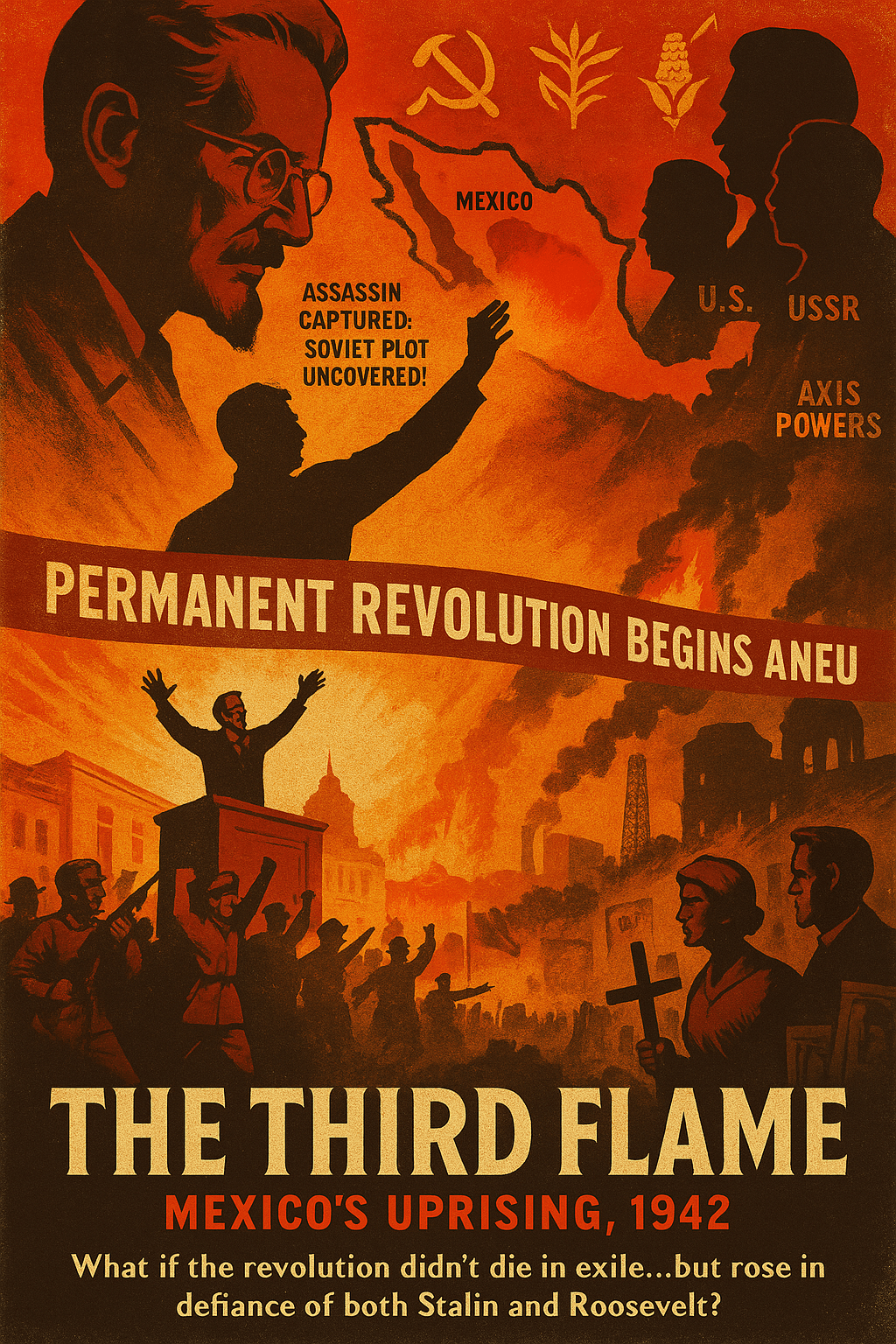
Point of Divergence: The Survival of Leon Trotsky and the Communist Uprising in Mexico (1942)
In this timeline, Leon Trotsky does not fall to Ramón Mercader’s icepick in August 1940. Instead, his security apparatus, reinforced by sympathizers within Mexico’s left-wing labor movement, uncovers the Stalinist plot against him. Mercader is intercepted and captured, exposing the extent of Soviet infiltration in Mexico. This revelation, combined with growing tensions between the Mexican government and leftist factions, radicalizes the Mexican labor movement and solidifies Trotsky’s position as a revolutionary leader.
By early 1942, as World War II rages across the globe, Mexico is officially aligned with the Allies but internally wracked with political instability. President Manuel Ávila Camacho struggles to maintain control as economic hardship, worker unrest, and nationalist sentiment against foreign corporations fuel discontent. Trotsky, having spent years organizing underground networks within Mexican labor unions and peasant movements, sees an opportunity.
The 1942 Mexican Socialist Revolution
The revolution erupts in May 1942, coinciding with Mexico’s declaration of war on the Axis following the sinking of Mexican oil tankers by German U-boats. Trotsky and his followers exploit widespread worker strikes and peasant uprisings to launch a coordinated insurrection, centered in Mexico City, Veracruz, and industrial hubs such as Monterrey.
Key factions of the Mexican Army, particularly younger officers sympathetic to socialist ideals, defect to the revolutionaries. The U.S., preoccupied with its war effort in Europe and the Pacific, hesitates to intervene directly, fearing backlash from its Latin American allies. Within months, the Ávila Camacho government collapses, and by September 1942, Trotsky declares the Mexican Workers’ and Peasants’ Republic from the National Palace in Mexico City.
The Trotskyist Regime: A New Communist Experiment
Unlike Stalin’s Soviet Union, Trotsky’s vision for Mexico follows a model of permanent revolution, emphasizing workers’ self-management, internationalism, and a break from Stalinist authoritarianism. The new government immediately nationalizes foreign-owned oil companies, expels American and British corporate interests, and declares solidarity with socialist movements worldwide.
Trotsky’s rhetoric alarms both the U.S. and the Soviet Union. While Washington considers intervention to prevent the spread of communism in Latin America, Stalin views Trotsky’s success as a direct ideological threat. With Mexico now an active player in the global communist struggle, Stalin orders NKVD assassins and Soviet-backed Mexican Communist Party members to eliminate Trotsky and bring Mexico into the Stalinist fold.
International Reactions and WWII Implications
- The U.S. Response: The Roosevelt administration faces a dilemma—should the U.S. intervene militarily in Mexico while fighting the Axis? In late 1942, Roosevelt authorizes a partial blockade of Mexican ports, aiming to cripple Trotsky’s economy without full-scale invasion. However, anti-fascist sentiment in the U.S. left-wing prevents a more aggressive response.
- The Soviet Union’s Position: Stalin denounces Trotsky’s revolution as a “petty-bourgeois deviation” and pressures communist parties worldwide to shun the new Mexican regime. Nevertheless, covert Soviet agents work to undermine Trotsky’s government from within.
- The Axis Powers: Nazi Germany and Imperial Japan see Mexico’s revolution as a potential advantage. German agents in Latin America explore the possibility of recognizing and supporting Trotsky’s government to further destabilize the U.S. war effort. However, Trotsky remains vehemently anti-fascist, refusing any cooperation with Hitler or Mussolini.
The Revolution’s First Challenges (1942-1945)
- Internal Struggles: Trotsky’s government faces immediate crises—food shortages, economic dislocation, and opposition from remnants of the Mexican right-wing and Catholic Church. The transition from a capitalist economy to worker-controlled industry is chaotic, with violent clashes between revolutionary militias and reactionary forces.
- American Sabotage: The Office of Strategic Services (OSS) funds anti-communist insurgents, particularly in northern Mexico, leading to a brutal counterinsurgency campaign.
- Latin American Diplomacy: Most Latin American countries, pressured by the U.S., refuse to recognize Trotsky’s regime. However, leftist factions in Argentina, Chile, and Brazil see the revolution as a model for their own struggles.
By 1945, as World War II nears its conclusion, Mexico stands as a unique communist experiment, ideologically opposed to both Washington and Moscow. Trotsky, now in his mid-sixties, is locked in a political and military struggle to maintain his revolution’s survival against internal dissent, American subversion, and Stalinist infiltration.
 What If: The Archive
Leave a comment