
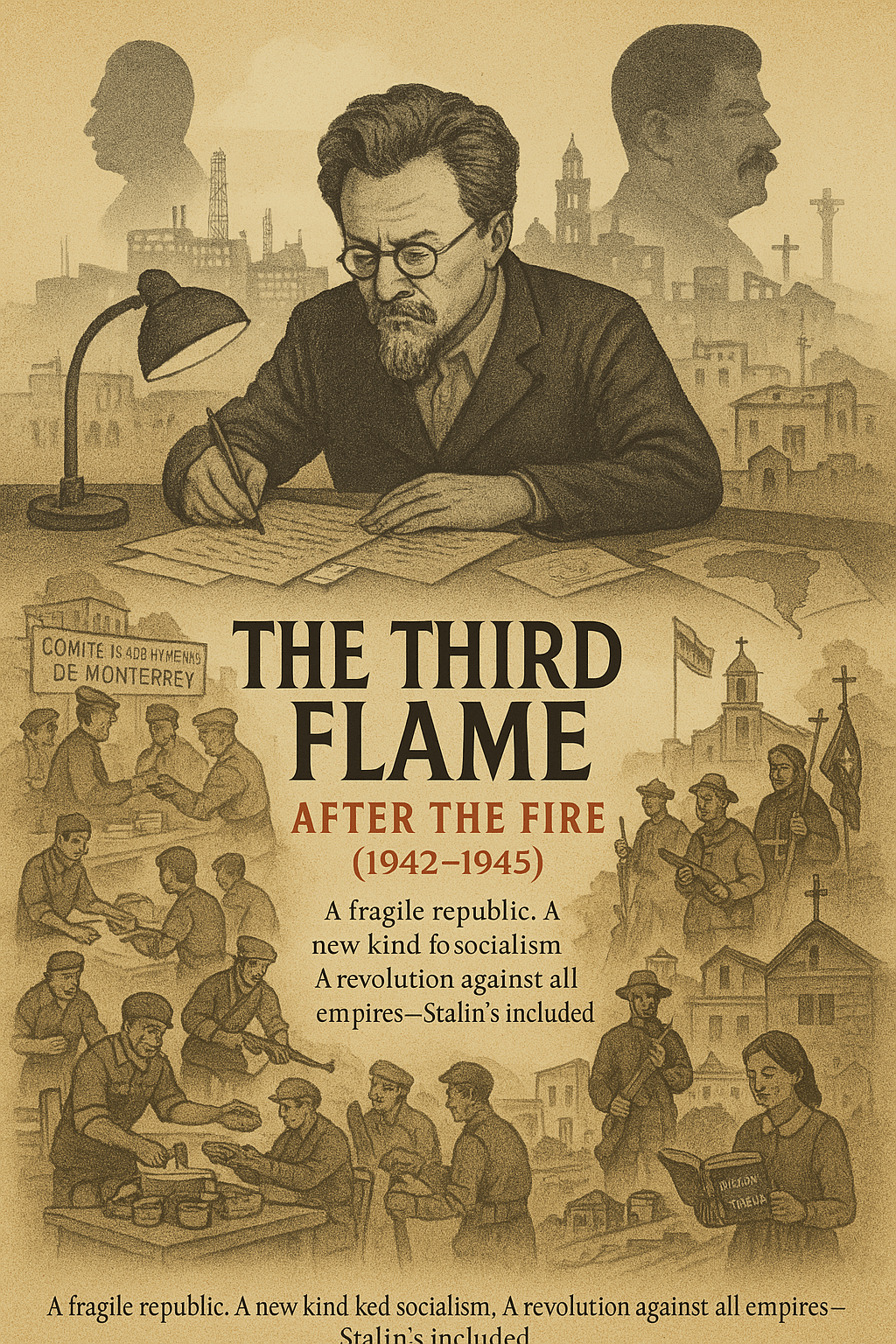
Building the Foundation of the Mexican Workers’ and Peasants’ Republic
Leon Trotsky’s sudden rise to power in 1942 left Mexico in a state of upheaval. Unlike Stalin’s Soviet model, Trotsky’s vision of socialism rejected bureaucratic authoritarianism and emphasized workers’ democracy, decentralized economic planning, and international revolution. However, maintaining his rule and improving Mexicans’ livelihoods in the face of economic disarray, U.S. hostility, and Stalinist subversion proved immensely challenging.
Economic Reforms and the Struggle for Stability
- Nationalization of Industry and Land Redistribution
- Trotsky immediately nationalized all foreign-owned enterprises, particularly American and British oil companies, railroads, and mines.
- Unlike Stalin’s forced collectivization, land was distributed to peasant councils, allowing small farmers to retain control while encouraging cooperative production.
- Worker-controlled factories were introduced in urban centers, especially in Monterrey, Guadalajara, and Mexico City, where elected workers’ councils replaced corporate management.
- Economic Crisis and Emergency Measures
- The U.S. blockade and capital flight caused severe shortages of industrial equipment and consumer goods.
- In response, Trotsky’s government implemented a rationing system and redirected resources toward basic needs: food, housing, and healthcare.
- Barter-based trade networks were encouraged in rural areas to compensate for the lack of currency and imports.
- Soviet-Mexican Relations: A Paradoxical Cold War Before the Cold War
- While Stalin officially denounced Trotsky’s Mexico, many rank-and-file communists and leftist intellectuals were intrigued by his worker-democracy model.
- Soviet trade unions pressured Moscow to at least secretly supply industrial equipment and technical expertise to Mexico, fearing that an economic collapse could push the country into U.S. control.
- Despite ideological hostility, Stalin agreed to send grain shipments and machinery via covert routes, using sympathetic Argentine and Spanish exiles as intermediaries.
Defending the Revolution: The Internal and External Threats
- The U.S. Economic War and Covert Sabotage
- The Office of Strategic Services (OSS) funneled money and weapons to Mexican right-wing militias, particularly in northern Mexico, where conservative landowners and ex-military officers launched sporadic uprisings.
- American-backed insurgents bombed oil pipelines, assassinated labor leaders, and sabotaged railroads, forcing Trotsky to establish a Revolutionary Defense Committee to oversee internal security.
- The Role of the Red Army Veterans and International Brigades
- Thousands of Spanish Civil War veterans, exiled in Mexico after Franco’s victory, became the core of Trotsky’s military forces.
- Trotsky restructured the Mexican Red Army using experienced commanders from the Spanish Republican forces and anti-fascist international brigades.
- Guerrilla warfare tactics were employed to suppress counter-revolutionary movements, particularly in the Catholic strongholds of Bajío and northern states like Chihuahua and Sonora.
- Catholic Resistance and the “Second Cristero War”
- The Mexican Catholic Church, long wary of leftist policies, became a center of resistance. Priests and church officials organized peasant rebellions under the banner of defending religious freedom.
- By mid-1943, this conflict escalated into what some called the “Second Cristero War,” with armed Catholic militias clashing with revolutionary forces.
- Trotsky, learning from past mistakes of the Soviet approach to religion, sought compromise rather than outright repression, allowing limited religious expression in exchange for ending militant opposition.
Improving Living Conditions: The Revolutionary Social Programs
Despite economic hardship, Trotsky’s government made efforts to improve workers’ and peasants’ daily lives, consolidating popular support.
- Universal Healthcare and Education
- Inspired by the Spanish Republic’s socialist policies, Trotsky implemented free, state-run healthcare, using medical professionals who had fled Europe due to war.
- Education reforms expanded literacy programs to rural areas, with radical socialist curricula emphasizing scientific thought, workers’ rights, and anti-imperialism.
- Worker Housing and Food Programs
- Government-led housing cooperatives were built in urban centers, modeled after worker housing in Barcelona and Paris during the 1930s.
- Rationing ensured that basic necessities—corn, beans, tortillas—remained affordable, even as luxury goods disappeared due to economic isolation.
- Women’s Rights and Indigenous Empowerment
- Women gained full political and economic rights, with active participation in factory committees and military brigades.
- Indigenous communities were given autonomous land rights, aligning with Trotsky’s anti-Stalinist approach to national minorities.
The Mexican Revolution’s Global Impact (1944-1945)
By the end of World War II, Mexico’s socialist experiment survived but remained fragile. The revolution had not yet been exported abroad, but it had inspired leftist movements across Latin America, alarming Washington.
- Latin America: Trotskyist uprisings erupted in Guatemala and Colombia, leading to brutal crackdowns by U.S.-backed governments.
- The United States: Roosevelt’s administration debated whether to normalize relations with Mexico or pursue a regime change operation, setting the stage for future U.S.-Mexico tensions.
- The Soviet Union: With the war against Hitler nearly over, Stalin shifted his focus back to Mexico, preparing a wave of Stalinist infiltration to overthrow Trotsky and bring Mexico into Moscow’s orbit.
By 1945, Mexico under Trotsky was a socialist state unlike any other—neither aligned with Stalin’s Soviet Union nor fully opposed to the Western Allies. However, as the Cold War loomed, it was clear that Trotsky’s biggest battles were yet to come.
 What If: The Archive
Leave a comment