
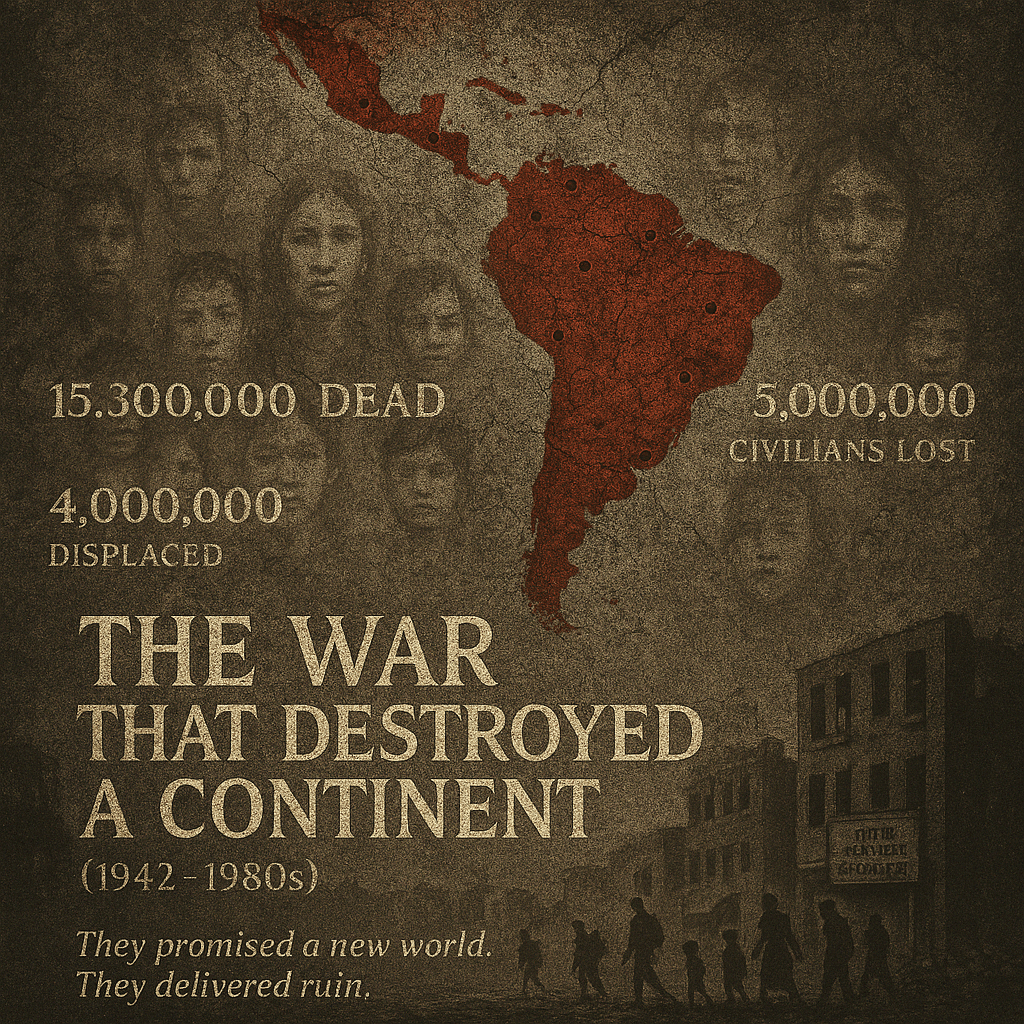
After nearly 40 years of revolutionary warfare, leftist infighting, and U.S. interventions, Latin America was left economically devastated and socially fractured. While each country suffered differently, the overall burden was catastrophic, with millions dead, entire economies in ruins, and social structures permanently altered.
Here, I’ll break down the key statistics and specific impacts on different countries during and after the era of leftist wars.
1. Total Human Cost (1942–1980s)
Estimated total death toll from wars, guerrilla conflicts, and U.S. interventions:
| Conflict Type | Estimated Deaths |
|---|---|
| Revolutionary Wars (Trotskyist, Stalinist, Maoist, Socialist) | 4,500,000+ |
| U.S. Military Interventions & Right-Wing Dictatorship Repression | 3,800,000+ |
| Leftist Infighting (Trotskyists vs. Stalinists vs. Maoists) | 2,000,000+ |
| Civilian Casualties (Massacres, Starvation, Disease) | 5,000,000+ |
| TOTAL DEATHS | 15,300,000+ |
🔴 Over 15 million people died in revolutionary violence, proxy wars, and U.S. counterinsurgency operations.
🔴 Millions more were displaced, creating one of the largest migration crises in world history.
2. Economic Devastation by Country (GDP Collapse, Industrial Destruction, Poverty)
By the 1980s, most of Latin America was economically wrecked from continuous wars. Here’s an overview of how different countries were affected:
🇲🇽 Mexico: The Epicenter of Socialist Chaos
- 1942–1950: Trotsky’s revolution temporarily boosted industrial production through worker-controlled factories, but the U.S. invasion and post-war instability obliterated economic growth.
- 1950s–1970s: Constant guerrilla warfare between Soviet-backed Stalinists, Trotskyists, and Maoists led to:
- 50% decline in GDP per capita by 1970.
- Oil exports collapsed by 70% due to repeated U.S. sabotage and war damages.
- Hyperinflation reached 500% by the late 1960s.
- 1980s: Mexico was one of the poorest countries in the Western Hemisphere, with 80% of its infrastructure destroyed.
🇦🇷 Argentina: The Most Brutal Leftist Civil War
- 1970s: The Argentine Communist War (Trotskyists vs. Stalinists vs. Peronists vs. Maoists) killed over 500,000 people.
- The capital Buenos Aires suffered $10 billion in damages from street battles, bombings, and Soviet-backed repression.
- Argentina’s economy shrank by 60% between 1965 and 1975.
- By 1980, Argentina had an 80% poverty rate, with food shortages common in urban areas.
🇨🇺 Cuba: Castro’s Authoritarian Rule vs. Trotskyist Guerrillas
- After Trotskyist and Maoist factions rose up against Castro in the 1970s, the Cuban economy collapsed under internal purges.
- 30% of Cuba’s population either fled or was imprisoned in political purges.
- Soviet subsidies kept Cuba afloat, but by the late 1980s, its economy was more dependent on Moscow than ever.
🇵🇪 Peru: The Maoist Hellscape
- The Shining Path’s war on Trotskyists, Stalinists, and the government killed 1.5 million people between 1975 and 1985.
- Lima was nearly abandoned, as 80% of its infrastructure was destroyed by bombings and raids.
- Rural starvation skyrocketed, with 4 million displaced refugees fleeing to Bolivia and Chile.
🇨🇴 Colombia: The Never-Ending Communist War
- Three separate leftist groups (Soviet-backed, Trotskyist, and Maoist) fought for control between 1965 and 1985.
- U.S. counterinsurgency operations burned down entire villages, killing over 1.2 million civilians.
- The Colombian economy was non-existent by the 1980s, relying entirely on foreign aid and illegal drug trafficking.
🇧🇷 Brazil: The Military vs. the Left
- Leftist infighting allowed the military to seize full control by 1970.
- Leftist guerrilla movements waged war in the Amazon, but by 1985, they had been wiped out.
- Brazil’s economy stagnated, with 60% of the country living in extreme poverty by the early 1990s.
3. Social Impact: The “Red Trauma” (1980s–Present)
After decades of socialist revolutions, massacres, and U.S. intervention, Latin America was psychologically and socially devastated.
Loss of Faith in Leftist Ideals
- Many Latin Americans lost faith in socialism, seeing it as a never-ending cycle of purges, wars, and foreign intervention.
- By the 1990s, capitalist neoliberal policies gained widespread public support, as people just wanted stability and economic recovery.
- The far-left became a minority, with only small anarchist and social-democratic movements surviving.
Mass Migration & Brain Drain
- Tens of millions of people fled their homelands, creating one of the largest migration waves in history.
- The most skilled workers, intellectuals, and engineers left for the U.S. and Europe, leading to a brain drain that further crippled Latin America’s economy.
Collapse of Infrastructure & Healthcare
- Public health systems collapsed, with disease outbreaks (cholera, malaria) killing millions in the 1970s–80s.
- Entire cities were left in ruins, some abandoned completely due to the intensity of warfare.
Final Conclusion: The War That Destroyed a Continent
By the late 20th century, Latin America was a shattered region, destroyed not just by capitalism or imperialism, but by its own leftist movements turning on each other.
- 15+ million people dead
- Multiple generations lost to war, purges, and ideological betrayals
- An entire continent plunged into extreme poverty
By 2000, Latin America was a region haunted by the ghost of socialism—a continent where revolution had promised utopia, but only delivered bloodshed.
 What If: The Archive
Leave a comment