
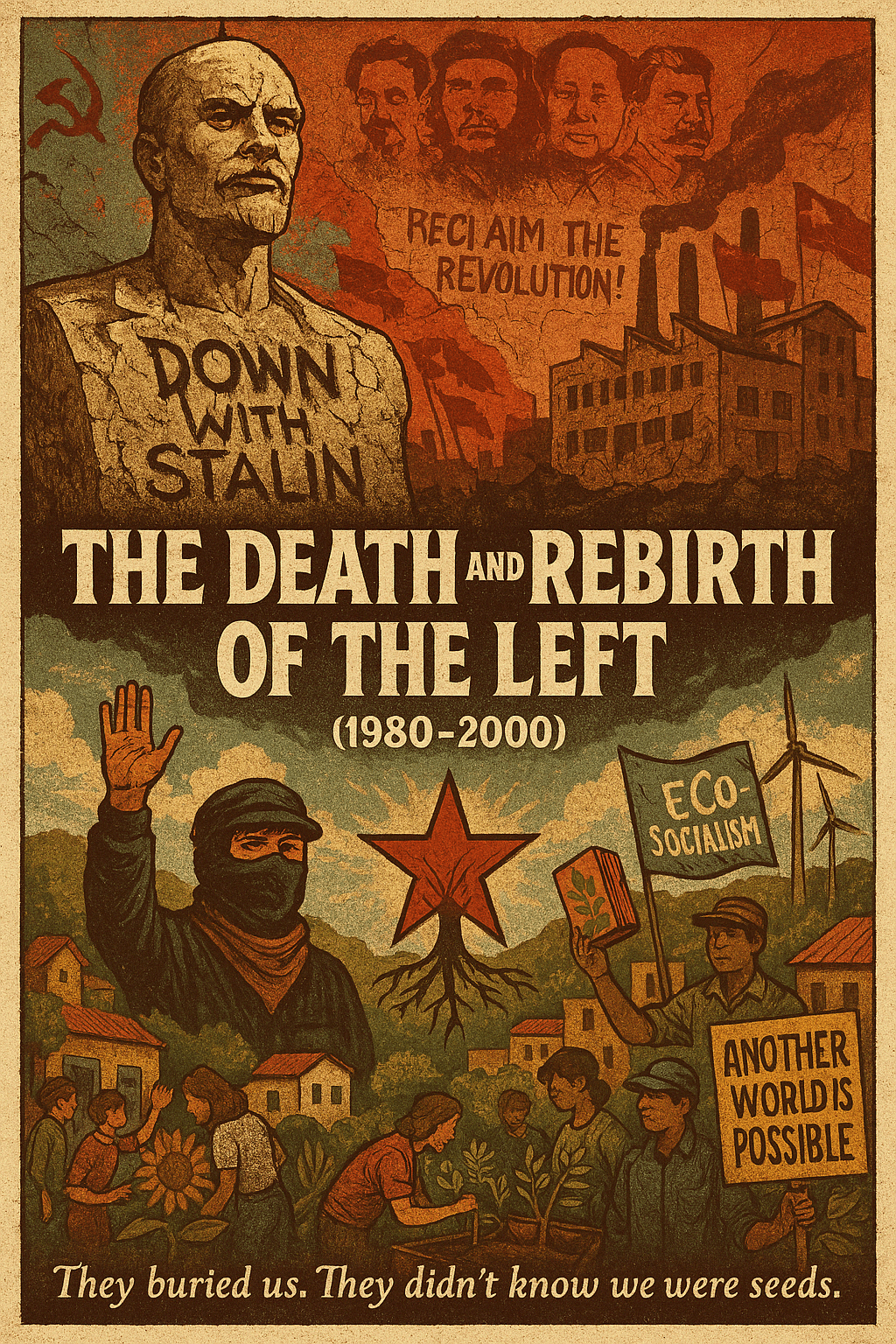
By 1980, the global left was in ruins—not because of capitalism, but because leftists had spent more time slaughtering each other than fighting imperialism.
- Soviet-aligned Marxist-Leninists controlled official communist governments, but their rule was increasingly seen as authoritarian, corrupt, and disconnected from revolutionary ideals.
- Trotskyists had been nearly wiped out in Latin America and elsewhere, suffering decades of purges from both the USSR and Maoists.
- Maoists had devolved into brutal rural insurgencies, fighting not for socialism, but for their own power.
- Meanwhile, capitalism flourished, as the left had spent too much time infighting to present a united front.
But by the late 20th century, something changed. The Soviet Union collapsed ahead of schedule, leftists reevaluated their past, and a new socialist movement emerged from the ashes—one that would redefine the 21st century.
1980–1991: The Accelerated Fall of the Soviet Union
Why Did the USSR Fall Faster in This Timeline?
In our timeline, the Soviet Union collapsed in 1991, but in this alternate history, it falls at least five years earlier due to two key factors:
- More Soviet Resources Were Wasted Fighting Leftists in Latin America, Africa, and Asia
- Unlike in our timeline, where the USSR focused on countering Western capitalism, in this timeline, the Soviets fought Trotskyists, Maoists, and independent socialists as much as they fought the U.S.
- The constant battle against Trotskyist uprisings in Latin America, Maoist insurgencies in Africa, and internal dissent within communist parties drained the Soviet economy faster than expected.
- Leftist Infighting Created Mass Disillusionment
- In countries like Mexico, Argentina, and Peru, revolutionary youth stopped believing in communism after seeing how leftists massacred each other.
- The 1980s saw a decline in communist party membership worldwide, as many young activists turned to alternative movements like environmentalism and anarchism.
Gorbachev’s Failed Reforms and the Accelerated Collapse (1985–1987)
When Mikhail Gorbachev came to power in 1985, he desperately tried to save the USSR by introducing:
- Glasnost (openness) → Allowed free speech, which led to an explosion of criticism from former Trotskyists, Maoists, and independent socialists who had been persecuted for decades.
- Perestroika (economic restructuring) → Loosened state control, but the economy collapsed faster because decades of internal purges had killed off any competent socialist planners.
By 1987, anti-Soviet uprisings broke out not only in Eastern Europe but also in Latin America, where Soviet-backed governments were overthrown by a mix of Trotskyist, anarchist, and moderate socialist forces.
By 1990, the USSR was in total freefall—not just because of capitalism, but because it had spent decades suppressing its own revolutionary movements.
The USSR Collapses Early (1991): The New Left Declares Victory
- By 1991, the Soviet Union disintegrated, but unlike in our timeline, the fall was not seen as a “victory for capitalism”—it was seen as a victory for independent leftists.
- Surviving Trotskyists and anarchists across Latin America, Eastern Europe, and Asia celebrated the end of Soviet tyranny, seeing it as the final nail in the coffin of authoritarian socialism.
With the USSR gone, the left was forced to rebuild from the ground up.
1991–2000: The Rebirth of the Global Left
The End of “Orthodox” Communism
With the USSR dead and China fully embracing state capitalism, the old model of centralized, authoritarian socialism was abandoned.
- Marxist-Leninist parties collapsed worldwide, as their funding from Moscow dried up.
- Maoist guerrilla movements faded, unable to justify their violence after the fall of the Soviet Union.
- Trotskyists and libertarian socialists re-emerged, reclaiming their place in history after decades of persecution.
The 1990s: The Rise of a New Leftist Ideology
Instead of a return to Stalinism, Maoism, or traditional Trotskyism, the new leftists of the 1990s embraced a decentralized, democratic socialist model.
Key features of this new left included:
- Anti-Authoritarianism: Rejecting both capitalism and Soviet-style communism.
- Grassroots Democracy: Inspired by the Zapatista movement in Mexico (1994), which created autonomous zones free from state control.
- Worker Cooperatives and Direct Action: Instead of state control, the new left focused on self-managed factories, community-based socialism, and worker-run enterprises.
- Environmentalism: Seeing capitalism and Soviet-style industrialism as destructive, leftists embraced green politics, eco-socialism, and sustainable development.
Key Moments in the Left’s Rebirth (1990s)
1. The Zapatista Rebellion (Mexico, 1994)
- The Zapatista Army of National Liberation (EZLN), led by Subcomandante Marcos, launched an indigenous-led uprising against neoliberal capitalism in Mexico.
- Unlike the old communist movements, the Zapatistas rejected state control, opting for autonomous self-governance.
- The rebellion gained international support from former Trotskyists, anarchists, and even disillusioned ex-Maoists, setting a precedent for future movements.
2. The Argentine Worker Takeovers (1997–2001)
- After Argentina’s economic collapse in 1997, workers seized control of bankrupt factories and turned them into worker cooperatives.
- Instead of following a Soviet-style central plan, they ran their businesses democratically, proving that socialism could function without a state.
3. The Anti-Globalization Movement (1999)
- The 1999 Seattle WTO protests became the largest anti-capitalist uprising in decades, uniting Trotskyists, anarchists, environmentalists, and indigenous activists.
- For the first time since the 1930s, the left presented a united front against capitalism—one that rejected both Stalinism and neoliberalism.
Conclusion: The Left’s New Future
By the year 2000, the global left was unrecognizable from its Cold War past.
 What If: The Archive
Leave a comment