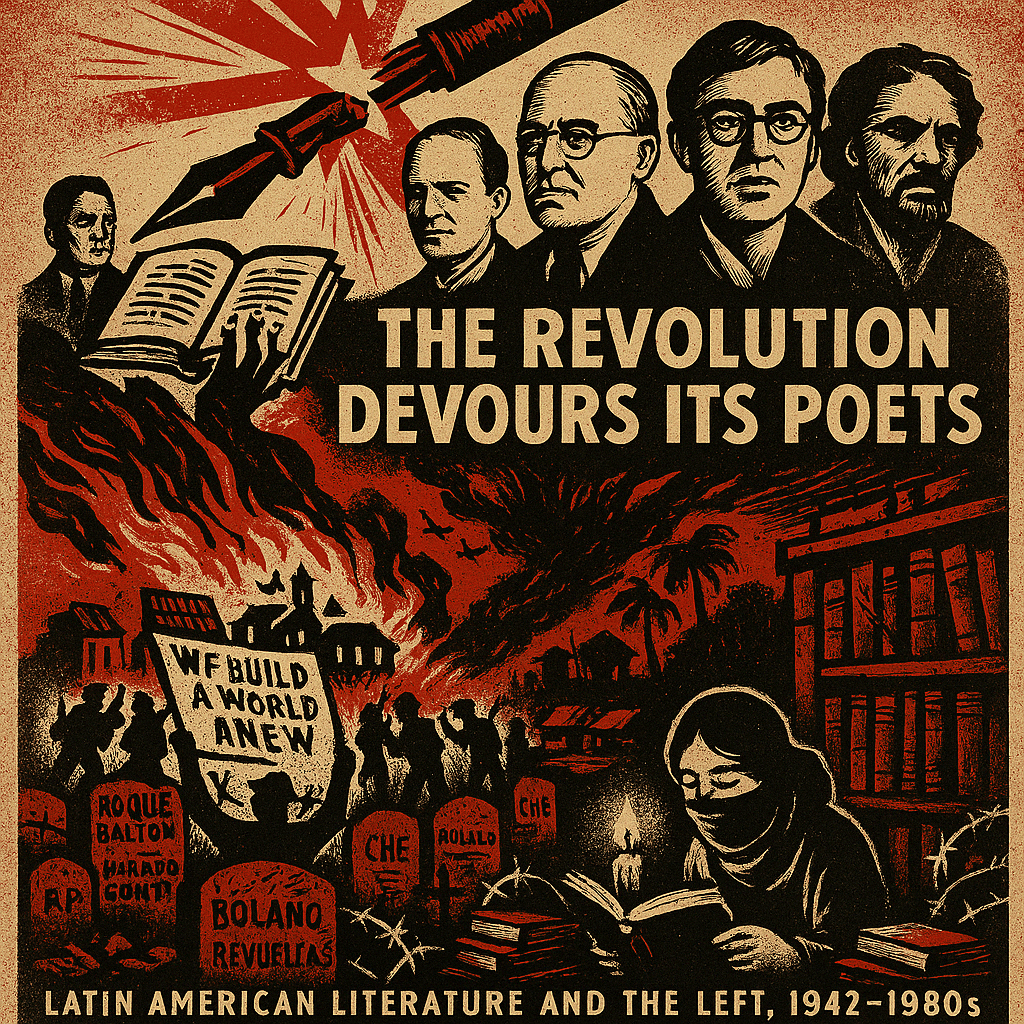
While Latin America’s literature has always been deeply political, the decades of leftist infighting, revolutionary violence, and U.S. interventions (1942–1980s) drastically reshaped the literary landscape. The idealistic revolutionary narratives of the early 20th century gave way to darker, more cynical literature, filled with disillusionment, exile, and horror at the left’s self-destruction.
Phase 1: Revolutionary Optimism (1940s–1950s)
During the early years of the Mexican Socialist Revolution (1942–1950) and other leftist uprisings, Latin American literature was filled with hope for a new socialist future.
Key Themes:
✔ Revolution as a force of liberation
✔ Peasants and workers rising against imperialism
✔ The heroic role of intellectuals in guiding the revolution
Notable Works and Figures:
- Pablo Neruda (Chile, pro-Soviet Communist) → His poetry, such as Canto General (1950), celebrated socialist revolution and anti-imperialism.
- Jorge Amado (Brazil, Communist Party member) → Wrote novels like The Violent Land (1943), portraying the struggles of workers and peasants against capitalist exploitation.
- José Revueltas (Mexico, Marxist intellectual, later Trotskyist) → The Hole (El Apando, 1969) depicted oppression under Mexico’s leftist regime but was still hopeful about revolutionary potential.
✍ This was the era when literature was an active tool of propaganda, used to inspire workers, students, and guerrillas.
Phase 2: The Left Eats Itself (1960s–1970s)
As Trotskyists, Stalinists, and Maoists turned on each other, literature changed dramatically. Revolutionary optimism faded, replaced by despair, violence, and exile.
Key Themes:
✔ Revolutions devouring their own children
✔ Political betrayals and ideological hypocrisy
✔ Leftist disillusionment and exile
Notable Works and Figures:
- Gabriel García Márquez (Colombia, former communist sympathizer) → One Hundred Years of Solitude (1967) symbolized the endless cycle of violence in Latin America—not just from imperialists, but also from the left’s own self-destruction.
- Mario Vargas Llosa (Peru, ex-leftist, later neoliberal) → Conversation in the Cathedral (1969) depicted leftist movements degenerating into dictatorship and paranoia.
- Roque Dalton (El Salvador, communist, later executed by his own party) → His poetry became darker before his own comrades in the People’s Revolutionary Army killed him in 1975, falsely accusing him of being a CIA spy.
- Carlos Fuentes (Mexico, disillusioned leftist) → The Death of Artemio Cruz (1962) showed how revolutionary heroes became corrupt, power-hungry leaders.
📚 This was the era when literature began to turn against the left itself, questioning the purity of revolutionary movements.
Phase 3: Exile, Horror, and the Literature of Terror (1970s–1980s)
By the 1970s and 1980s, most leftist intellectuals were dead, imprisoned, or in exile due to:
✔ CIA-backed right-wing coups (Pinochet in Chile, Videla in Argentina, etc.)
✔ Leftist purges within their own parties (Trotskyists vs. Stalinists vs. Maoists)
✔ Ongoing civil wars that destroyed universities and cultural institutions
Thus, literature became the voice of the exiled and the imprisoned, often depicting the horrors of torture, mass executions, and revolutionary betrayals.
Key Themes:
✔ The trauma of dictatorship (both left-wing and right-wing)
✔ The nightmare of exile and losing one’s country
✔ Political paranoia and the impossibility of trust
Notable Works and Figures:
- Isabel Allende (Chile, exile in Venezuela) → The House of the Spirits (1982) captured the terror of Pinochet’s dictatorship, while also criticizing the failures of the Chilean left.
- Eduardo Galeano (Uruguay, exile in Argentina, later Spain) → Open Veins of Latin America (1971) was a blistering critique of both U.S. imperialism and leftist failures.
- Roberto Bolaño (Chile, ex-Trotskyist, later anarchist) → By Night in Chile (2000) depicts a leftist poet who sells out to Pinochet’s regime, exposing how intellectuals betrayed their ideals.
- Haroldo Conti (Argentina, kidnapped and executed by right-wing forces in 1976) → His novels were suppressed by both leftist and right-wing governments, as he refused to pick a side.
📚 By this point, literature was no longer revolutionary—it was a graveyard of leftist dreams.
Final Impact: The Death and Rebirth of Latin American Literature
By the late 20th century, Latin American literature had been completely transformed by leftist wars.
What Changed?
✔ Revolutionary idealism disappeared—replaced by disillusionment, exile, and trauma.
✔ The dream of a perfect leftist utopia was gone, and literature became a critique of both capitalism and failed socialist revolutions.
✔ Writers no longer blindly supported Marxist parties—instead, they exposed how the left had betrayed itself.
What Survived?
✔ Some revolutionary themes lived on in movements like the Zapatistas, who inspired new literature about indigenous resistance and self-rule.
✔ Leftist literature evolved into critiques of power, authoritarianism, and corruption—whether capitalist or socialist.
📚 By the 2000s, Latin American literature no longer “belonged” to the left—it had become a voice of resistance against all forms of oppression.
 What If: The Archive
Leave a comment