
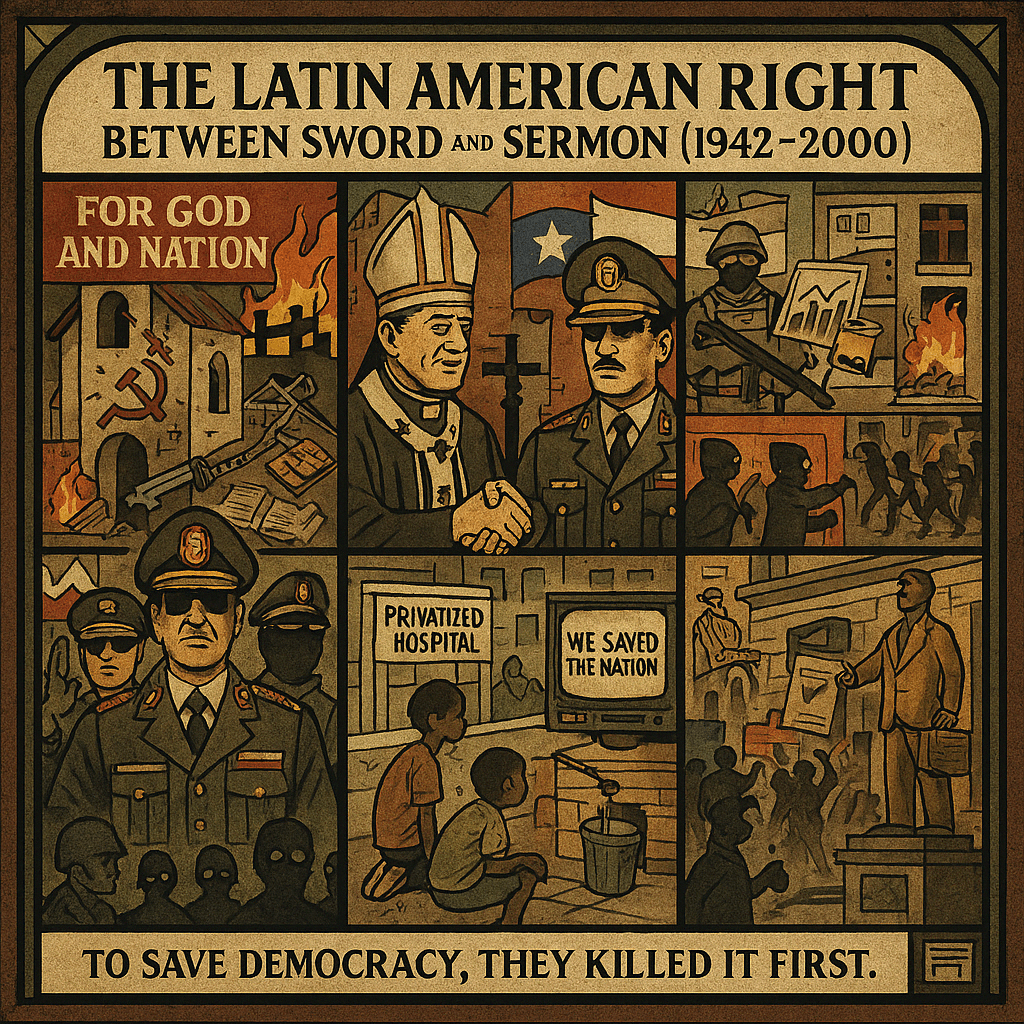
⚔️ Act I: The Right in Retreat (1942–1950s)
When Trotsky’s revolution exploded in Mexico in 1942, it shocked the entire Latin American conservative establishment. The traditional right—landed elites, conservative clergy, monarchists, military officers—had underestimated the revolutionary potential of the radical left.
1. Shock and Fragmentation
- In countries like Guatemala, Bolivia, and Argentina, conservative governments tried to ban leftist parties, but the spread of the Mexican Revolution radicalized their own peasants and workers.
- Some right-wing intellectuals fled abroad, especially from Mexico and Colombia, while others began building paramilitary networks to defend “Christian civilization.”
2. The Rise of “National Catholicism”
- In response, the right increasingly fused Catholicism with nationalism, creating a Latin version of Christian democracy—minus the democracy.
- Bishops and generals aligned to build a bulwark against “atheist Marxism”, especially after the Catholic Church in Mexico was nearly destroyed in the revolution.
🔴 The 1940s were an era of reactionary regrouping—a mixture of panic, moral fervor, and bitter memory of lands and power lost.
🪖 Act II: The Authoritarian Consolidation (1950s–1970s)
As the leftist wars spread and radical factions began killing each other, right-wing forces seized the opportunity to reclaim power—not as defenders of democracy, but as saviors of civilization.
1. The Birth of the Anti-Communist Security States
- From 1950 onward, U.S. intelligence agencies began building up right-wing regimes under the logic of the Cold War—but these were not mere puppets.
- Many military officers were ideologically committed anti-communists, educated in the School of the Americas, steeped in both counterinsurgency tactics and Catholic doctrine.
- Generals saw themselves as political surgeons, using torture, censorship, and terror to “cleanse the body politic.”
2. The Caudillo Revival
- Across the continent, right-wing leaders emerged as new caudillos (strongmen)—not in the populist mold of Perón, but as order-obsessed authoritarians.
- Chile: Pinochet (1973–1990), whose coup crushed leftist dreams, but instituted market reforms.
- Argentina: General Videla’s Junta (1976–1983), which killed Trotskyists and Maoists alike.
- Colombia: A patchwork of military-corporate regimes, which alternated between legal authoritarianism and shadow warfare.
- These regimes often used the left’s own chaos as justification, presenting themselves as the last defense against total collapse.
3. Technocrats and the Chicago Boys
- Some right-wing regimes turned to neoliberal economists trained in the U.S., particularly Chile and Brazil.
- These “technocrats” argued that free markets, not bullets, would defeat socialism—leading to the neoliberal experiments of the 1970s–80s.
- However, the right often relied on terror to enforce these reforms, creating a hybrid system of economic liberalism and political repression.
🔴 This wasn’t “capitalism vs. communism”—it was authoritarianism vs. chaos, with capitalists riding shotgun.
👔 Act III: The Right Turns Democratic… Mostly (1980s–2000)
By the 1980s, the revolutionary left was shattered. And with the Soviet collapse approaching, the U.S. and local elites began to promote a managed transition to “democracy”—but not without preserving the economic and institutional legacies of authoritarianism.
1. The Transition Governments
- In countries like Chile, Brazil, and Argentina, the military allowed elections only after ensuring their power would remain intact.
- Amnesty laws protected generals.
- Conservative economic policies remained, often embedded in constitutions.
- Right-wing parties rebranded as “center-right,” pushing Christian democracy, neoliberalism, and family values.
2. The Rise of Neoliberal Civilian Elites
- New right-wing power brokers emerged: bankers, media moguls, U.S.-aligned NGOs, and Silicon Valley-style entrepreneurs.
- These actors replaced generals with economists, promising “freedom through markets”—but in practice, created mass inequality, privatization, and weakened labor protections.
- They often co-opted anti-leftist rhetoric, blaming the poverty and dysfunction of the 1980s on “decades of leftist war”, rather than on their own austerity regimes.
3. The Anti-Left Populists
- In rural areas and conservative strongholds, new figures arose who blended right-wing economics with authoritarian nostalgia.
- These were proto-Trumps and proto-Bolsonaros, railing against cultural decay, leftist degeneracy, and international conspiracies.
🔴 By the end of the century, the Latin American Right had reinvented itself—not as generals, but as “anti-leftist democrats” who ruled in suits instead of uniforms.
📊 The Moral Economy of the Right: Myth, Memory, and Power
To truly understand the Right in this timeline, we must look beyond policies and coups—and into the stories they told about themselves.
The Narrative of the Right
“The left wanted a perfect world. They gave us mass graves. We saved what could be saved.”
- This narrative justified everything: the coups, the torture, the neoliberal turn.
- The Right portrayed itself as the parent who disciplines a violent child: harsh, but necessary.
The Memory Wars
- In schoolbooks and TV dramas, the Right painted itself as the guardian of civilization.
- Memorials to leftist victims were opposed or defaced.
- Truth commissions were blocked or silenced.
🔴 By 2000, many Latin Americans believed the Right had “saved them from communism”—even if it meant living under dictatorship or crushing poverty.
🔚 The Irony of Victory
The Latin American Right survived. It adapted. It liberalized—on its own terms.
But in doing so, it absorbed some of the left’s own contradictions:
- It promised order but fostered massive inequality.
- It claimed to protect tradition while privatizing everything sacred.
- It killed to save democracy, then ruled without democratic legitimacy.
In the end, the Right didn’t win—it outlasted.
 What If: The Archive
Leave a comment