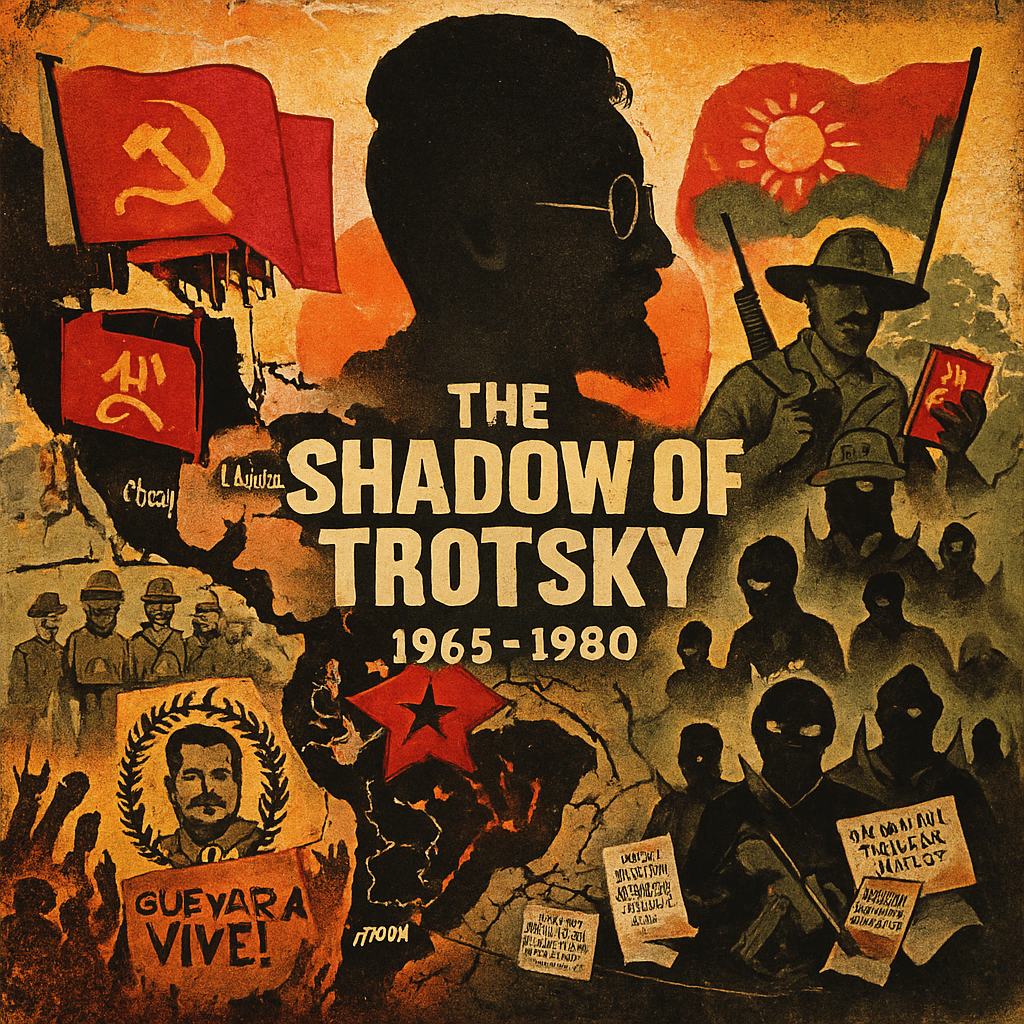
By the mid-1960s, Latin America had become the primary Cold War battleground for socialist revolution, influenced by three competing leftist factions:
- Soviet-backed Marxist-Leninists, loyal to Moscow and seeking to establish communist states aligned with the USSR.
- Trotskyist revolutionaries, inspired by the Mexican Workers’ and Peasants’ Republic (1942–1950), advocating permanent revolution and workers’ democracy.
- Maoist insurgents, supported by China as an alternative to Soviet influence, focusing on rural guerrilla warfare and peasant uprisings.
As the United States escalated its intervention in Vietnam, it also intensified its covert operations in Latin America, determined to prevent another Trotskyist Mexico or a Maoist China in the Western Hemisphere. Meanwhile, the Soviet Union and China competed for dominance over the Latin American left.
By 1980, the region was engulfed in an ideological war that shaped the future of socialism worldwide.
1965–1970: The Latin American Left Divides
The Second Mexican Revolution’s Aftermath: Who Owns Trotsky’s Legacy?
After the U.S. withdrawal from Mexico (1960) and the establishment of the Third Mexican Republic, leftist groups fractured:
- The Soviet-backed Communist Party of Mexico (PCM) attempted to seize control of leftist movements, aligning with Moscow’s state-controlled socialism.
- The Trotskyist “Mexican Liberation Front” (FLM), which had led the guerrilla war against the U.S. junta, refused to submit to Soviet influence, continuing an underground struggle for worker-led socialism.
- Maoist factions, influenced by China, called for a new rural-based revolution, branding both the PCM and FLM as “bourgeois intellectuals” detached from the peasants.
This rivalry spread across all of Latin America as revolutions flared in multiple countries.
The Cuban Split: Trotskyism vs. Stalinism in the Caribbean
Cuba’s 1959 revolution, led by Fidel Castro and Che Guevara, had originally been inspired by Trotskyist ideas, especially permanent revolution and international guerrilla struggle.
However, by 1965, Cuba was firmly in the Soviet camp, as Castro aligned with Moscow for military and economic support.
This led to a major split within the Cuban left:
- Guevara’s Vision (Trotskyist Influence): Che Guevara rejected the Soviet model of bureaucratic socialism and called for “permanent revolution” across Latin America.
- Castro’s Realpolitik (Soviet Influence): Castro, needing Soviet aid to counter the U.S. embargo, abandoned Guevara’s vision and purged Trotskyists from the Cuban government.
- Guevara’s Death and Martyrdom (1967): Guevara attempted to spread revolution to Bolivia, where he was captured and executed with CIA assistance. His death turned him into a martyr for Trotskyists worldwide, fueling leftist insurgencies from Argentina to Chile.
The Cuban government, despite officially supporting revolution, became a tool of Soviet policy—hunting down Trotskyists while training Soviet-backed guerrillas across Latin America.
1970–1975: The Latin American Wars of Revolution
The “Trotskyist Wave” in Latin America
After Che Guevara’s death in 1967, Trotskyist movements gained traction across Latin America, challenging both U.S.-backed regimes and Soviet-supported communist parties.
1. The Argentinian Socialist Uprising (1970–1974)
- Inspired by Trotskyist Mexico and Guevara’s writings, workers in Buenos Aires launched a mass general strike in 1970, demanding direct worker control of industry.
- By 1972, the uprising escalated into a full-scale revolution, led by the Workers’ Vanguard (Vanguardia Obrera)—a Trotskyist coalition.
- The Soviet-backed Communist Party of Argentina refused to support the rebellion, fearing an independent socialist state outside Moscow’s control.
- The U.S. and Argentina’s right-wing military cracked down violently, launching Operation Condor (1973–1974)—a CIA-backed campaign of assassinations and disappearances targeting Trotskyist leaders.
- By 1974, the revolution was crushed, but Trotskyist cells survived, waging an underground war into the 1980s.
2. The Maoist Counter-Revolution: The Rise of the Shining Path (1972–1975)
- In Peru, the Maoist-inspired Shining Path (Sendero Luminoso) launched a brutal peasant insurgency, claiming that both Trotskyists and Soviet-backed Marxists had betrayed the revolution.
- China covertly supplied weapons and advisors, seeing the conflict as a proxy war against Soviet influence in Latin America.
- The Shining Path targeted not only government forces but also Trotskyist activists and Soviet-backed communists, escalating into a three-way civil war between Maoists, Trotskyists, and the Peruvian government.
By 1975, Latin America was a battlefield where Trotskyists, Maoists, and Soviet communists all fought against the U.S. and each other.
1975–1980: The Global Leftist Struggle Intensifies
By the late 1970s, Trotskyist movements had spread beyond Latin America, influencing leftist factions in Europe, Africa, and Asia.
Europe: The “Trotskyist Spring” (1975–1980)
- The 1973 oil crisis caused economic turmoil in Western Europe, fueling a wave of Trotskyist-led labor strikes and protests in France, Italy, and Spain.
- Trotskyist factions in the UK and France became the primary opponents of Moscow-backed Communist Parties, accusing them of betraying socialism by supporting Soviet authoritarianism.
- In Portugal (1975), after the Carnation Revolution, Trotskyist and Maoist factions battled Soviet-aligned communists for control of the country’s future—a fight that ended with a moderate socialist victory.
The Sino-Soviet Split Reaches Africa and Asia
- In Africa, Trotskyist and Maoist guerrillas fought over the legacy of post-colonial socialist movements, particularly in Angola and Mozambique, where China and the USSR backed rival factions.
- In Southeast Asia, Maoist insurgents in Thailand and the Philippines began rejecting Soviet influence, aligning more with China.
By 1980: The Global Leftist World at a Crossroads
By 1980, the battle for socialism had shattered into multiple competing factions:
- Soviet-backed communists controlled governments in Cuba, Nicaragua, and parts of Africa and Asia but were seen as authoritarian puppets of Moscow.
- Trotskyist movements survived underground in Mexico, Argentina, and Europe, continuing to challenge both U.S. imperialism and Soviet bureaucracy.
- Maoist factions gained influence in rural Latin America, Africa, and Southeast Asia, challenging both Soviet and Trotskyist factions.
- The United States remained deeply involved, funding death squads, right-wing dictatorships, and anti-communist paramilitaries.
 What If: The Archive
Leave a comment