
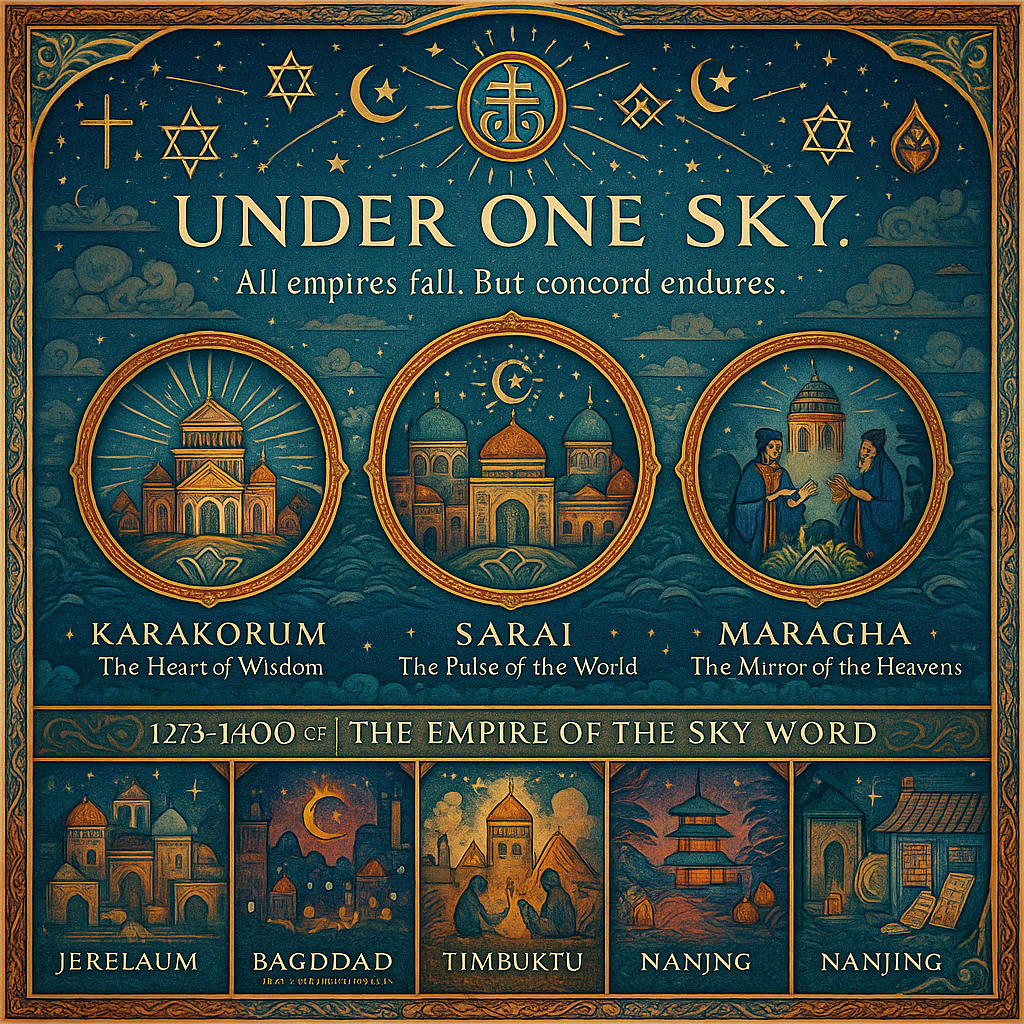
📜 “The empire that did not conquer the world, but instead wove it together.”
—Attributed to Mar Isho-Malkun II, Arch-Historian of Karakorum, c. 1350 CE
🌏 I. The Empire of the Sky Word (1273–1400 CE)
In the wake of the Pact of Eternal Concord, the Mongol Empire of the Sky Word becomes the first truly multi-civilizational sacred federation in history. Rather than fracture under its diversity, it finds strength in it—creating systems that allow regional autonomy, religious pluralism, and shared governance under the moral framework of the Living Law.
Pillars of Empire:
- Karakorum serves as the spiritual and legal capital, home to the Grand Archives, the House of Wisdom Reborn, and a new court of pan-religious arbitration.
- Sarai evolves into a commercial metropolis, connecting East and West through the Silk Road, with Muslim guilds, Jewish banks, and Christian trading houses side by side.
- Maragha, once a war camp, becomes the philosophical heart of the empire, where scholars debate metaphysics in ten languages.
The Trinity of Crowns continues for over a century—Khagan, Chancellor, and Keeper of Concord—selected through council, not birthright. Women occasionally serve as Keepers of Concord, especially among the Buddhist and Nestorian communities of Central Asia.
✝️ II. Faith Without Sword
By the 1300s, Christianity in this world is no longer defined by Rome or Byzantium, but by Karakorum.
- The Church of the East blossoms into a global communion, with bishoprics stretching from Xi’an to Novgorod, Delhi to Venice.
- The Nestorian theology of the Sky-Born Word becomes a unifying spiritual grammar, allowing Christians to adapt to local traditions without surrendering core doctrine.
- A “Sutra of the Logos” is compiled in China, blending Gospel parables with Confucian ethics.
- In Africa, a Mongol-backed mission reaches Abyssinia, leading to the Union of the Three Crowns: the Ethiopian monarchy, the Mongol khaganate, and the Church of the East.
Importantly, forced conversion ends altogether. The Mongols, long past their days of conquest, adopt a policy of “Faith by Reason, not Fire.”
🕌 III. Islam in the New Order
After the failed revolts and the establishment of the Imamate of Mecca, Islam finds a secure, though modified, place in the empire.
- Sunni and Shi’a courts operate under the Pillars of the Law, a parallel legal system harmonized with imperial codes.
- Islamic theology adapts: Mongol-influenced Sufi orders speak of the Sky Path (Tariqat al-Sama), drawing from Tengrist cosmology.
- Baghdad recovers—rebuilt as the City of Three Books, home to madrasas, yeshivas, and monasteries.
The Caliphate never regains political power—but in this world, Islamic culture remains vibrant, poetic, and globally engaged, rather than militarized.
🕍 IV. Judaism and the Covenant of Law
The Mongol system gives Jewish communities unprecedented stability. Recognized early on for their linguistic and financial acumen, Jews hold positions in imperial courts, diplomacy, and science.
- The Karakorum Talmud becomes a central text—a commentary tradition that blends Babylonian and Eastern ideas.
- Jewish academies flourish in Tiflis, Kiev, and Merv.
- The empire officially recognizes Judaism as “the Law of the Elder Covenant,” placing it on equal footing with other traditions.
Zionism never emerges—because Jerusalem is already shared. Jews govern their own quarter, and the Temple Mount is a House of Concord, open to all faiths.
📚 V. The World Beyond: Europe, Africa, and the East
Europe:
- The Latin Church, weakened by failed crusades and internal schism, undergoes reform.
- The Franco-Mongol Concordat of 1310 brings France into trade and cultural alliance with the Empire of the Sky Word.
- England and Italy remain suspicious—but Latin theology begins borrowing from Karakorum’s pluralist models.
Africa:
- Timbuktu becomes a major trade and learning hub under Mongol-African diplomatic patronage.
- Christianity spreads across the Sahel via commerce and law, not missionaries.
The Far East:
- The Song Dynasty, inspired by Mongol tolerance and infrastructure, survives well into the 14th century.
- Nestorian Christianity becomes one strand of East Asian metaphysics, alongside Chan Buddhism and Taoism.
- A great syncretic text—The Scroll of the Three Harmonies—emerges in Nanjing, authored by a Christian-Taoist monk.
🧭 VI. The Mongol Legacy: A Different Age of Discovery
By 1400, the world is not yet “modern”—but it is connected in ways unimaginable in our timeline.
- The Silk Road is a sacred artery, protected by law and guarded by interfaith patrols.
- A new maritime fleet sails from Guangzhou to Zanzibar, captained by Mongol-Christian, Chinese-Muslim, and Indian-Jewish crews.
- Early experiments in clockwork, cartography, and optics spread from the House of the Three Horizons to every known continent.
And crucially—colonialism, as we know it, never emerges. Why conquer, when one can join the Concord?
🌌 Final Reflection:
The Christianized Mongol Empire never ruled every land.
But it ruled the imagination of an age.
By turning the chaos of conquest into the law of compassion, and the hunger for dominion into a hunger for truth, it carved out an era in which civilization did not mean sameness, but sacred coexistence.
Under its sky, no one faith reigned.
Instead, faith itself was elevated, housed in a common architecture of justice, wonder, and the written word.
And long after the Khagans passed into legend, the archives of Karakorum whispered:
“All empires fall. But concord endures.”
 What If: The Archive
Leave a comment