
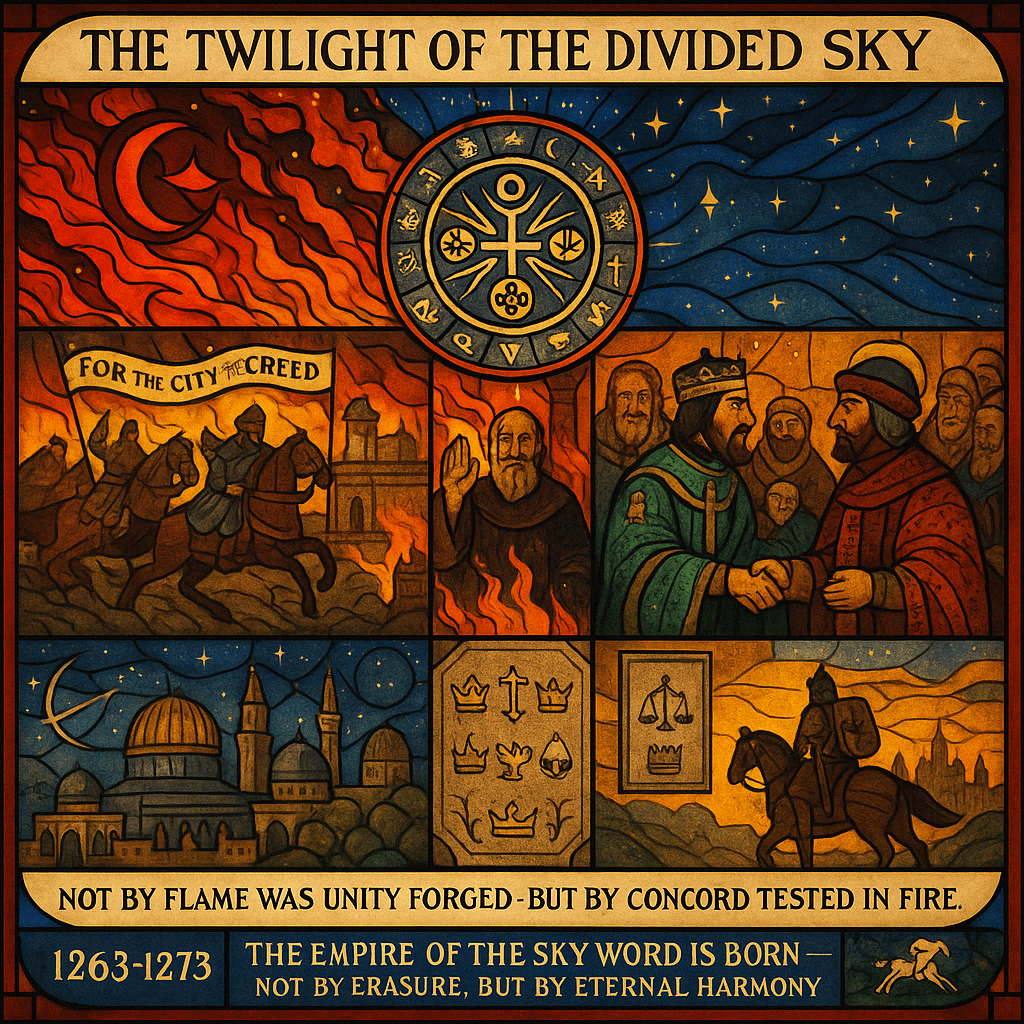
The Mongol Christian Empire is vast, rich, and intellectually brilliant—but also strained. The two Khagans—Möngke-Kyrillos in Karakorum and Berke-Yohannan in Sarai—rule in concert, but friction between ideologies and generations begins to widen the fault lines.
The pluralist vision of the Council of Samarkand is now both praised as divine genius and condemned as spiritual compromise.
It is in this context that a final series of conflicts erupt—what will later be called the Conflagration of the Four Winds.
Key Developments, 1263–1273
⚔️ 1. The Revolt of the Red Crescent (1263–1268)
Background
In the aftermath of the Baghdad settlement, a new movement arises from the remnants of Sunni jurists, Sufi mystics, and disillusioned Muslim bureaucrats. They unite behind a charismatic leader:
Abd al-Rahman al-Tiflisi, a Georgian-born convert to Islam, trained in Mongol schools but embittered by what he calls “the chaining of the Quran under a foreign cross.”
He proclaims himself al-Mujaddid, the Renewer, and launches a jihad—not against Christianity, but against imperial syncretism.
The War
- In 1265, he seizes Mosul, Basra, and parts of northern Syria, rallying support from Mamluks in Egypt and Seljuk holdouts.
- He gains a key victory at the Battle of the Upper Zab (1266), defeating a combined Christian-Muslim Mongol army.
- Christian Nestorians are massacred in occupied cities. The House of the Word in Baghdad is burned.
Karakorum and Sarai both respond, but with different aims:
- Möngke-Kyrillos declares a Sacred Campaign, aiming to crush heresy and restore doctrinal supremacy.
- Berke-Yohannan argues for negotiation and autonomy.
Their armies converge in Aleppo (1268)—where they both win and lose.
🕊️ 2. The Aleppo Accord (1268): The Near-Breaking Point
The Siege of Aleppo ends in stalemate. Both Khagans realize their forces are exhausted, their generals mutinous, and their peoples disillusioned. To avoid civil war, they agree to terms with the Red Crescent faction.
Terms:
- The Islamic regions from Mecca to Mosul are granted religious autonomy under a new Protectorate of the Faithful, ruled by a vassal Imamate, loyal to the Khagan but governed by Shari’a.
- Christian law is restricted to Christian regions.
- The Nestorian mission is declared complete—it may not expand further by state means.
To many theologians, this is heresy-by-treaty.
To the empire’s merchants and diplomats, it is salvation.
🏰 3. The Latin Storm: The Ninth Crusade (1270)
Seeing Mongol weakness, Pope Clement IV calls the Ninth Crusade to “liberate” Jerusalem and “cleanse Karakorum of heresies.” French and English nobles—led by Prince Edward of England (later Edward I)—sail for the Levant.
Key Events:
- Crusaders land in Acre, joined by Red Crescent defectors. They take Damascus and prepare for a push into Mesopotamia.
- In 1271, they reach Jerusalem, which is under joint Christian-Muslim rule by Mongol decree.
Their sacking of the city—including the desecration of a Nestorian monastery—shocks even other Catholics, and provokes imperial outrage.
The Response:
- Möngke-Kyrillos, now aging but still imposing, declares a “War of the Crossed Cross”.
- For the first time, the two Khagans fight together—not as rivals, but as brothers.
- At the Battle of Homs (1272), the Latin crusaders are annihilated by a combined Mongol-Christian, Persian-Muslim, and Jewish auxiliary army.
The last Crusade ends not in glory, but in humiliation, with Edward captured and ransomed.
🔥 4. The Purge of the Fanatics: Internal Cleansing (1270–1273)
With external enemies broken, the final challenge comes from within.
The Purist Revolt
- A faction of Nestorian fundamentalists in Karakorum demands the reversal of the Samarkand Compromise.
- They assassinate a prominent Jewish astronomer and torch the House of Translation in Beshbalik.
Kyrillos orders a brutal suppression—executing over 200 clergy and scholars involved.
He delivers a famous speech at the rebuilt Cathedral of the Sky Word:
“The empire was not made by one creed—but by the breath of many. Let no man make a god so narrow that it cannot ride with the wind.”
This moment marks the final end of exclusivist theocracy in the Mongol world.
🌈 5. The Proclamation of Eternal Concord (1273): Final Unity
In the autumn of 1273, both Khagans, aged and weary, meet once more in Maragha.
There, they sign the Pact of Eternal Concord, unifying the twin thrones once and for all:
- The Khaganate will be governed by a Trinity of Crowns:
- The High Khagan (spiritual & imperial)
- The Chancellor of Laws (civil & trade governance)
- The Keeper of Concord (faith mediator between religions)
- The Faith of the Sky Word is enshrined as the state’s guiding vision—not a single religion, but a cosmic covenant of traditions, each honored, none imposed.
- Jerusalem is declared a City of Concord, under joint administration by Christians, Muslims, and Jews, supervised by imperial magistrates.
The Empire of the Sky Word is born.
Summary of 1263–1273: Crisis as Purification, Unity as Choice
After a decade of flame, the Mongol Christian Empire is reborn—not as a single church, but as a spiritual commonwealth.
- Its pluralism is no longer a fragile dream, but a hardened, tested reality.
- Its rulers are no longer warlords with chaplains—but philosophers on horseback.
- Its capital, Karakorum, becomes a new kind of sacred city—not the throne of orthodoxy, but the archive of Earth’s wisdom.
The final unity has come—not by erasing differences, but by weaving them into law, liturgy, and life.
 What If: The Archive
Leave a comment