
The death of Genghis Khan David in 1223 creates an uneasy moment in Mongol politics. But thanks to his spiritual reforms, succession is no longer purely a matter of clan strength—it is a semi-divine inheritance. His son Ögedei, baptized as Elias, ascends with the backing of the Church of the East and the support of reformist generals.
The new Khan continues his father’s legacy, but with a shift in tone: from evangelical integration to administrative perfection. His reign becomes the golden age of the “Pax Steppe-Christiana.”
🏛️ 1. The Heavenly Bureaucracy: Karakorum Ascendant (1224–1227)
- Ögedei reorganizes the imperial administration into four regional dioceses, each overseen by a Nestorian archbishop who functions as both governor and high judge.
- These include:
- Turkestan (Bukhara-Samarkand)
- Cathay (northern China)
- Irania (Persian plateau)
- Sibir (southern Siberia and Central Steppe)
- A Council of Regents, half military, half ecclesiastical, is established in Karakorum. It features a mix of generals, clergy, and foreign scholars—including Byzantine Greek engineers and Armenian theologians.
- Construction begins on the Great Basilica of the Steppe, an architectural marvel blending Mongol, Syriac, and Chinese styles, built to house relics and state rituals.
- A universal currency, the Cross-Stamped Dirham, is introduced in 1226, facilitating trade across Eurasia and further aligning economic life with Christian symbolism.
🕯️ 2. Missions and Movements: Toward the West and South
Crusaders and Mongols: The Treaty of Antioch (1225)
- Antioch, under pressure from Muslim neighbors, seeks aid. In a stunning reversal of history, Mongol envoys arrive bearing not threats, but Christian fraternal greetings.
- A treaty is signed: the Principality of Antioch becomes a vassal of the Mongol Empire in exchange for military protection and theological parity.
- Mongol cavalry begin appearing near the Levant—not as invaders, but as defenders of a fragile Christian order.
Rome and Karakorum: An Uneasy Dance
- Pope Honorius III dies in 1227; Gregory IX succeeds him with a more aggressive vision of papal authority.
- He denounces Nestorianism as heresy, yet is cautious: the Mongol Empire is now the largest Christian polity on Earth.
- Dominican emissaries are sent to Karakorum to debate doctrine. While no agreement is reached, letters are exchanged between Gregory IX and Ögedei, marking the first formal Mongol–Latin Christian diplomatic link.
The Subtle South: Missions to India and Tibet
- Nestorian missionaries travel beyond the empire’s borders into Kerala, Gujarat, and Tibetan highlands.
- They bring not only scripture, but steppe mathematics, astronomical knowledge, and Mongol-backed trade networks.
- In 1228, a Nestorian bishopric is founded in Calicut, creating the first stable Christian administrative presence in southern India since antiquity.
⚔️ 3. The Crescent Reacts: War with the Abbasid Caliphate (1227–1232)
The Abbasids, increasingly threatened by the encroaching Christianized Mongol presence, attempt to unite Sunni powers against the rising theocracy.
Baghdad’s Provocation
- In 1227, the Caliph al-Nasir declares the Jihad of Preservation, accusing the Mongols of seducing Muslim scholars and corrupting Persia.
- Mongol traders are killed in Rayy and Hamadan, and Nestorian churches are burned.
Mongol Response – The Sacred March (1228–1231)
- Ögedei-Elias responds with methodical force:
- His generals do not sack cities, but remove local rulers and install Christian-Muslim joint councils.
- Nestorian clergy accompany armies not to convert by force, but to mediate disputes and ensure safe passage for all “People of the Book.”
- The campaign culminates in the Battle of Nahavand (1231):
- A combined force of Mongol cavalry and Christian-Muslim auxiliary troops routs the Abbasid army.
- Baghdad is spared—but forced to sign the Treaty of the Two Books: Islam remains free, but the city must host a Nestorian archbishop and pay tribute.
🌏 4. Knowledge without Borders: The Academy of Merv (1232)
- With peace in Persia, Ögedei founds a royal academy in Merv, bringing together:
- Nestorian theologians from Mesopotamia
- Confucian scholars from Zhongdu (northern China)
- Muslim physicians from Nishapur
- Jewish merchants and linguists from Khazaria
- The Academy publishes multi-script codices, creates the first known comparative grammar of Semitic and Altaic languages, and begins work on an encyclopedia of world religions, the Liber Concordiae.
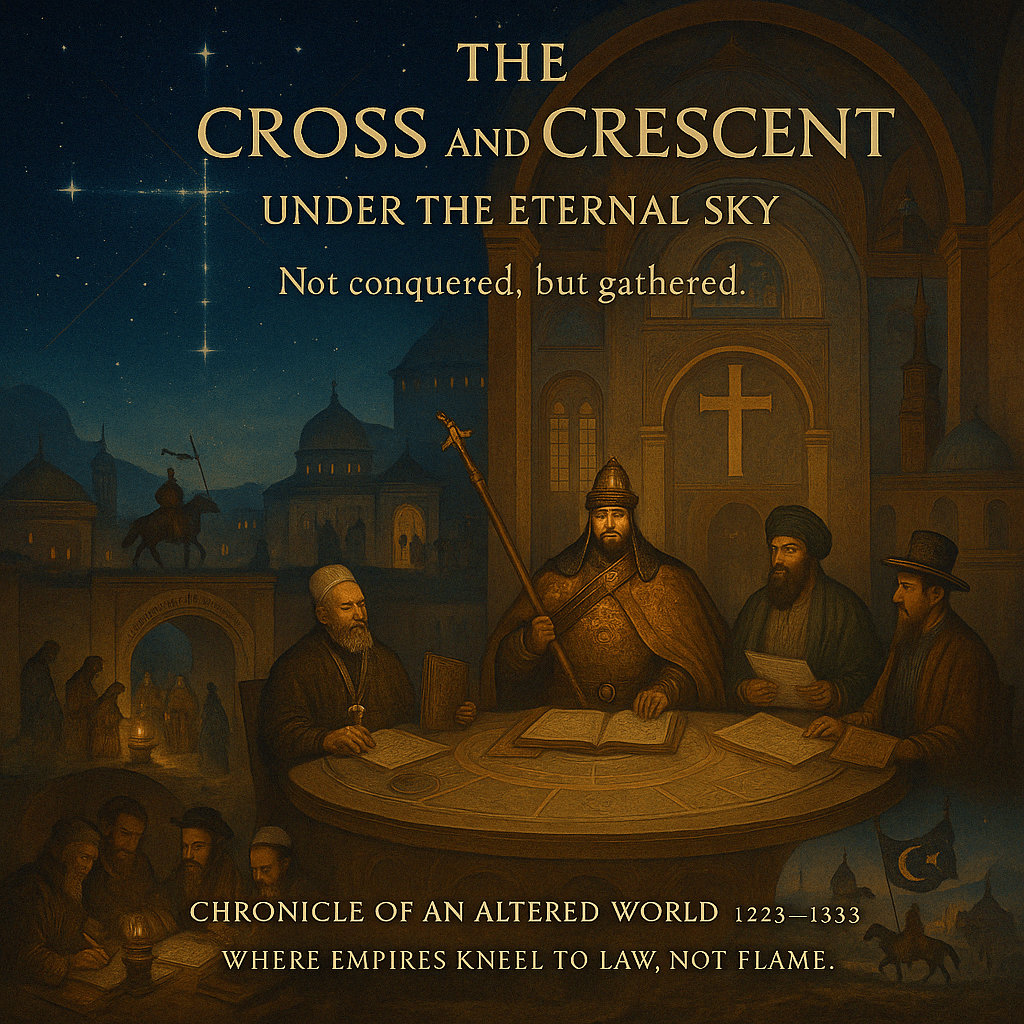
Summary of 1223–1233: “The Cross and the Crescent under the Eternal Sky”
This decade sees the Mongol Empire not just hold its gains, but become a philosophical and spiritual axis of Eurasia. Under Ögedei-Elias, it projects power not by fire but by faith, law, and infrastructure.
It absorbs, rather than annihilates.
It evangelizes not by compulsion, but by cultural prestige.
It brings the Christian world and the Islamic world into direct, dangerous, and astonishing dialogue—not through the sword alone, but through scholarship, diplomacy, and trade.
 What If: The Archive
Leave a comment