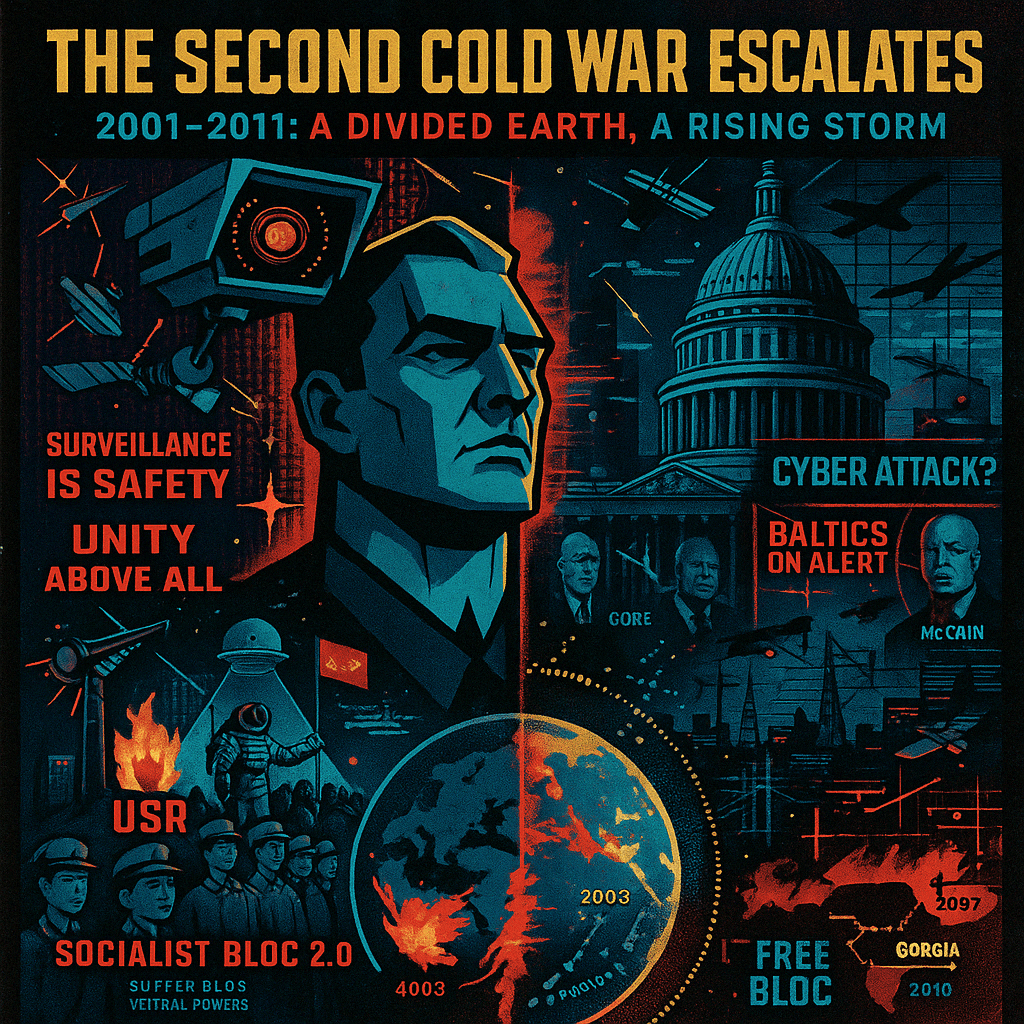
“The Second Cold War Escalates”
🟥 Union of Soviet Socialist Republics (USSR)
By 2001, Ivan Gromov had ruled the USSR for nearly a decade. His grip was absolute. Surveillance had become seamless. Censorship airtight. His cult of personality now rivaled Stalin’s in its reach and intensity.
The economy had stabilized—but remained stagnant, heavily militarized, and deeply unequal.
🔧 Domestic Developments
• Expansion of the SOVNET Surveillance State (2001–2005):
- The VUGB launched “Project ZENIT”, the Soviet Union’s answer to Silicon Valley.
- SOVNET (Soviet intranet) evolved into SOVNET-2, a closed digital ecosystem used for internal commerce, education, and surveillance.
- Every citizen was assigned a Personal Ideological File (PIF), updated via school performance, workplace loyalty, and online behavior.
• Military Urbanization & “Model Cities” (2003–2009):
- New industrial cities were built in the Urals and Siberia, each dedicated to a branch of the military-industrial complex: aerospace, naval engineering, advanced ballistics.
- Urban youth were relocated en masse to staff these centers under the “Builder Generation” campaign.
- They were promised benefits—apartments, vehicles, even ration perks—but subjected to near-military discipline.
• The Gromov Constitution (2006):
- Declared “Socialist Unity Above All.”
- Gave Gromov the title of “President of the Supreme Union for Life.”
- Made the Communist Party the only legal political force in perpetuity.
- Removed republic autonomy entirely. The USSR became a hyper-centralized union state with 27 administrative zones.
⚙️ Economic & Scientific Development
- GDP remained flat, but defense spending grew to 40% of the total budget.
- Artificial intelligence research was folded into military planning bureaus. Voice analysis and predictive behavior modeling became standard VUGB tools.
- Soviet scientists made breakthroughs in hypersonic missiles, cyberwarfare, and hardened communications tech.
- Civilian life, however, stagnated. Consumer goods were dated and scarce. Emigration was impossible. Life expectancy began to fall.
🗺️ Global Developments
🇺🇸 United States of America: From Dominance to Distraction
The U.S., under Presidents Al Gore (2001–2005) and John McCain (2005–2013), took increasingly aggressive stances toward the USSR.
• 2001 Baltic Defense Treaty
- Gore signed a fast-track defense pact with the Baltic states, stopping short of NATO membership to avoid escalation.
- U.S. military advisors deployed to Estonia and Latvia, training new border forces.
• 9/11 Still Happens… but is Interpreted Differently
- In this timeline, the September 11 attacks occur—but the Gromov regime publicly blames American imperialism and refuses to condemn al-Qaeda.
- Soviet intelligence is known to share signals intel with Iran during early U.S. operations in Afghanistan.
• New Arms Race (2004–2011):
- The U.S. and USSR restart full-scale strategic weapons competition:
- U.S. develops orbital surveillance drones and cyber command networks.
- USSR launches the “Vozmezdiye” project, building new mobile ICBMs and EMP weapons.
• Cyber Front Opens (2008–2011):
- The Soviet VUGB hacks U.S. government servers and defense contractors.
- In 2010, the Baltimore Power Grid Failure is quietly blamed on a Soviet cyberattack—publicly labeled a “technical anomaly.”
🇨🇳 People’s Republic of China: A Cold Balancer
China under Hu Jintao plays both sides, carefully.
- Pursues economic ties with the U.S., but shares intelligence with the USSR to pressure the West.
- By 2005, China and the USSR sign the Tashkent Neutrality Agreement, pledging not to interfere in each other’s spheres of influence.
- China begins to militarize the South China Sea, while the USSR expands its naval reach in the Arctic and North Atlantic.
🌍 Eastern Europe and the “Iron Fringe”
- Poland, Czech Republic, and Romania push hard for NATO inclusion—but the U.S. and Germany hesitate, fearing Soviet escalation.
- Slovakia, Moldova, and Bulgaria are pulled into the Soviet orbit via energy dependency and pro-Gromov propaganda.
- In 2008, “Unity Parties” (Gromov-aligned socialist-nationalist groups) take power in Hungary and Serbia, triggering EU sanctions.
- A “Cold Curtain” emerges along the Carpathians, separating the Free European Zone (Germany westward) from the Buffer Bloc (pro-Soviet or neutral nations).
🗽 The Non-Aligned & the Reborn Left
- Latin America experiences a leftist revival:
- Venezuela, Bolivia, and Ecuador form the “People’s Alliance for the South”, openly supported by Cuba and the USSR.
- Soviet arms shipments reach Caracas by 2006.
- In Africa, the USSR supports anti-Western regimes in Sudan, Zimbabwe, and the DRC.
- Left-wing student movements reemerge globally, many unknowingly backed by the VUGB’s overseas psychological operations unit.
🚀 Space Race II Begins
- 2004: USSR launches Vostok-Next, a manned lunar program designed to “correct the betrayal of Khrushchev’s cowardice.”
- 2007: U.S. announces “Pathfinder Mars”, a public-private crewed mission plan.
- 2009: Soviet cosmonauts land on the moon again. Gromov broadcasts the landing live to every school in the USSR.
🔥 Key Flashpoints of the Decade
| Year | Event | Description |
|---|---|---|
| 2001 | Baltic Treaty Signed | U.S. commitment to defend Estonia, Latvia, Lithuania. USSR responds with troop movements. |
| 2003 | Second Ukrainian Uprising | Crushed within days by Soviet-backed special forces. Thousands arrested. |
| 2005 | Arctic Incident | Soviet and U.S. submarines collide near Svalbard. Tensions near boiling point. |
| 2007 | Serbia Unity Coup | Pro-Gromov military officers seize power in Belgrade. U.S. refuses to intervene. |
| 2010 | Baltimore Grid Blackout | First public Soviet cyberattack on U.S. infrastructure. Official cause unreported. |
📈 By 2011: The World in Two Camps Again
| Camp | Members | Characteristics |
|---|---|---|
| Free Bloc (Democracies) | U.S., UK, France, Germany, Japan, Baltics | Economically powerful but divided, struggling to counter Soviet subversion |
| Socialist Bloc 2.0 | USSR, North Korea, Cuba, Belarus, Venezuela, Syria | Ideologically unified, state-controlled economies, heavily militarized |
| Neutral Powers | China, India, Brazil | Playing both sides, increasingly influential |
 What If: The Archive
Leave a comment