
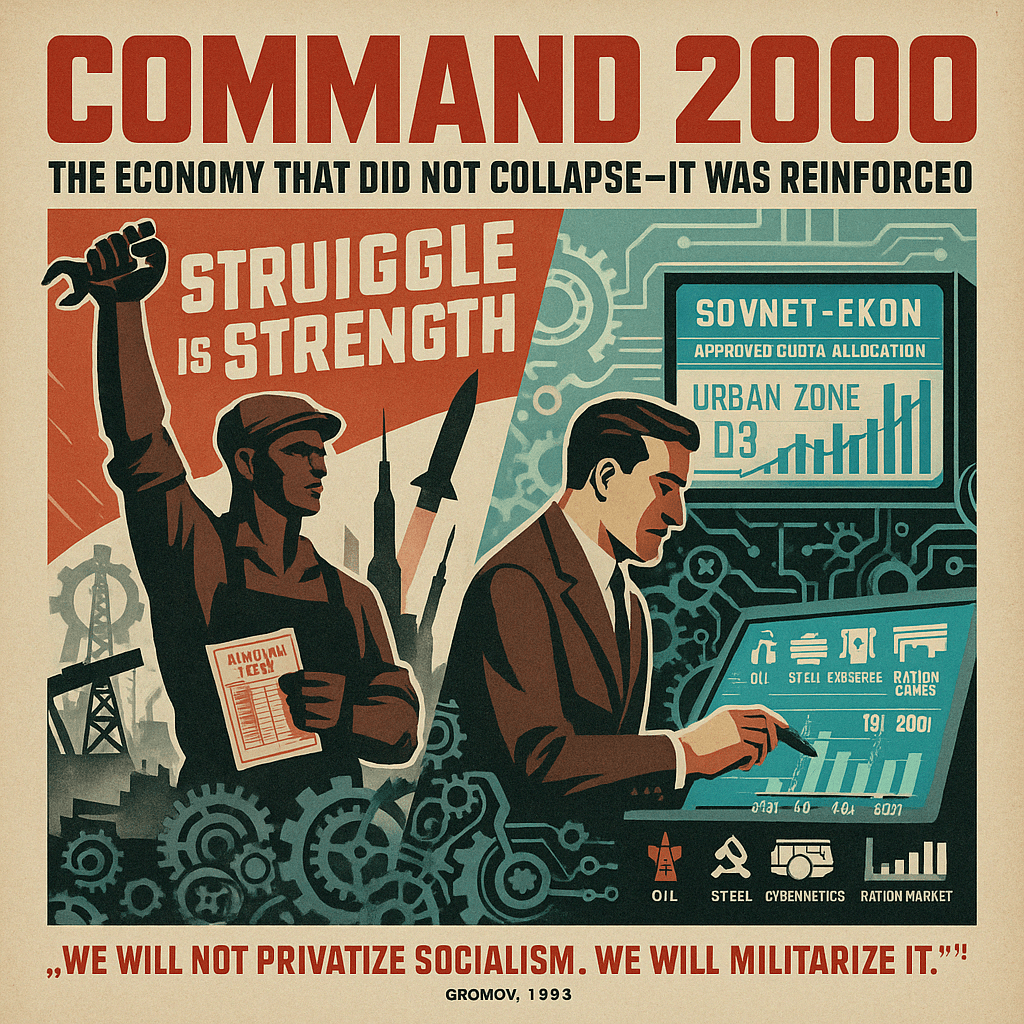
💰 Economy of the USSR (1991–2001): The “Command 2000” Period
🏗️ Overview
While Russia in our timeline suffered hyperinflation, mass privatization, and a collapse of living standards, Gromov’s USSR avoided this capitalist shock—but at the price of economic stagnation, widespread shortages, and centralized repression. The economic strategy was called:
“Command 2000”:
A hybrid model fusing pre-Khrushchev Stalinist central planning, selective automation, and limited technocratic reform—strictly under Party control.
It was designed by a team of second-tier planners and military economists under Viktor Pavlovich Trubitsyn, a GOSPLAN loyalist who had resisted perestroika.
📉 Economic Crisis at the Start (1991–1994)
Problems Inherited:
- Near-total collapse of consumer goods production.
- Acute shortages of food and medical supplies.
- Sharp declines in energy sector efficiency and exports.
- Huge military-industrial complex demanding resources.
- Entire Soviet bloc trade system (COMECON) disintegrating.
Gromov’s Emergency Measures:
- Re-nationalization of all semi-privatized enterprises (Gorbachev’s early experiments).
- “Emergency Food and Fuel Distribution Committees” (EFFDCs) placed under military control to guarantee urban survival.
- Barter economy legalized but strictly monitored, especially in rural areas.
- Massive currency reforms in 1993:
- Old rubles exchanged for “New Rubles” at a punitive rate.
- Hoarded wealth wiped out.
- Black market shrunk dramatically through fear and surveillance.
🗣️ “We will not privatize socialism. We will militarize it.” —Gromov, 1993
Outcome:
- Hyperinflation was avoided, unlike in Russia.
- But widespread shortages, price controls, and hoarding intensified.
- Rural areas returned to quasi-feudal barter systems.
- Urban workers received wages in goods or ration cards.
🔧 Mid-1990s Recovery: The “Technocrat Compromise”
By 1995, it became clear even to hardliners that some economic modernization was needed—but it had to serve the Party-state. This led to the rise of “Red Technocrats”, many trained in cybernetics, systems analysis, and computer modeling.
Key Features of Command 2000:
1. Industrial Prioritization
- Focus returned to “heavy triad”: steel, energy, and armaments.
- Civilian industries left to rot unless deemed “strategic.”
- Massive new investments in military R&D, especially cybernetics, robotics, and aerospace.
2. Cybernetic Planning Tools
- Revival of OGAS (a proto-internet planned in the 1970s) under new name: SOVNET-EKON.
- Regional production and distribution data was centralized in data coordination centers in Moscow and Novosibirsk.
- Artificial shortages used to manipulate labor flows and discipline urban unrest.
3. Worker Discipline & Economic Militarization
- Workplace absenteeism criminalized again.
- Bonus systems tied to political loyalty and quota fulfillment.
- Economic “shock brigades” formed—youths sent to revitalize dying factories and mining towns.
4. Export-for-Survival Strategy
- The USSR boosted exports to socialist-aligned nations, especially:
- Oil and gas to North Korea, Cuba, and Slovakia.
- Military tech to Syria, Vietnam, and Venezuela.
- Barter agreements were common: food for uranium, tanks for sugar, etc.
- Secret oil deals with rogue states (Iraq, Libya, Sudan) brought hard currency.
🛢️ Energy Sector: The Soviet Lifeline
The Soviet energy sector was the regime’s lifeboat:
- Oil and gas infrastructure had suffered in the 1980s, but massive investment from 1994 onward revived it.
- By 1998, pipeline systems were fully nationalized and upgraded with limited Western tech (via back channels through Austria and Cyprus).
- Ukraine and Belarus were bullied into favorable transit agreements.
- Energy was sold cheaply to domestic users but at premium prices abroad (especially in Southeast Asia and India).
🍞 Agriculture and Food Supply: Still the Soviet Achilles’ Heel
Agriculture remained a permanent disaster zone:
- Collective farms were not reformed.
- Crop yields remained low due to outdated equipment, fuel shortages, and mismanagement.
- Siberia and Central Asia were repopulated through forced “agricultural mobilizations.”
- Urban food supply stabilized only through rationing, imports from Cuba, and state-owned black markets.
🔻 Soviet cities never starved, but lines for basic goods like meat and butter persisted through 2001.
📊 Economic Metrics (Estimated)
| Metric | Value (1991) | Value (2001) | Notes |
|---|---|---|---|
| GDP (official) | ~$2.7T (PPP) | ~$3.1T (PPP) | Modest growth, mostly military-industrial |
| Inflation | 210% | 13% | Sharp fall after 1993 currency reform |
| Consumer goods production | 100 (index) | 78 | Steady decline due to neglect |
| Oil exports (million barrels/day) | 5.2 | 6.1 | Key driver of recovery |
| Ration card dependency (urban) | ~40% | ~30% | Gradual improvement, still high |
| Black market size (% of GDP) | ~30% | ~15% | Suppressed by VUGB enforcement |
🧠 Ideological Framing: “Struggle Economics”
Gromov refused to admit economic weakness. He and his propagandists painted the system as:
- A necessary mobilization against Western economic subversion.
- A “People’s War” against internal corruption and capitalist temptation.
- A temporary austerity to prepare for a “Second Socialist Century.”
Radio and television broadcast daily reports on heroic factory workers, agricultural shock brigades, and “traitors caught undermining the five-year plan.”
Summary: The Red Economy, Reinforced by Iron Will
| Strengths | Weaknesses |
|---|---|
| Avoided post-Soviet collapse | Persistent shortages |
| Maintained centralized industrial base | No consumer sector recovery |
| Rebuilt military production | Agriculture stagnated |
| Used energy exports as leverage | Black markets suppressed innovation |
| Developed crude cybernetic planning | No private sector innovation |
 What If: The Archive
Leave a comment