
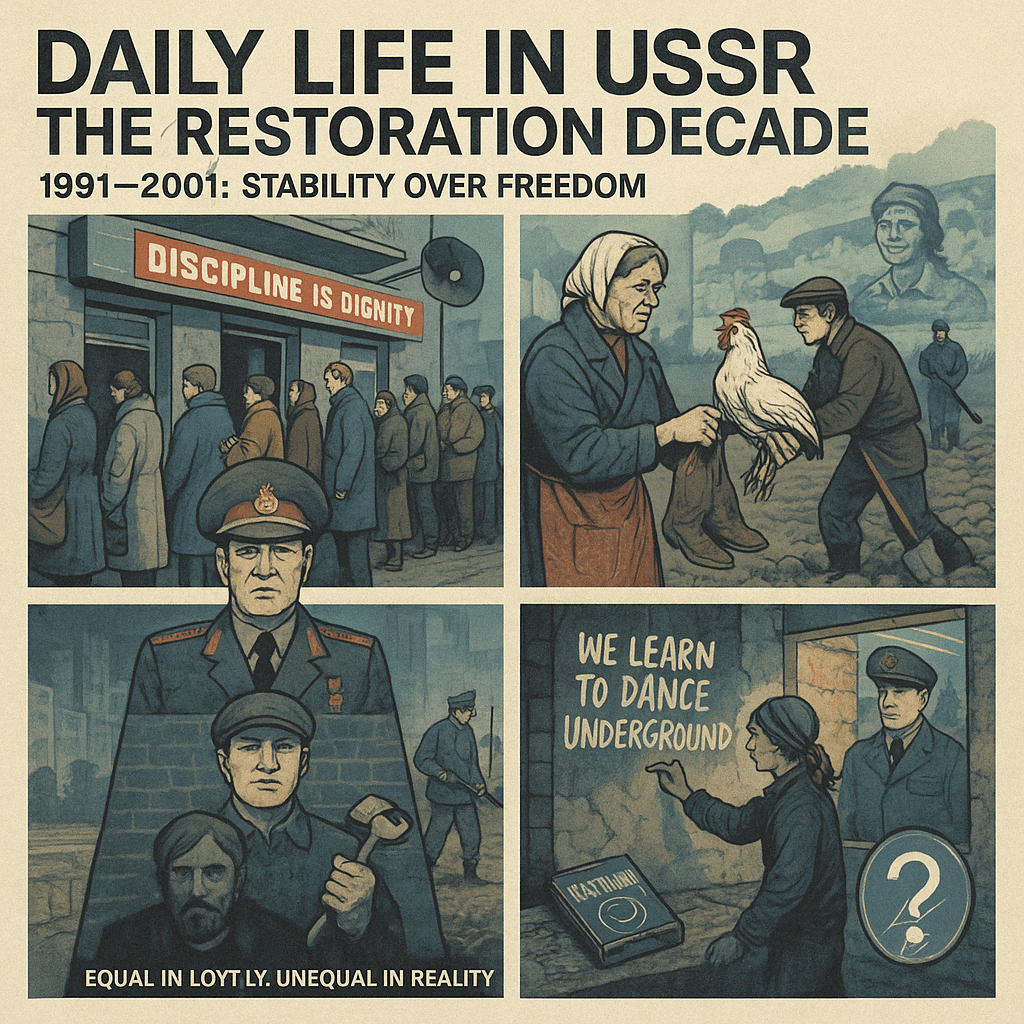
Let’s take a deep dive into daily life in the USSR during the 1990s in this alternate timeline. The decade was one of authoritarian stability, economic austerity, and forced ideological conformity. Compared to the chaos and poverty in real-life post-Soviet Russia, this USSR avoided total collapse—but at a high cost in freedom, innovation, and material comfort.
Let’s explore multiple angles of daily life: urban vs rural, class structure, youth culture, gender, minority experiences, and ideological enforcement.
🏙️ 1. Urban Life: Order Over Comfort
Living Conditions:
- Soviet cities avoided the housing collapse of post-Soviet Russia. Public housing, while cramped and aging, remained functional.
- Utilities were subsidized, but heating and hot water were intermittent in poorer districts due to fuel rationing.
- State grocery stores offered rationed staples (bread, sugar, oil, vodka), but fresh produce and meat were scarce or prohibitively expensive on the black market.
🧺 “You wait in line for sausage, and you wait in line to find out where the line is.” —Popular urban saying, 1996
Transportation:
- Subways and buses continued functioning smoothly—one of the few bright spots.
- Fuel shortages meant fewer cars; public transport remained essential.
- Factory workers often traveled in “mobilized routes” managed by workplace brigades.
🌾 2. Rural Life: Return to the Soil, and Silence
Rural areas—neglected even in the best Soviet years—saw no real improvement. In fact, for many, life regressed to pre-industrial conditions.
- Barter became the dominant system in many villages: chickens for boots, potatoes for fuel.
- The regime reintroduced “Agricultural Mobilizations”, forcing young people and political dissidents to work in collective farms or “Patriotic Villages”.
- Small family plots (private kitchen gardens) were quietly tolerated and became vital for survival.
👩🌾 “If we didn’t grow it, we didn’t eat it.”
State media portrayed the countryside as a moral heartland, while in truth it was largely abandoned by the technocratic elite.
👔 3. Class Structure: Reemergence of a “Red Aristocracy”
Though the USSR claimed classlessness, Gromov’s state quickly evolved into a pyramid of privilege:
| Class | Description | Lifestyle |
|---|---|---|
| Nomenklatura Elite | Party, VUGB, military leaders | Chauffeurs, private dachas, imported food, Western medicine |
| Red Technocrats | Cybernetic planners, scientists | Better housing, access to SOVNET, educational perks |
| Loyal Workers | “Shock brigades,” veterans | Regular rations, public recognition |
| Suspect Classes | Intellectuals, non-Russians, religious minorities | Surveillance, blocked promotions, labor camp risk |
| Dissidents | Reformists, black marketeers | Arrest, exile, forced labor |
🧑💼 The elites had access to special stores (spetsmagaziny) stocked with foreign luxuries and quality meat—off-limits to ordinary citizens.
🎓 4. Youth Culture: Indoctrination and Rebellion
Gromov made the re-education of youth a top priority.
Tools of Indoctrination:
- The All-Union Youth Vanguard (AUYV) replaced the Komsomol. Its slogan: “Discipline, Strength, Loyalty.”
- Military-technical training started at age 12.
- Western music, games, and movies were banned. Instead, youth were exposed to heroic war films, biographies of Lenin, and state-approved punk and rock groups.
Hidden Resistance:
- Black market cassette tapes of Nirvana, Tupac, and Rammstein circulated in major cities.
- Pirate SOVNET boards hosted “subversive poetry,” anti-party jokes, and digital samizdat (underground literature).
- A small punk scene in Leningrad defied the regime with anti-Gromov graffiti and coded lyrics, often targeted by the VUGB.
🕶️ “They tell us to march. We learn to dance underground.” —Youth poet, executed in 1998
👩🦰 5. Gender Roles: A Return to Soviet Conservatism
Despite earlier Soviet advances in gender equality, the Gromov era saw a regression in women’s roles:
- Women were pushed out of elite academic and political positions, redirected to nursing, teaching, or motherhood roles.
- State propaganda idealized the “Socialist Mother”: strong, silent, patriotic, and endlessly enduring.
- Access to abortion was severely restricted by 1996, citing demographic needs.
Yet women also led many underground movements, especially in healthcare, education, and dissident networks.
🌐 6. Ethnic Minorities: Repression and Russification
Gromov saw nationalism as a threat to the Union. He revived Stalin-style russification policies:
- Non-Russian languages were marginalized in schools and media.
- The VUGB targeted cultural organizations in Ukraine, the Baltics, and Central Asia.
- Tens of thousands were deported or relocated through “Population Harmonization Initiatives.”
In Central Asia, this coincided with:
- Repression of Islam, including banning of religious schools.
- Secret police infiltration of mosques.
- Forced “integration brigades” sent to Kazakh, Uzbek, and Azeri regions.
📚 In Ukraine, Taras Shevchenko’s works were censored, and statues of Lenin restored in all major cities by 1998.
🎭 7. Art, Media, and Surveillance
Propaganda Culture:
- Television was flooded with historical epics, glorifying Lenin, the Great Patriotic War, and Gromov himself.
- Comedians and musicians had to register with the Union of Cultural Workers, a front for censorship.
- The 1997 hit series “Gromov’s Guard” followed heroic secret police thwarting capitalist plots—mandatory viewing in schools.
Surveillance Society:
- Every apartment block had a “People’s Liaison Officer” reporting suspicious behavior.
- The VUGB tapped phone lines, SOVNET access, and library records.
- Parents warned their children: “Don’t speak politics outside the kitchen.”
📉 Life Satisfaction and Morale
| Category | Condition | Notes |
|---|---|---|
| Housing | Stable but cramped | No new construction outside showcase cities |
| Food | Controlled, limited variety | Fresh goods scarce, ration cards required |
| Healthcare | Free, understaffed | Better care for Party elites |
| Education | Ideologically rigid | Technical schools favored over humanities |
| Travel | Restricted | Internal passports enforced, foreign travel banned |
| Freedom of Expression | Near zero | High risk for even mild dissent |
| Community | Strong local ties | Shared suffering, mutual aid common in cities |
In Summary:
For the average Soviet citizen in the 1990s:
- You had food, heat (most days), and work.
- You had no voice, few choices, and constant fear of making a wrong move.
For the elite, life was materially comfortable, ideologically insulated, and haunted by the need to suppress dissent constantly.
For the dissenter, life was a careful dance between quiet resistance and survival.
 What If: The Archive
Leave a comment