A Study in Loyalty, Fear, Nostalgia, and Fracture
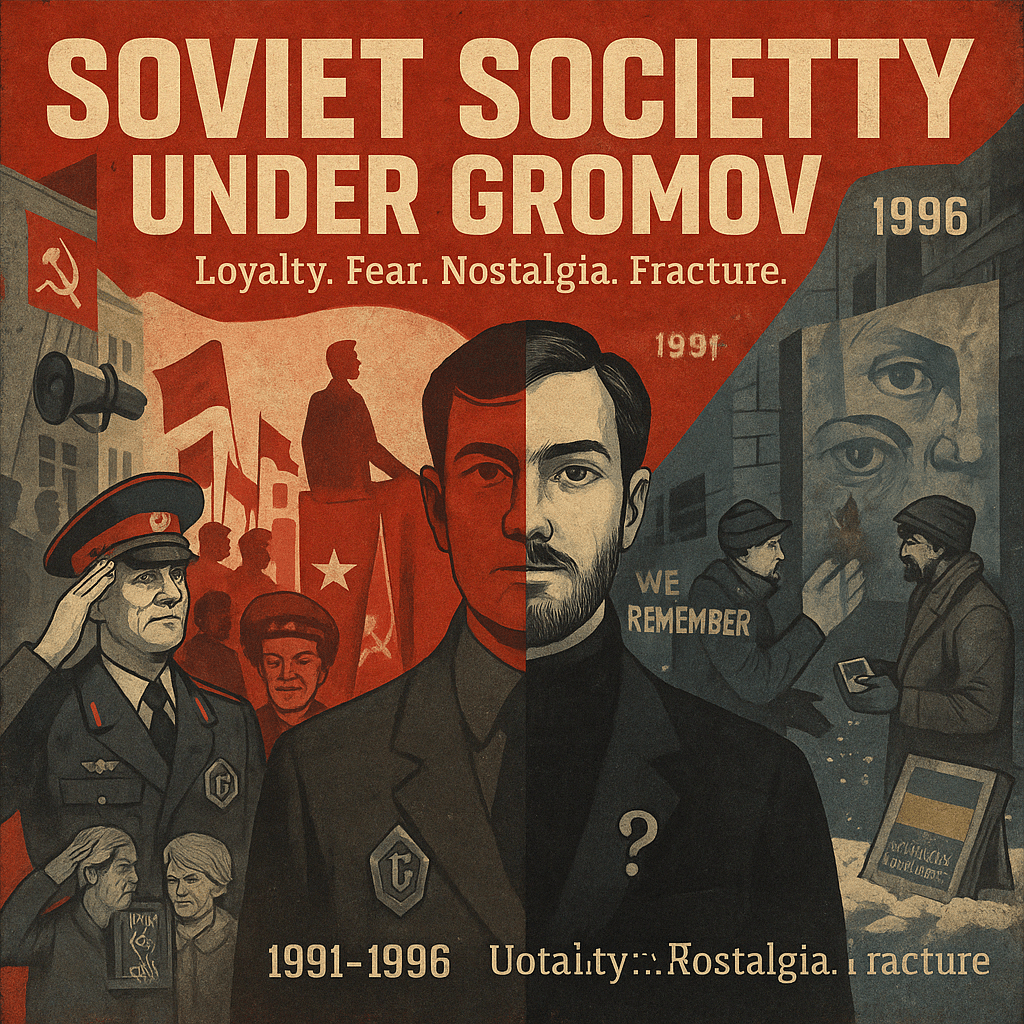
🟥 Supporters of the Restoration
These groups actively supported or at least publicly accepted the return of authoritarian socialism. But their support was layered: some from belief, others from fear, many from bitter experience of the chaos before.
1. Old-Guard Party Cadres and Bureaucratic Elites
Who they were:
Middle-aged to elderly men and women who had risen under Brezhnev, now revived from political retirement. Regional apparatchiks, factory directors, union bosses, defense sector managers.
Why they supported it:
They had been sidelined under Gorbachev, afraid of the vacuum his reforms created. Gromov’s restoration promised stability, hierarchy, and the return of the Party’s divine right to rule.
Cultural Symbols:
- Dark gray Party pins reissued with Gromov’s initials engraved subtly beneath the hammer and sickle.
- Offices re-decorated with portraits of Lenin, Gromov, and Stalin—the “Unbroken Line.”
- Red directive banners reading: “THE PARTY FALTERED. NOW IT STANDS AGAIN.”
Rhetoric:
“We do not apologize for order.”
“History bent—but now it is straightened.”
2. KGB/VUGB and Internal Security Officers
Who they were:
The security class—field agents, analysts, internal informants, ideological monitors, prison camp officers. Many had been marginalized or demoralized in the late ’80s.
Why they supported it:
Gromov was one of their own. They were given resources, prestige, and a sacred mission: root out “ideological contamination.”
Public Presence:
- Patrolling in black greatcoats with crimson armbands reading ЧИСТОТА (“Purity”).
- Posters showing a VUGB officer shielding children from Western “decay”—depicted as a many-eyed, blue-lit monster.
- Campaigns like: “Your silence is loyalty. Your watchfulness is patriotism.”
Slogans:
“THE ENEMY DOES NOT SLEEP.”
“TRUTH NEEDS TEETH.”
3. Rural Populations and the Elderly
Who they were:
Collective farm workers, small-town pensioners, war veterans—those who remembered bread lines, ration books, and Khrushchev’s dithering with cold resentment.
Why they supported it:
Gromov promised subsistence and structure. For them, chaos was not liberation—it was existential risk. The Restoration revived food programs, military pensions, and rail discounts.
Imagery:
- Trains and buses with “FOR MOTHERLAND AND STABILITY” scrawled in red.
- Local markets renamed “Soviet Provision Points” with ration cards reissued.
- National holiday for pensioners established: “Day of the People’s Endurance”.
Common sayings:
“He brought back meat.”
“I’d rather be watched than starve.”
4. Ethnic Russian Nationalists
Who they were:
Not all were Marxists. Some were Orthodox revivalists, military romantics, or young men drawn to imperial nostalgia.
Why they supported it:
They equated the USSR with Russian pride. The humiliations of the West during Gorbachev’s time were now reversed. The Soviet flag meant greatness, revenge, and resurgence.
Visual Culture:
- Street murals of Soviet cosmonauts weeping over the broken USSR—restored with Gromov’s silhouette holding a torch.
- Dual flags: Soviet red crossed with Saint George’s Orthodox cross—symbolizing the strange blend of old Communism with Russian mythic nationalism.
Slogans:
“A RED EMPIRE IS STILL AN EMPIRE.”
“GROMOV: THE RUSSIAN IRON.”
“NO MORE DECADENCE. NO MORE SHAME.”
🟦 Opponents of the Restoration
These were the silenced voices. Most did not resist openly—they adapted, whispered, or fled. But they represented a different vision of the USSR: democratic, open, post-ideological. Gromov called them “soft enemies.”
1. Urban Liberals, Students, and Reformists
Who they were:
Educated classes in Moscow, Leningrad, Kiev. Former journalists, literature professors, software engineers, economists who had flirted with Western ideas.
Why they opposed it:
They had tasted freedom—the ability to publish, travel, joke. Now it was gone. Their radios jammed. Their email filtered. Their friends “reassigned.”
Signs of Resistance:
- Underground poetry circles, ironic performance art in back alleys, flash graffiti in metro stations: “GROMOV IS A STATUE. WE ARE RAIN.”
- Black market recordings of Pink Floyd, Nirvana, and Mikhail Bulgakov audiobooks circulated on cassette.
Dress Code:
- Black turtlenecks, Czech trench coats, pins shaped like question marks or cracked hourglasses.
Slogans (whispered, not shouted):
“WE REMEMBER.”
“THE SNOW MELTED ONCE. IT WILL AGAIN.”
2. National Minorities and Peripheral Republics
Who they were:
Ukrainians, Estonians, Georgians, Armenians, Tatars, Kazakhs—who had seen independence in reach before the coup crushed their hopes.
Why they opposed it:
They now faced Russification, surveillance, and the suppression of their languages and cultures.
Acts of Defiance:
- Secret schools in basements where children learned banned alphabets.
- Folk songs sung in code: upbeat in tone, mournful in meaning.
- Religious holidays celebrated behind blacked-out windows.
Visual Symbols:
- Ukrainian blue-and-yellow stitched into the lining of coats.
- Georgian crosses hidden in belt buckles.
- Graffiti: “THE USSR IS A PRISON. OUR SPIRIT IS NOT A CELL.”
3. Young Urban Professionals and Cultural Westernizers
Who they were:
The so-called “MTV Generation”—people in their 20s and 30s, fluent in English, raised on the edge of Western influence.
Why they opposed it:
They had planned to leave. To start startups, get scholarships, join the world. Now their passports were frozen, their music banned, and their future algorithmically reassigned.
Cultural Icons:
- Faux-foreign cafés raided for “ideological contamination.”
- Black-market Levi’s and Walkmans traded in the same alleys as illicit vodka in the 1980s.
They wrote slogans in English—to practice, and to distance:
“BORDERS ARE LIES.”
“THE WALL IS BACK. THIS TIME, IT’S INVISIBLE.”
4. Dissidents of the Eastern Bloc
Who they were:
Polish Solidarity veterans. Czechs from the Prague underground. East Germans who had walked out into the West.
Why they opposed it:
They saw the coup as a betrayal of history. Many had allies in Soviet reformist circles—now arrested or “vanished.”
Survival:
- Some fled to Vienna, Berlin, or Helsinki.
- Others stayed, smuggling information, hiding texts, teaching counter-history.
Icons of Resistance:
- Hidden busts of Václav Havel and Lech Wałęsa.
- Messages in toothpaste scrawled under bathroom mirrors.
Their warning:
“WHEN THE RED RETURNS, THE NIGHT IS LONGER.”
🪖 The Military: Fragmented Allegiance
- High-ranking generals favored Gromov.
- Middle and junior officers were split, often sympathetic to reformists, especially in the border republics.
- Some units were quietly purged after “hesitating” during the coup.
Military Propaganda Imagery:
- Posters of Gromov on horseback in the style of Alexander Nevsky, facing down a hydra labeled ‘Liberalism, Nationalism, Capitalism.’
Slogan used in parades:
“NOT JUST STEEL. RED STEEL.”
Final Texture: What Society Looked Like (1992–1995)
- Loudspeakers returned to factory floors, playing state-approved news and patriotic marches.
- Giant murals painted over 1980s advertising boards: “GROMOV RESTORED WHAT THE WEST CORRUPTED.”
- Swan Lake played again—not just during emergencies, but at train stations and post offices.
- Schools taught history not as fact—but as formula: Lenin + Stalin + Gromov = Eternity.
- People learned to smile with closed lips.
To whisper instead of shout.
To remember that silence was not submission—it was survival.
 What If: The Archive
Leave a comment