What if history did not end, but merely paused to sharpen its knives? What if the ghost of order, humiliated and driven into the cold, returned — not with thunder, but with calculations, algorithms, and perfect silence?
There are moments in history when men, having glimpsed the sun, willingly return to the cave — not because they prefer darkness, but because the light frightened them. It was too bright, too boundless, too uncertain. And so they kneel, not before gods, but before routines, statistics, and screens glowing like artificial dawns in windowless ministries.
In August of 1991, the hand of fate did not tremble — it struck. The coup succeeded. The city held its breath as the tanks did not retreat, as the statues did not fall, as the ghosts of old commissars found flesh once more. Gorbachev vanished into the obscurity of exile. Yeltsin fell not into history, but into the earth. And the empire — that battered, ever-resurrecting empire — rose again, wearing a new face: not the face of a tyrant, but of an engineer.
His name was Ivan Gromov, but names no longer mattered. Titles mattered. Functions mattered. He did not promise bread, nor happiness, nor paradise. He promised only this: order. And that was enough. After all, men who had been lost in the fog of glasnost and the humiliation of westernization were tired of questions. They wanted answers. Even if those answers came at the price of their own memory.
There is a kind of comfort in obedience — the way a prisoner, long enough confined, forgets the difference between the cell and the world. Gromov understood this. He did not ask for love, nor loyalty. Only obedience. Love is too unstable; ideology too vague. But obedience — obedience can be measured. Quantified. Predicted.
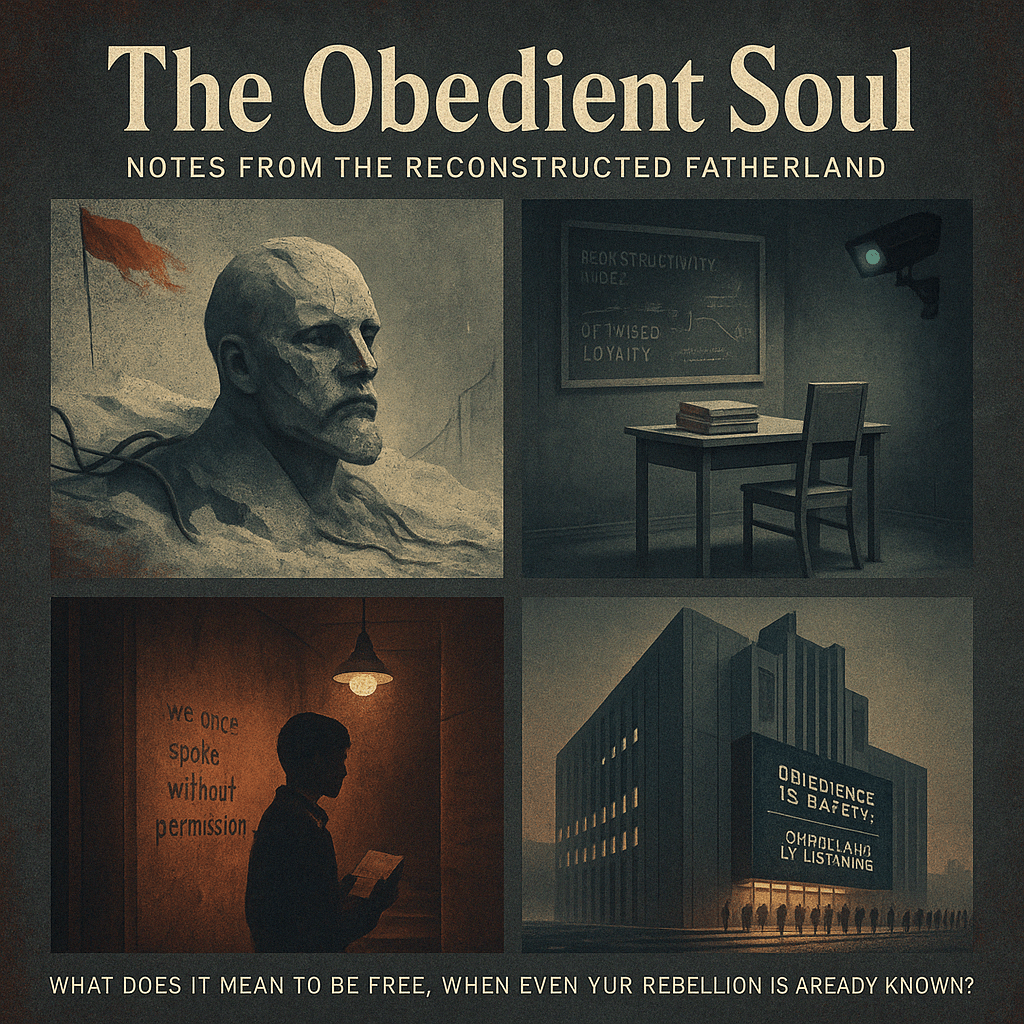
And thus began the great project: not of revival, but of reconstruction. The memory of the past was not erased — no, that would be too crude. It was optimized. The Revolution was cleaned, edited, restored in high fidelity. The Great Terror was reclassified as “Necessary Mobilization.” Stalin was not forgiven — he was reformatted. Lenin was not debated — he was curated. Even suffering was not mourned; it was catalogued, archived, and fed into a planning algorithm.
In classrooms, children no longer memorized poems — they memorized production quotas. In factories, men no longer drank to numb their fatigue — they scanned their ideological metrics. A machine began to think for the people, and the people, weary of their own thoughts, accepted its verdicts like gospel.
They called it Orpheus — the system, the intelligence, the non-human mind that whispered to ministries and monitored dissidents before they even knew they would become dissidents. Orpheus did not command. It merely recommended. And its recommendations became laws.
We became citizens of a logic too vast to comprehend and too subtle to resist.
But still — in basements, in quiet glances, in half-remembered songs from the Gorbachev years — something stirred. A hesitation. A doubt. A memory, perhaps not real, but no less sacred: that once, just once, we spoke without permission.
And now?
Now, we no longer remember what that felt like. Only that it hurt. And that it mattered.
 What If: The Archive
Leave a comment