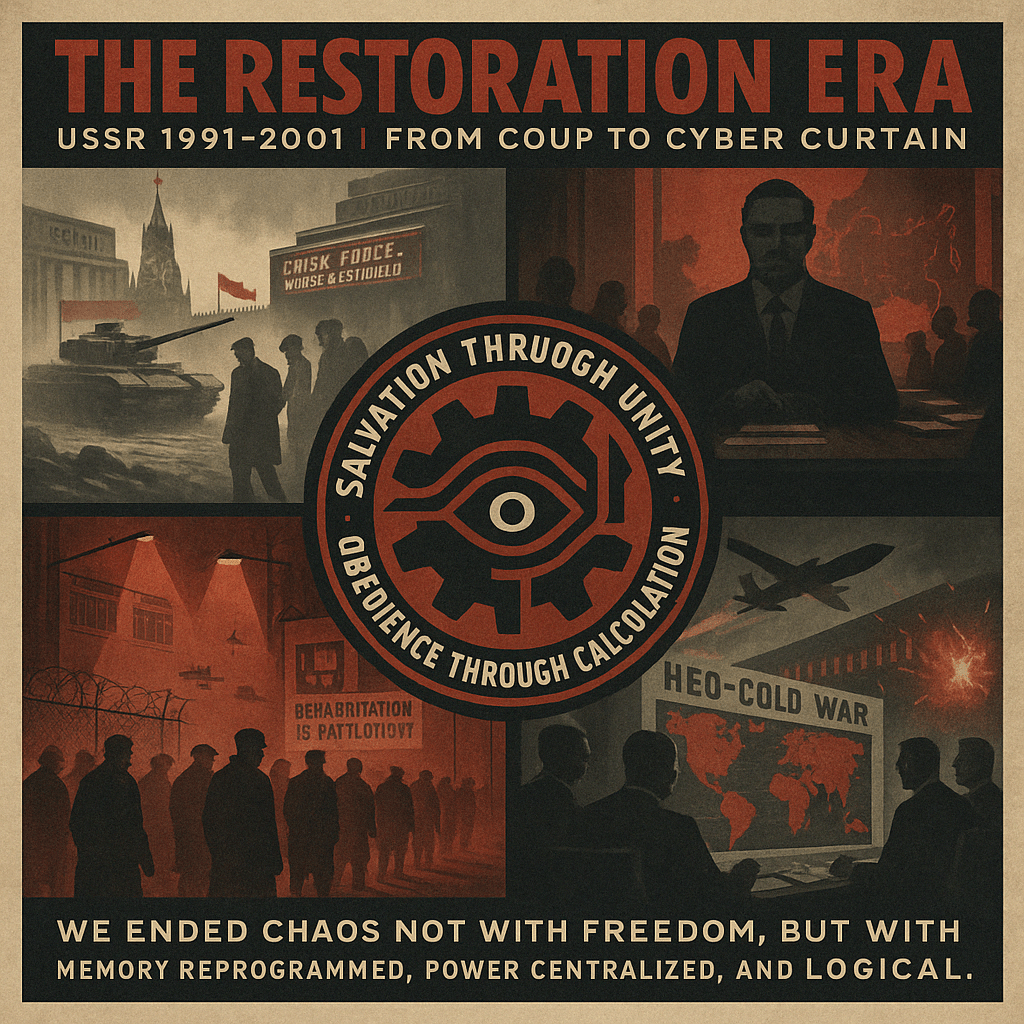
Following the successful coup d’état on August 19, 1991, the Soviet Union entered a turbulent but decisive period of restoration under a new authoritarian leadership. The junta, initially composed of hardline Communist Party officials, was soon eclipsed by a rising figure within the KGB and Ministry of Internal Affairs—Ivan Gromov, a previously obscure but ruthless security apparatchik who rapidly consolidated power and became de facto leader of the USSR by late 1993.
The August Restoration Coup (1991)
The coup succeeded when elements of the military, particularly elite airborne divisions and Interior Ministry troops, remained loyal to the GKChP. Boris Yeltsin’s famous defiance on a tank outside the Russian White House never occurred—he was arrested on the morning of August 20, 1991, and executed within days under charges of treason. Resistance in Moscow and Leningrad was crushed within a week through the imposition of martial law, blackouts, and selective purges of liberal reformers, journalists, and regional officials.
Mikhail Gorbachev, after a short period of house arrest, was quietly exiled to a dacha near the Black Sea and disappeared from public life.
Rise of Ivan Gromov (1991–1993)
Gromov, a high-ranking officer in the KGB’s Fifth Directorate, known for his ideological orthodoxy and personal loyalty to the Soviet ideal, began maneuvering to outflank other junta members, particularly Vice President Gennady Yanayev and Defense Minister Dmitry Yazov. Leveraging support from younger KGB officers and hardline military elements, Gromov orchestrated a series of “anti-corruption purges” that removed rival members of the GKChP. By December 1993, he declared the creation of the Supreme Committee for the Salvation of Socialism (SCSS), effectively placing himself at its head with extraordinary executive powers.
The Politburo was restructured into a rubber-stamp body. The Communist Party was restored to exclusive legal status, and Gromov was granted the newly created title of General Secretary and Chairman of the Supreme Committee—a position later compared by Western analysts to Stalin’s fusion of party and state leadership.
The Second Red Terror (1994–1997)
Gromov’s consolidation of power ushered in a chilling era known as the Second Red Terror, characterized by mass arrests, internal deportations, ideological re-education programs, and the creation of Reformist Rehabilitation Camps in remote Siberian and Central Asian regions.
Approximately 750,000 people—intellectuals, Western-educated economists, former reformers, journalists, and ethnic dissidents—were imprisoned or disappeared during this period. Satellite states such as Belarus, Kazakhstan, and Ukraine saw the re-establishment of strong Communist leadership under direct supervision from Moscow.
The KGB, rebranded as the All-Union Directorate of State Security (VUGB), returned to its former prominence, with new “loyalty programs” introduced in all major universities and workplaces. Censorship was reimposed, and the Iron Curtain effectively descended once more, this time under a new generation of technocrats trained in both repression and digital surveillance.
Foreign Relations and the “Neo-Cold War” (1995–2001)
Gromov’s USSR shocked the Western world with its reversion to hardline Communism. NATO, confused and unprepared for the reversal of Soviet collapse, hastily reoriented its strategy. The expansion of NATO eastward stalled by 1996 as Russian-aligned militias staged armed demonstrations in Latvia and Estonia. In 1997, Moldova’s government was overthrown by pro-Soviet elements backed covertly by VUGB operatives.
China, under Jiang Zemin, pursued a pragmatic but wary stance, maintaining relations while quietly distancing itself from Gromov’s aggressive ideology. North Korea grew closer to the USSR once again, and Cuba received a renewed flood of economic aid and military advisers.
In 1999, the newly-elected American president, Al Gore, took a firmer stance against Soviet aggression, leading to a minor diplomatic crisis when a U.S. spy plane was shot down over the Baltic Sea. By 2000, the term Neo-Cold War was widely used to describe the renewed global ideological and military tension.
The Gromov Doctrine
Gromov’s ideological policy was encapsulated in what became known as the Gromov Doctrine:
- Absolute ideological unity of the Soviet people under Marxism-Leninism.
- Restoration of Soviet territorial influence in former republics.
- Rejection of capitalist and “cosmopolitan” influences in culture and economics.
- Pursuit of technological self-sufficiency, particularly in military and cyber capabilities.
Technology and Economy
The Soviet economy, while still lagging behind the West, was reorganized along Command 2000, a technocratic plan blending central planning with limited automation and cybernetic modeling. Though inefficient by Western standards, this created a modest industrial revival and prevented collapse.
The USSR began experimenting with state-controlled internet services, known as the SovNet, which became a tool for both propaganda and surveillance.
 What If: The Archive
Leave a comment