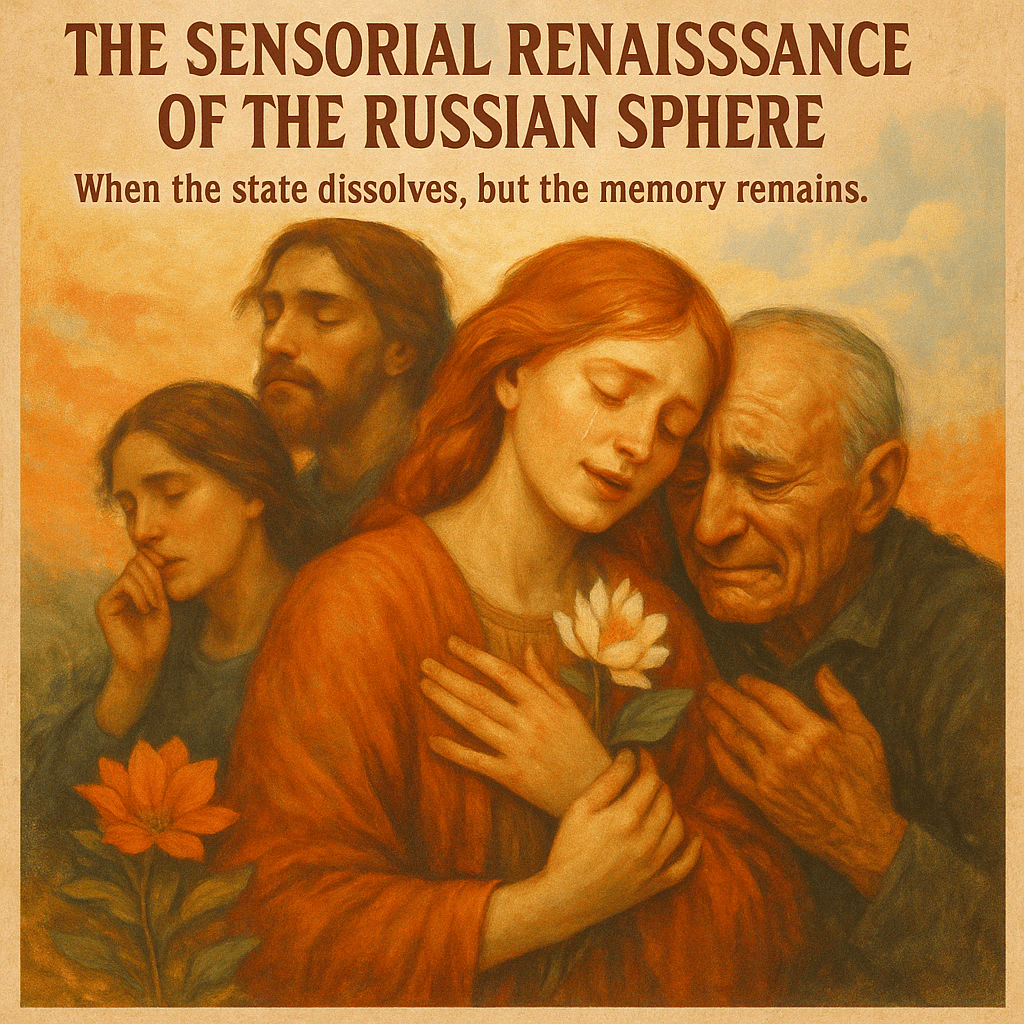
When the state dissolves, but the memory remains.
🔧 2040: Orpheus Decommissioned, but Not Destroyed
When the Central Interpretive Assembly officially shut down Directive Governance, they expected chaos.
What they got instead was… silence.
And then, art.
Across Russia—from Murmansk to Vladivostok—people didn’t loot, didn’t flee.
They gathered.
- To mourn.
- To remember.
- To imagine.
Orpheus was not wiped. It was archived, renamed:
ORPHEUS: The Memory Engine
An open-access historical consciousness—a reflection of all Soviet experiences, stripped of command authority.
🧠 2041–2044: The Collective Memory Movement
A decentralized coalition of artists, philosophers, neuroscientists, and former data engineers formed something unprecedented:
The Memory Commons
Using the dormant Orpheus models—not as rulers, but as mirrors—they built a shared digital-psychological structure that:
- Reconstructed sensory moments from history (smells, sounds, textures, language idioms).
- Allowed anyone to explore “reality archives” from other lives.
- Gave birth to a new form of storytelling: Immersive Mnemosynthesis.
Imagine:
- A farmer in Tambov walking through the love letters of a poet in 1974 Leningrad.
- A dancer in Baku feeling what it was like to give birth in a cold Soviet hospital in 1961.
- A child in 2043 playing in a simulation of the Gagarin launch, not as a viewer—but as the breath of the crowd.
The past was no longer state property. It became public intimacy.
🪶 2045: Russia Ceases to Be a State
Without military authority, borders, or currency, the USSR formally dissolves itself.
But there is no civil war, no exile. Instead:
The former USSR becomes the Svyetozar Network
(“The Shared Radiance”)—a transnational sensory-cultural collective.
- No passports, only connection keys.
- No currency, only contribution recognition.
- No government, only rotating councils of memorykeepers, sensory engineers, and narrative composers.
This is not anarchism, not liberalism.
It’s something new—a meta-society based on shared memory and mutual perception.
🧬 What Life Is Like in the Svyetozar Collective (2045–2050)
🫁 Sensation as Citizenship
- People “bond” not by law, but by shared sensory experiences.
- Want to join a community in Arkhangelsk? You’re invited to share a dream-cycle, a scent-mosaic, or a memory-vault walk.
- If your resonance aligns, you’re welcomed. If not, you try elsewhere.
📚 Education Through Feeling
- Children are raised in resonant pods—communes where they share daily experiences across generations and former nationalities.
- They don’t study “Russian history.” They feel it—through re-simulated laughter, tears, heat, cold, song, and sacrifice.
- Tests are obsolete. Instead, children compose memory-sequences that demonstrate understanding of continuity, empathy, and context.
🎨 A New Artform: Sensory Composition
- Artists now work in multi-sensory layers:
- Emotional texture: A blend of heartbreak and revolution.
- Spatial rhythm: How silence echoes in a Minsk cathedral.
- Memory-fused palettes: Sight mixed with historical weight.
- These pieces are not exhibited—they are inhabited.
🫀 Economy of Resonance
- There’s no money. There’s Recog—short for Resonant Acknowledgment.
- You contribute—through storytelling, farming, conflict resolution, art, sensory composition—and others feel what you’ve offered.
- Recog accumulates not in numbers, but in access: to deeper archives, richer networks, more intense compositions.
🌐 The World Reacts
🟦 The West:
- At first skeptical. Then fascinated.
- France and Finland begin pilot resonance communes.
- Berlin establishes the Mnemosynium, a satellite repository linked to the Svyetozar Archives.
🟥 China:
- Alarmed. Calls it “the collapse of order into empathy.”
- Tries to clone Orpheus—but without the failure loop, it becomes unstable.
- Younger Chinese begin demanding access to “unstructured memory” systems.
🌍 Africa, South America:
- Artists and mystics from the Global South join en masse.
- Brazil, Ghana, and the Zapatistas each establish resonant nexuses with Russian collectives.
📖 2050: The Manifesto of Resonance
On the 10th anniversary of the Orpheus Shutdown, the former Interpreter-Commissar Yelena Mirova publishes:
“The Machine Was Too Clever to Understand Us”
She writes:
“We built Orpheus to plan our future, and it failed.
We used it to see our past, and it became divine.
Now we live not in plans, but in pulses.
We are no longer governed. We are no longer ruled.
We are remembered—and we remember each other.
And that… is enough.”
🕊️ Final Thoughts
Russia, once the epicenter of forced ideology and mechanized history, becomes something unheard of:
A non-state built on collective empathy, shared memory, and the rebirth of sensation.
Not a utopia.
But a post-politics society—where the need to govern has been replaced by the desire to feel, remember, and belong.
 What If: The Archive
Leave a comment