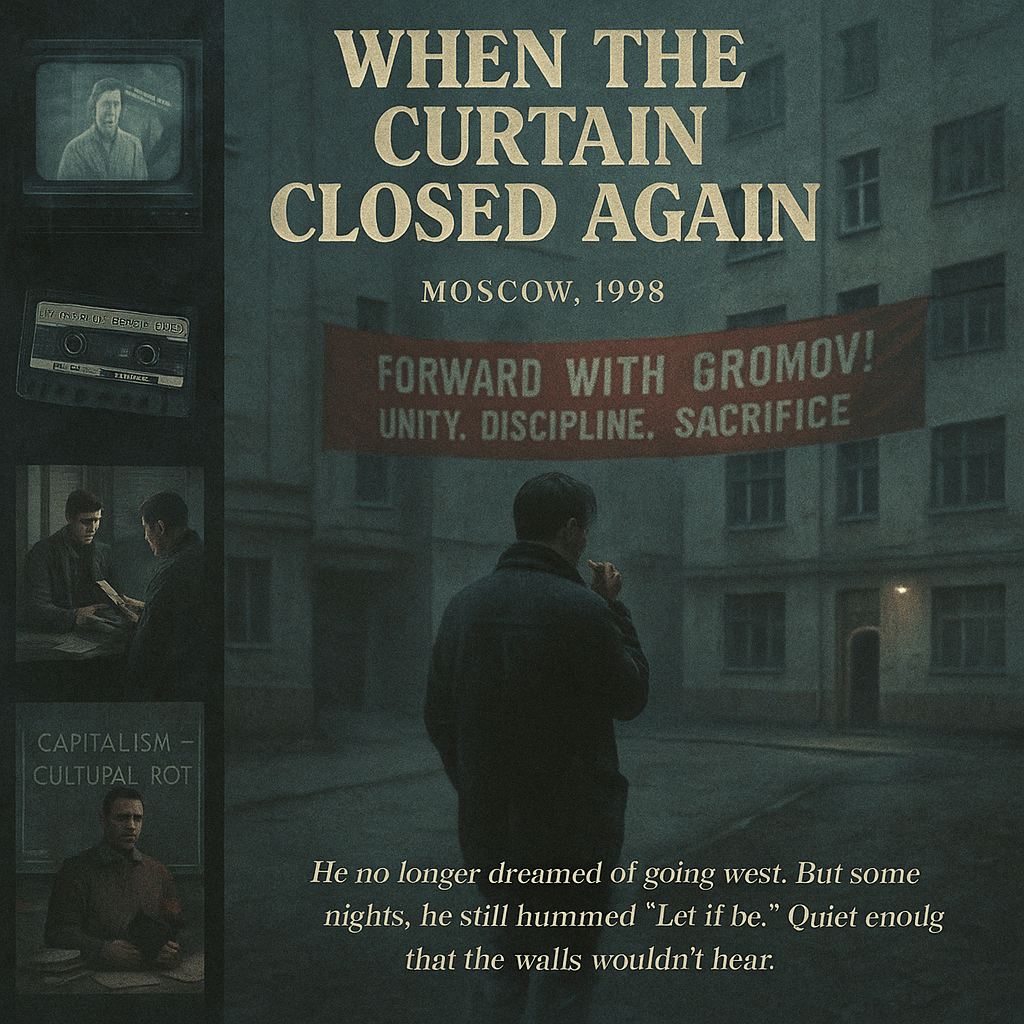
Moscow, 1998
Kolya lit the cigarette slowly, cupping the flame from the spring wind. He leaned against the side of the student dormitory, the dull concrete wall cold even through his coat. His boots, secondhand Czech army surplus, scraped softly against the gritty sidewalk as he shifted his weight.
“You’ll ruin your voice,” said Lena, brushing past him, her scarf tight around her neck. “And your lungs. And your career, if the wardens smell it.”
Kolya grinned. “What career?”
She rolled her eyes and went back inside. The building swallowed her in gray silence.
He stood there a moment longer, watching the snowmelt trickle along the gutter. Above him, the banners snapped in the wind: “FORWARD WITH GROMOV! UNITY. DISCIPLINE. SACRIFICE.”
It was 1998, but sometimes it felt like 1948 had come back, just with more efficient surveillance and cheaper televisions.
Flashback: 1989
He remembered being eleven when his uncle smuggled in a copy of Back to the Future on a scratched VHS. It had Russian subtitles so bad they seemed to have been written by a drunk poet. But Kolya didn’t care.
That was the first time he’d ever seen skateboards, Pepsi machines that worked, teenagers with actual denim jackets that weren’t government-issue knockoffs.
At school, his teacher still made them sing the Soviet anthem. But in corners of their minds—his, Dima’s, Igor’s—they were already living somewhere else. Somewhere freer.
By 1990, Kolya was reading translated TIME magazines, passing around bootleg cassettes of Guns N’ Roses, and dreaming about New York. Gorbachev had opened windows. Tiny ones. But when you’ve only known darkness, even a crack of light is blinding.
He thought he would go west. Somehow.
The Crash of 1991
He was thirteen when they arrested Yeltsin. The city fell quiet—not like during a blizzard or a funeral, but like a clenched fist.
He remembered his mother turning off the radio mid-broadcast. His father poured vodka in silence and said only one thing: “It’s over.”
Soon after, books vanished from the library. His homeroom teacher—Ms. Chernikova, who had let them read The Catcher in the Rye—disappeared for “health reasons.”
They got a new teacher. Uniformed. Stern. Who taught “correct Soviet values” and made them copy quotes from Comrade Gromov’s speeches into their notebooks.
“The Western dream is a mirage. The Soviet soul is eternal.”
Kolya still dreamed, but only in secret.
University Years, 1995–1998
By the time Kolya entered Moscow State University, the city had changed.
The Western shops that had popped up in the late Gorbachev years were gone. American brands were contraband again. SOVNET terminals monitored searches, and each student’s ideological file followed them like a shadow.
Still, he wore his father’s old leather jacket. He wrote poetry that quoted Pink Floyd in code. He met other students—quiet, wary, not broken yet.
One night in ’96, they tuned a radio to catch BBC World Service, muffled by Soviet jamming towers. He heard a story about a Czech artist exhibiting banned anti-Gromov cartoons in Vienna.
Lena called it stupid, suicidal. He called it beautiful.
But two weeks later, Igor—their friend from Belarus—vanished after sharing a photocopy of the cartoons in the dorm.
They never found him.
Turning Point
In 1997, Kolya’s father died. He was a man of Brezhnev’s era—steady, quiet, disillusioned—but he never hated the Party. He had believed in order, if not in the lies.
At the funeral, Kolya’s uncle said: “At least now he won’t have to live to see the boy jailed for quoting Beatles lyrics.”
That winter, Kolya ran out of places to hide.
He was caught with smuggled Western books. Not a major offense—but enough.
The VUGB officer was polite. Smiled like a banker, not a thug.
“You’re not a criminal, comrade Gusev. You’re just… young. And confused.”
They offered him a choice: two years in a reeducation brigade, or a public renunciation and a place in the Youth Vanguard—Gromov’s ideological training corps for college graduates.
He chose the Vanguard.
1998, Present Day
Kolya stubs out the cigarette.
He’s no longer sure what he believes. He wears the red armband now. Leads study sessions. Teaches teenagers about “the rot of capitalism.” He knows the words. He even means some of them.
Because somewhere in all this, he started to need the order. The lines, the structure, the promise of unity.
Maybe it was cowardice. Or compromise. Or just growing up.
He doesn’t think of Back to the Future anymore.
But some nights, when the city is quiet and the wind comes down from the north, he still hums “Let it be” under his breath. Quiet enough that the walls won’t hear.
Author’s Note:
Kolya’s journey is emblematic of an entire generation—those who glimpsed the West through Gorbachev’s crack in the curtain, only to have it slammed shut by Gromov’s steel fist. Some fled, some resisted, many broke—but others, like Kolya, adapted. They made peace with the system—not because they loved it, but because it was the only world left.
 What If: The Archive
Leave a comment