🌟 1960–61: The First Glorious Defense
- United, fresh off their historic European Cup win in 1960, charge into the new season with the fire of champions.
- Duncan Edwards, now 24 and universally hailed as the best all-around footballer in the world, leads the charge with his usual thunderous presence.
- Bobby Charlton flourishes in a deeper creative role, threading passes for Dennis Viollet and Albert Scanlon.
- United capture the First Division title, finishing six points clear.
- The “Red Machine,” as they are dubbed by the continental press, looks unstoppable.
🏛️ 1961–62: The Unexpected Stumble
- The 1961–62 season begins under strange, heavy skies.
- The team looks tired, emotionally and physically.
- United stutter early, losing to Sheffield Wednesday and drawing against Leicester City. The press start whispering: “Is the dynasty already fading?”
- Matt Busby refuses to panic but senses something is missing — a spark, a fresh belief.
🎖️ December 1962: The Ballon d’Or and the Turning Point
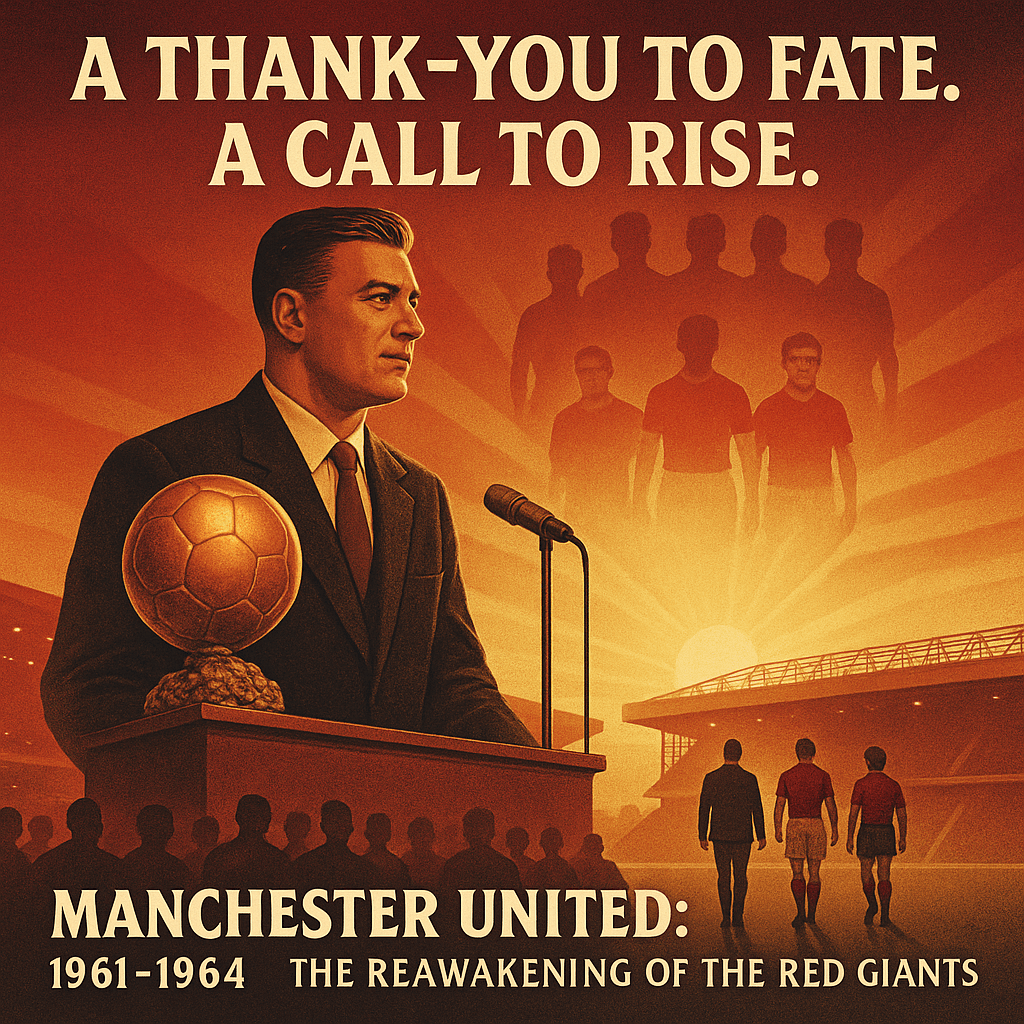
In December 1962, amidst the gloom of a struggling campaign, Duncan Edwards travels to Paris to receive his second Ballon d’Or, the ultimate individual prize in world football.
At the grand ceremony, with Di Stéfano, Puskás, and a young Eusebio watching, Edwards steps up to the podium, golden trophy glinting under the chandeliers.
The room expects a standard thank-you speech. What they get is something far deeper.
Duncan Edwards, voice low and steady, says:
“Four years ago, in February 1958, my teammates and I sat on a runway in Munich, waiting to fly home. The weather was terrible. We almost didn’t make it.”
“But fate gave us another chance. A chance to live, to play, to dream.”
“Every match we play, every trophy we chase — it’s a thank-you to fate. A thank-you for the second chance.”
“Manchester United isn’t just a club. It’s a family that refuses to let dreams die. We rise. We always rise.”
There is silence. Then a roaring standing ovation.
Journalists later say it was not just a speech — it was a call to arms.
It isn’t only United fans who feel it; the footballing world is shaken by the rawness, the gratitude, the fire in his words.
🔥 A Team Rekindled
Back in Manchester, the effect is immediate.
- The locker room, still bruised by a poor start, watches footage of the speech on grainy television.
- Players sit stunned — men like Bobby Charlton, Dennis Viollet, even the usually stoic Bill Foulkes, blink back tears.
- In a meeting after training, Duncan addresses his teammates: “We’ve survived worse than a few bad matches. We owe it to the badge, to the journey, to ourselves. Let’s show them who we are.”
From that day forward, Manchester United rises again.
- Winter 1962: United beat Tottenham 4–1 and Arsenal 3–0 in back-to-back weeks.
- Spring 1963: They make a heroic charge up the league table, narrowly missing another title but regaining their aura of invincibility.
- FA Cup 1963 Final:
United defeat Leicester City 3–1 at Wembley.
Duncan Edwards lifts the FA Cup trophy high, the same arm that nearly never held it at all.
It’s not just a win — it’s a resurrection.
🌱 The Arrival of a Young Fighter: George Best
Meanwhile, deep in Northern Ireland, a 15-year-old boy named George Best watches Edwards’ Ballon d’Or speech on his father’s battered television.
Best, a shy, slight teenager from Belfast, sees in Duncan Edwards not just a footballer — but a symbol of survival, of strength, of destiny.
Years later, when Best signs with Manchester United and nervously approaches Edwards for the first time at the Cliff training ground, he says quietly:
“If you hadn’t survived… if you hadn’t played on… I don’t know if I’d have ever believed a skinny kid from Belfast could dream like this.”
“You surviving… made me believe. You made me want to fight for this club.”
Edwards, deeply moved, simply claps a hand on Best’s shoulder and says:
“Then fight, George. Fight every minute. For yourself. For this shirt.”
From that moment, George Best becomes not just a young talent — he becomes a fighter, a warrior for Manchester United’s cause.
The spirit of survival that Busby, Edwards, and Charlton forged now runs in the blood of the next generation.
🎖️ 1963–1964: The Peak of the Busby Dynasty
- United continue their resurgence, winning the First Division title again in 1963–64, completing a league and FA Cup double for the first time in the club’s history.
- Duncan Edwards, playing the best football of his life, scores and assists with equal ease.
- Bobby Charlton becomes one of the world’s most intelligent midfielders.
- George Best, beginning to break into the first team, dazzles with his audacious skill and fearless heart.
By 1964, Manchester United stands atop English football once again — not just as champions, but as a club reborn from the edge of oblivion into a dynasty of iron and fire.
✨ Legacy of the Era (1961–1964)
- The team that could have lost its soul in 1958 instead found a higher calling: to live, to fight, to triumph.
- Duncan Edwards becomes not just a captain but a living legend — a symbol of second chances seized with both hands.
- Manchester United earns its reputation not just through trophies, but through the spirit of resilience, courage, and family.
- George Best, carrying the fire lit by Edwards, becomes the icon of the next wave — reckless, brilliant, and gloriously alive.
 What If: The Archive
Leave a comment