
🌪️ 1964–65: The Champions, but the Cracks Appear
- Manchester United, riding high off the back of their double in 1963–64, storm through the domestic First Division again, winning the 1964–65 league title.
- But it’s different this time.
- United’s dominance in England is undeniable, but cracks show in Europe.
- In the European Cup semi-final, they clash with Benfica, led by the Portuguese phenom Eusébio — the “Black Panther” whose explosive pace, ruthless finishing, and charismatic aura electrify Europe.
- Over two legs, United battle ferociously.
- Duncan Edwards holds the midfield with heroic intensity, but Eusébio, with two brilliant goals at the Estádio da Luz, powers Benfica to victory.
- Manchester United fall short. Again.
The Media’s Whisper Becomes a Roar
For the first time in years, the media turns their gaze critically toward Duncan Edwards.
- They admire his strength, his leadership, but begin whispering: “Is he being left behind?”
“Is he football’s Elvis Presley — once the king, now overshadowed by a new wave?” - The metaphor sticks. In the exploding pop culture of the 1960s, it becomes an easy comparison:
- Duncan Edwards is Elvis — the traditional titan, the bedrock.
- Eusébio is the Beatles — new, exciting, dynamic, changing the rules.
Newspapers splash headlines:
- “The Old King and the New Panther.”
- “Is Duncan Still Europe’s Best?”
In England, many fiercely defend Edwards. But across Europe, voices grow louder that Eusébio is the new face of football.
🎶 The Global Argument: Pelé, Eusébio, Edwards
Meanwhile, Pelé, still riding high from World Cup victories in 1958 and 1962, remains an unavoidable presence in the GOAT debate.
- His magic with Brazil, his unstoppable scoring at Santos, his youthful smile — they capture the world’s imagination.
- Journalists pose the uncomfortable question: “If Pelé owns the world, and Eusébio owns Europe… what, then, of Duncan Edwards?”
For a man who had carried so much — his club, his country, the memory of survival — it stings deeply.
But true to his nature, Edwards shows nothing publicly.
Inside, though, the fire smolders.
⚡ 1965–66: The Struggle for Greatness
- United’s 1965–66 season is bruising.
- Another strong league run sees them fall short to Liverpool domestically.
- In Europe, they again reach the semi-finals but are outmuscled by a brutal, tactical Internazionale side under Helenio Herrera.
United’s beautiful football is out-thought.
Edwards, nearing 29, plays brilliantly but without the same aura of invincibility.
The Growing Shadow of Doubt
- Critics sharpen their knives.
- They say Edwards is “too rigid,” “not evolving with the modern game.”
- Some question if he should captain England at the 1966 World Cup at all.
- Even sympathetic voices begin to ask: “Has the king held the crown too long?”
Matt Busby believes in him.
Bobby Charlton and George Best swear by him.
But the noise grows deafening.
🏟️ Summer 1966: The World Awaits
The 1966 World Cup arrives on English soil like a storm.
- Flags wave from every window.
- Streets throng with fans, face-painted and hopeful.
- England, as hosts, are under immense pressure.
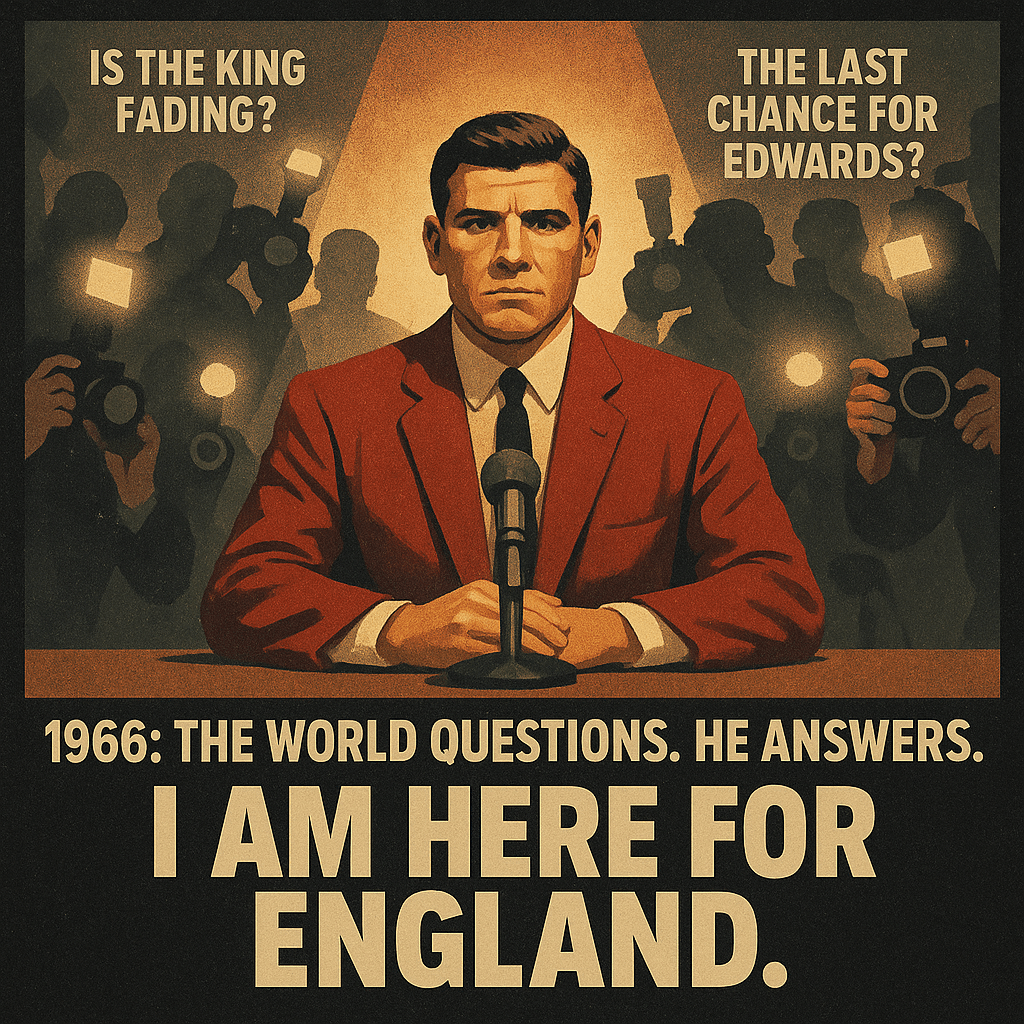
In the days leading up to England’s first group match, the media relentlessly hounds Duncan Edwards:
- “Can you outshine Eusébio?”
- “How do you compare to Pelé?”
- “Are you still the best, Duncan?”
- “Is this your last chance?”
At every press conference, in every hotel lobby, on every training ground — the same questions, over and over.
The weight of a nation’s hope, the doubts of the critics, the memory of survival, and the shadow of younger stars all converge on his broad shoulders.
Finally, on the eve of England’s first match, a packed press room in London buzzes with tension.
Cameras flash. Pens scratch. Voices press him for answers.
Duncan Edwards leans into the microphone.
Pauses.
Looks up — a calm, unshakable look in his eyes — and says simply:
“I am here for England.”
 What If: The Archive
Leave a comment