⚔️ Before the Storm
The press hounded him.
The critics doubted him.
The world questioned him.
Was he still the best? Could he outshine Pelé? Could he resist the fire of Eusébio?
In a packed press room, flashing bulbs and breathless reporters, Duncan Edwards stood tall and simply said:
“I am here for England.”
Not for glory.
Not for himself.
Not even for redemption.
For England.
For something bigger.
🎨 The Group Stage: The Canvas Opens
From the first kick of the tournament, it becomes clear:
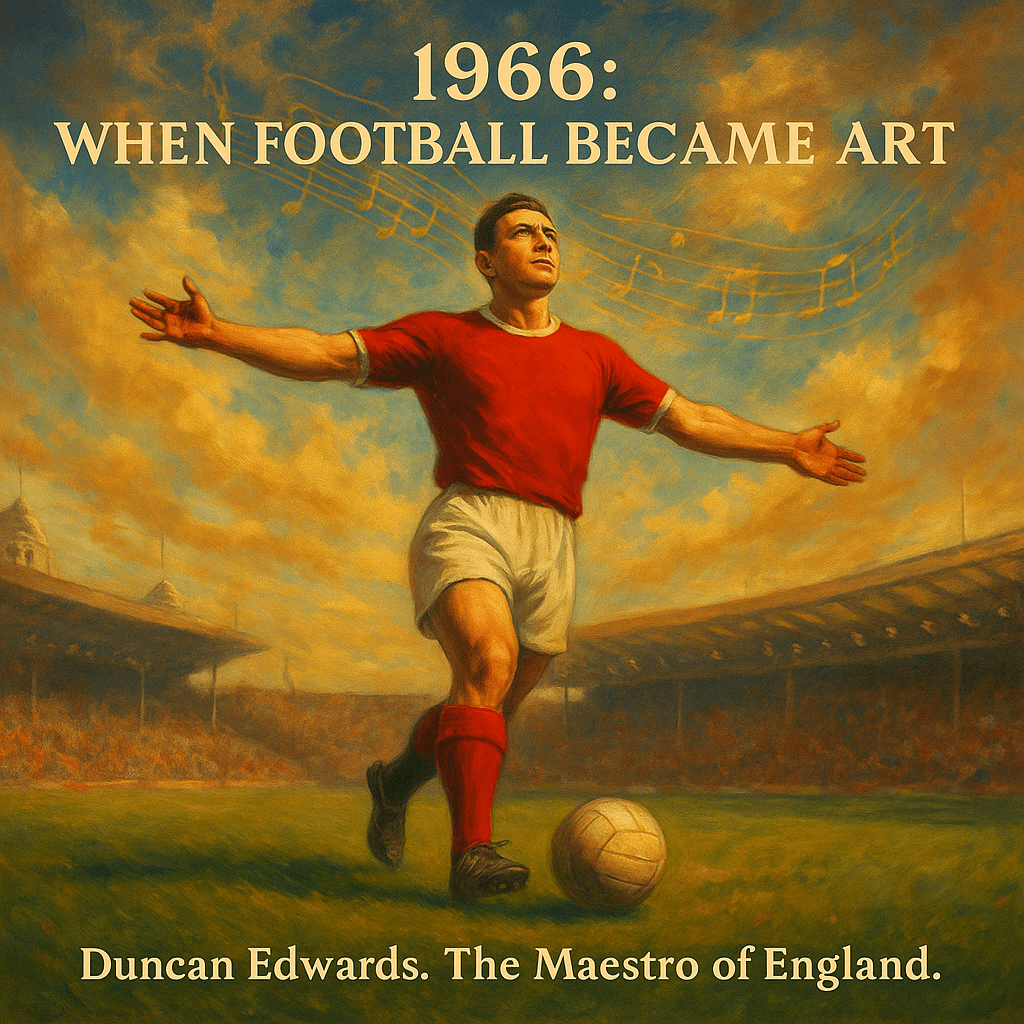
Duncan Edwards is painting a masterpiece.
But not with a brush — with his boots, his body, his soul.
Against Uruguay, while the rest of England start nervously, Duncan moves with a serene, devastating grace.
- He doesn’t just pass the ball — he caresses it, sending it gliding like a whisper across Wembley’s sacred turf.
- He tackles, yes — but even his tackles have a rhythm, like percussion in a symphony.
The 0–0 draw is frustrating, but already, those who know football see:
Something is awakening.
Against Mexico, the crowd sees it bloom.
- In the 43rd minute, Duncan picks up the ball near halfway.
- One sidestep.
- One shoulder feint.
- He powers forward, boots barely kissing the grass, and from 25 yards, unleashes a shot so pure it seems to bend the air around it.
The ball explodes into the top corner.
A goal not of power alone — but of artistry.
The stadium erupts not just in cheers, but in awe.
Against France, he orchestrates play as if the ball were a marionette, and he the puppeteer.
- Attack, retreat, flick, switch.
- Every movement perfectly weighted, timed, sung.
The world starts whispering: This isn’t just football. This is ballet. This is jazz. This is poetry.
🔥 The Quarter-Final: The Battle of Wembley
Facing Argentina, the game descends into chaos — fouls, shouts, blood, rage.
But at the center of the storm stands Duncan — a monolith of calm.
- When Argentina’s captain is sent off and tempers threaten to ignite, Duncan raises his arms, speaks words few hear but all obey.
- The game settles. England reclaims control.
And then, rising like a god in the middle of the box, he scores with a thunderous header off a Charlton corner.
Power and grace, united.
⚡ The Semi-Final: The Duel of the Giants
The semi-final is billed as the clash of the decade:
- Duncan Edwards vs. Eusébio.
- The Old King vs. The New Panther.
The Estádio da Luz, the beaches of Rio, the streets of Lisbon — all Europe holds its breath.
Eusébio attacks, quick as lightning.
But every time, Duncan reads him — not just reacting, but anticipating, like a grandmaster in a chess duel.
- He intercepts passes before they’re made.
- He nudges the ball away with delicate, brutal precision.
- He shatters Portuguese attacks and launches his own.
On the ball, he is art.
Off the ball, he is iron.
When England wins 2–1, it’s not just a victory.
It’s a coronation.
Eusébio, gracious in defeat, says after the match:
“Today, I saw the complete footballer. Duncan was the orchestra, and the field was his stage.”
🏆 The Final: England vs. West Germany — The Symphony Reaches its Crescendo
On July 30, 1966, Wembley is not just a stadium. It’s a cathedral.
In the 20th minute, Duncan Edwards takes the ball deep in midfield.
- He dances around Beckenbauer.
- Powers past Overath.
- From 30 yards, he fires a shot so fierce, so perfectly placed, it becomes known forever after as:
“The Shot Heard Around the World.”
It’s not raw strength.
It’s precision.
It’s music.
It’s destiny.
Germany fights back. It’s 2–2 into extra time. Tension cuts the air like a knife.
Then Duncan, with vision almost supernatural, lofts a ball so perfectly weighted to Alan Ball on the wing that it bypasses the entire German midfield.
Ball crosses to Hurst — 3–2.
Wembley explodes.
In the dying seconds, Germany surges for one last desperate attack.
And who intercepts the ball with a sliding tackle so clean, so beautiful, it’s later shown in coaching manuals for 50 years?
Duncan Edwards.
When the final whistle blows, it’s not just England who roars.
The whole footballing world feels it: something more than a game has been won.
🕊️ The Legacy of Duncan Edwards, 1966
- It wasn’t just the strength.
- It wasn’t just the skill.
- It wasn’t even just the leadership.
It was the art.
For one glorious month in 1966, Duncan Edwards redefined football.
- He made it not just a sport, but a form of expression.
- He showed that football could be powerful and beautiful, brutal and sublime.
As he lifted the Jules Rimet Trophy, the sunlight catching the gold, tears in his eyes, the world understood:
Football had found its soul.
And it wore the No. 6 of England.
It answered to the name Duncan Edwards.
 What If: The Archive
Leave a comment