🏟️ Old Trafford, May 1971 — The Night Football Held its Breath
The banners hung heavy under the grey Manchester sky.
Old Trafford — the Theatre of Dreams — had never looked more solemn, more proud.
60,000 voices hummed with expectation, with sorrow, with love.
Tonight was not just a match.
It was a farewell.
Tonight, Duncan Edwards, England’s Colossus, Manchester’s immortal son, would play his final game.
Across the pitch, dressed in the bright gold of Santos FC, stood Pelé — the King of Brazil, the wizard of the world.
He had crossed oceans, continents, time itself to be here for Duncan.
Because some moments are bigger than seasons.
Some moments are bigger than football.
🎶 The Match: The Last Dance
From the first whistle, it was clear: this was not a battle.
It was a celebration.
- Duncan, now 34, still moved with the wisdom of a river — slower, perhaps, but every touch filled with grace.
- Pelé, at the peak of his godlike powers, played with a smile that lit the night.
- George Best, now a man forged by trials and triumphs, weaved spells along the wings, carrying Duncan’s legacy in every step.
In the 30th minute, Pelé unleashed a curling strike from 20 yards.
Goal. Santos led 1–0.
But Old Trafford didn’t jeer.
It rose and applauded, knowing it had just witnessed poetry.
Minutes later, the ball fell to Edwards just outside the penalty area.
No hesitation.
He struck — not with brute force, but with the accumulated memory of a thousand battles fought and won.
The net rippled.
1–1.
The roar from the stands shook the sky.
The match drifted into a 2–2 draw — but no one cared about the scoreline.
They were there for something else.
They were there for the moment that would follow.
🌟 The Shirt Swap: The Final Coronation
As the referee blew the final whistle, the stadium fell into a strange, holy silence.
All eyes turned to the two giants standing in the center circle.
Pelé and Duncan Edwards approached each other, every step heavy with the weight of history.
Sweat-slicked, mud-streaked, tired but radiant, they stopped an arm’s length apart.
For a heartbeat, they simply stared — no words, only understanding.
Then Pelé, smiling, pulled his gleaming gold Santos jersey over his head.
Duncan, smiling wider, peeled off his sacred red Manchester United shirt, the number 6 worn thin from a decade and a half of wars.
They swapped shirts — a simple, ancient rite.
But then, something more:
Pelé dropped to one knee and kissed the Manchester badge on the shirt he now held.
Duncan, moved beyond words, clutched the yellow jersey to his chest, like a knight receiving a sacred banner.
They embraced — a long, brotherly hug — and the cameras flashed so brightly it seemed as if the stars themselves had come down to witness it.
🕊️ The Meaning of the Moment
No more questions.
No more debates.
There were no longer “who is the greatest” arguments.
- Duncan Edwards and Pelé stood together, not as rivals, but as two eternal pillars holding up the very idea of football itself.
- Two lives, two journeys, two continents — one brotherhood.
That night, in a quiet, sacred way, football crowned two kings — side by side.
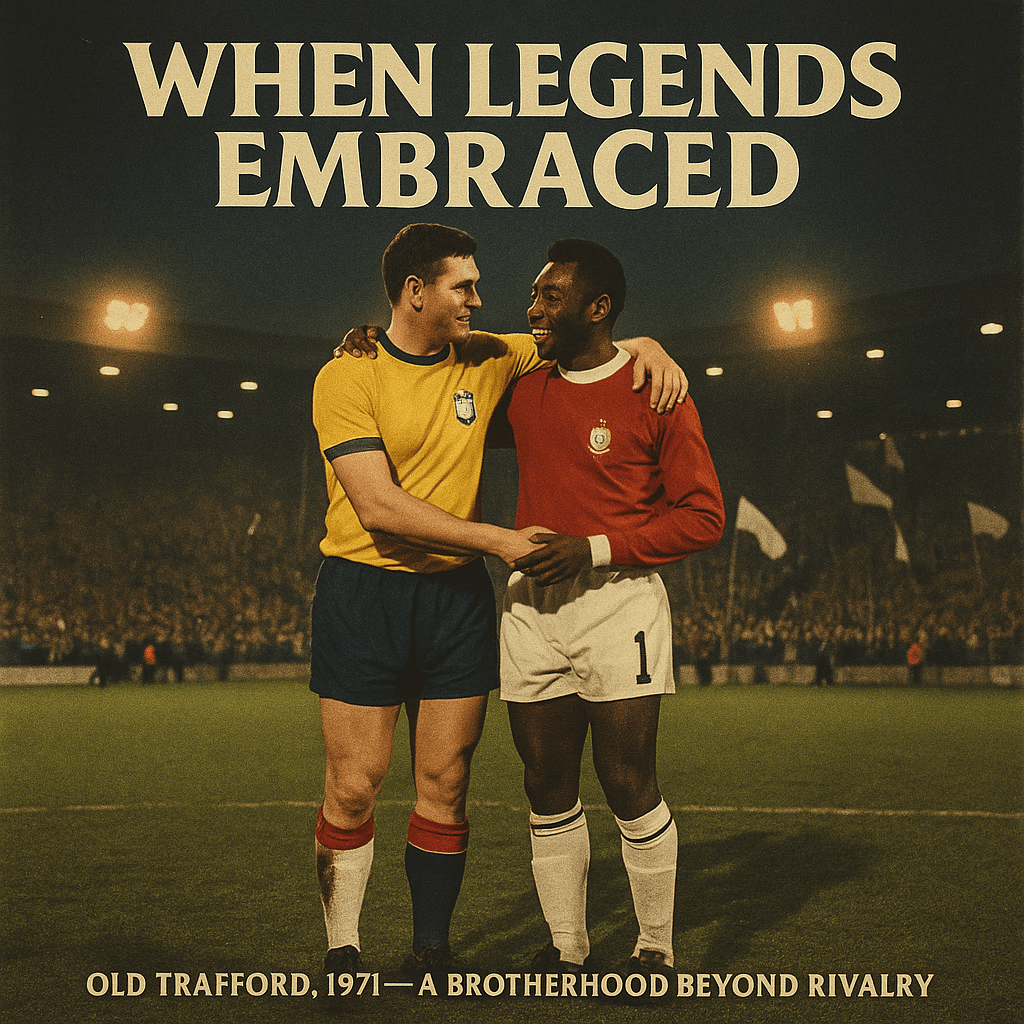
📸 The Iconic Photo
The image is burned into history:
- Duncan Edwards, towering and unbreakable, wearing the bright yellow Santos jersey.
- Pelé, golden and smiling, wrapped in the red of Manchester United.
- Arms over each other’s shoulders.
- Behind them, a sea of faces — weeping, singing, witnessing something too great for words.
It runs on front pages from São Paulo to London, from Johannesburg to Tokyo:
“When Legends Embraced.”
“The Two Pillars of Football.”
“Not Rivals, but Brothers.”
🛡️ Legacy of the Night
- Pelé’s Manchester United shirt hangs in his home, framed beside his World Cup medals.
- Duncan’s Santos shirt is placed in the Manchester United Museum, under a plaque that reads:
“For those who turned football into something greater than a game.
For Duncan. For Pelé.
For all who dream.”
And so, the book closed on Duncan Edwards’ playing career — not with sadness, but with triumph, brotherhood, and a legacy that would echo as long as football was played.
 What If: The Archive
Leave a comment