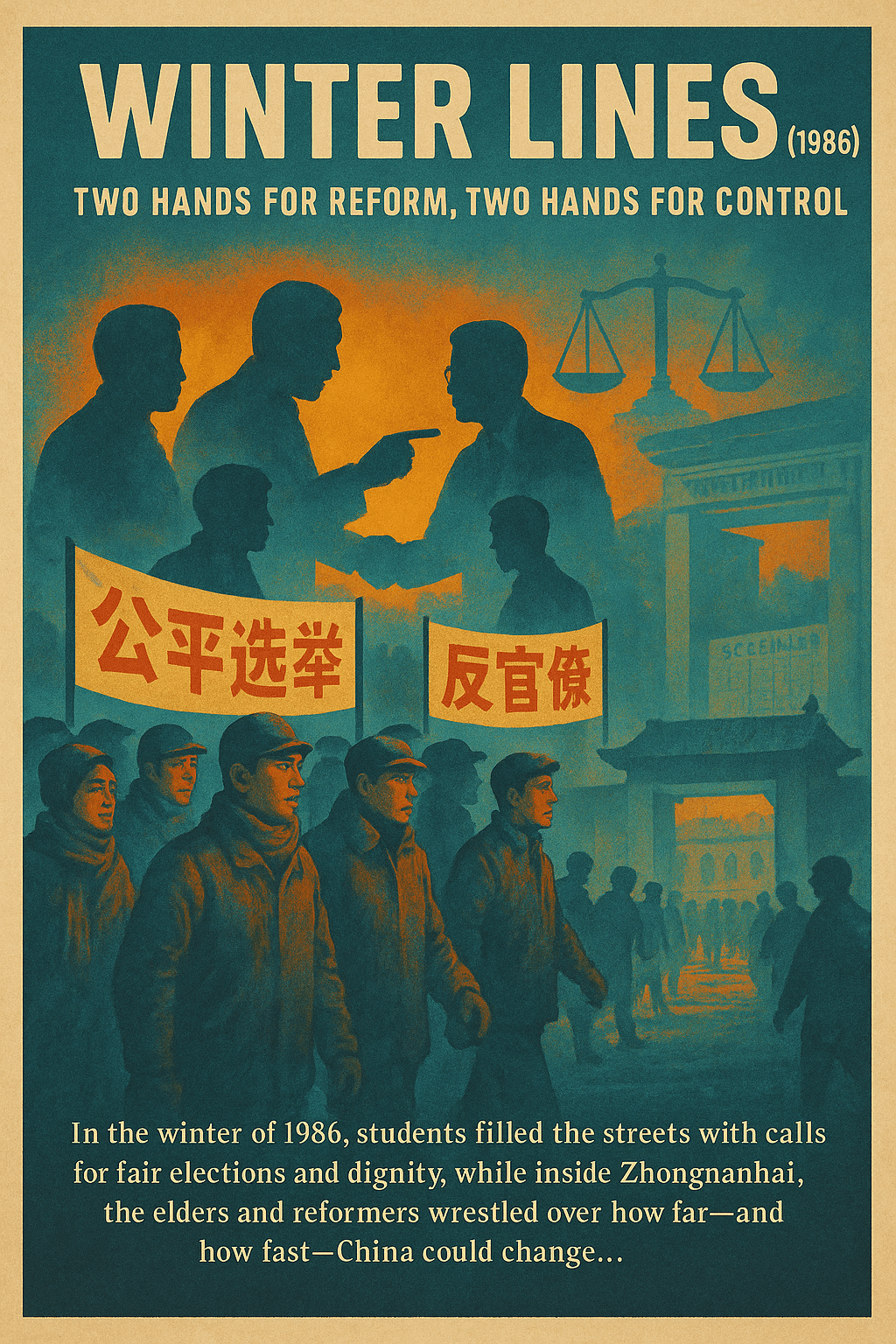
The campuses smelled like chalk dust and cheap tea. In Hefei that December, flyers fluttered under dorm doors like autumn leaves that missed their cue. “公平选举” (fair elections). “反官僚” (oppose bureaucracy). Out in the dark, the roads were slick and the students walked in clusters, shoulders pressed together against the wind and against their own fear of the Public Security Bureau’s gray sedans.
At the University of Science and Technology of China, the physicist-turned-public-intellectual Fang Lizhi was the spark they blamed and the light they followed. He spoke about dignity and the freedom to think — not in slogans, but in equations that led to conclusions the elders didn’t like. When students marched in Hefei on December 4, the local party secretary called Beijing before midnight. “Not big,” he said. “But noisy.”
Zhongnanhai: the room where tea goes cold
In Beijing, Deng Xiaoping listened more than he spoke. That was how you knew he was angry. The elders’ corner of the room felt emptier than it used to: Li Xiannian gone since ’83, Song Renqiong buried before the leaves fell that same year, Chen Yun too frail to climb the steps, sending letters in a quivering hand.
Wang Zhen sat forward like a coiled spring.
Bo Yibo smiled the way a man smiles when he has already counted the votes.
Peng Zhen paged through draft statutes on elections, pencil tapping margins.
Hu Yaobang argued for air: “They’re kids. Patriotic. If we prove we aren’t afraid of words, they’ll go back to class.”
Zhao Ziyang argued for plumbing: “Price reform is delicate. Panic kills it faster than inflation. Break heads on campus, and investors will smell blood.”
Deng stared at the steam rising from his cup. He had not forgiven the plague for taking Li Xiannian — not because Li had always been right (he hadn’t), but because Li had always been there: Yan’an, the war, the long meetings in smoky rooms when the state was new and crooked and they had hammered it straight with bare hands.
And there were shared investments, too — not the kind that appeared in the People’s Daily, but the quiet arrangements that linked old comrades’ children and nephews to the new hybrid economy. 官倒 was a word the students whispered with contempt; the elders muttered it with unease. The reform economy was a table piled with dishes, and their families already had seats. Too much “liberalization,” and someone might clear the table entirely.
Promises in the marrow
Deng’s ties to the conservatives weren’t just sentimental. There was the unwritten pact: the next generation of leadership must come from their generation’s political bloodlines. Reform or not, the Party’s torch would pass to their sons, not to some stranger in jeans who quoted Western philosophers. In the cloakroom of politics, comradeship and self-interest shared the same hanger.
Chen Yun’s last note sat in Deng’s inside pocket, a careful warning in neat characters: Keep the bird in the cage, or it will fly into a storm it cannot survive. Chen didn’t need to say the rest — that storms might drown the old guard’s heirs before they learned to swim.
Deng finally spoke, soft and flat: “两只手要硬:改革一只,稳定一只.” Two hands must be strong: one for reform, one for stability.
December spreads
Hefei’s march brought Nanjing and Shanghai in its wake, then Beijing in cautious trickles. The slogans were narrow at first — local elections, university autonomy — but the rhythm of feet on pavement invites broader words. In Shanghai, students from Fudan and Jiao Tong debated crossing the Suzhou Creek to join workers on their lunch break. The security services got that call early and leaned hard to make sure it didn’t happen.
Beijing’s order to the provinces came as Central Circular No. 27 (1986) — a compromise in five pages:
- No batons, no blood. Police to form “dialogue teams” and keep marches inside campus gates where possible.
- No cross-city coordination. Train stations watched; student organizers quietly put on homebound trains after warnings.
- No slogans against the Party. “Patriotism encouraged, subversion punished.” A line that looked crisp in print and blurry on the street.
- Talk, but frame it. Campus forums permitted if chaired by party secretaries; propaganda to praise “healthy criticism” and slam “bourgeois liberalization.”
- Find the fulcrums. Identify a handful of organizers for “rectification measures” — academic suspension, cadre warnings — not prison.
It was not the solution Wang Zhen wanted. He called Deng after midnight. “老邓, if you don’t break a little bone now, you’ll have to break the spine later.” Deng grunted. He had heard versions of that sentence all his life.
The price of “not too hard, not too soft”
Hu Yaobang visited Beida in a gray overcoat and smiled the kind of smile that leaks into photographs. He told the students he respected their zeal and asked them to go home before New Year’s. Some listened. Some didn’t. In the Party journal, an editorial appeared with Chen Yun’s name attached — likely polished by his aides, but the cadence was his: Markets serve the people, not the other way around. Winds from the West are cold. Shut the window when you must. It gave cover to conservatives and gave Hu a paper wall to lean against.
Behind closed doors, Hu paid a price. He delivered a self-criticism to the Politburo about lax ideological work and “failure to guide youth” — a thin, bitter tea of words he didn’t believe. Zhao helped draft it so it would sting less and save more. In exchange, Hu kept his chair. The deal had terms:
- Fang Lizhi was removed as USTC vice president and reassigned to a research institute in the northwest. Not expelled, not arrested — just exiled out of the camera frame.
- A pair of liberal editors at an economics weekly in Shanghai were “rotated” to provincial posts where their pens would be duller.
- The NPC under Peng Zhen began revising local election guidelines to emphasize “organizational leadership” — a lawyerly way of saying the Party chair sits at the head of the table, always.
Wang Zhen fumed and recruited younger security men to draft a memorandum cataloging “hostile forces” among intellectuals — a list longer than it needed to be. Bo Yibo played both sides of the chessboard, backing Deng’s “two hands” line in public while reminding Hu privately that one misstep would give the old soldiers the rope they wanted.
What Deng would not say aloud
At year’s end, Deng went to see Chen Yun. The room smelled like antiseptic and old paper. They didn’t talk long; neither man had the breath for it. Chen asked if Deng remembered the grain quotas of 1962, the panic, the way a small policy shift had felt like turning a battleship with a bamboo pole. Deng nodded. He remembered more than that. He remembered Li Xiannian’s grave. He remembered Song Renqiong’s widow’s hands shaking as she poured tea.
In the car back to Zhongnanhai, Deng said to his secretary, almost to himself: “If Li were here, he’d scold me for being soft. Then he’d find a way to keep Hu. We need both legs to walk.” Self-interest dressed itself as balance; grief disguised itself as pragmatism. Either way, the decision held.
The lid that doesn’t fit
By the last week of December 1986, the marches were dwindling, exhausted more by cold and finals than by fear. The Circular 27 approach had worked — if “worked” meant no blood on the snow and no photographs that would frighten investors in Hong Kong. But something had changed that wouldn’t change back: students had learned the dimensions of the cage; officials had learned the cost of rattling it; and the elders, fewer and frailer since the ’83 Black Winter Fever, no longer cast the long, unanimous shadow they once had.
Hu survived the winter, chastened but unbroken. Zhao kept the pipes humming for price reform. Wang Zhen kept his lists. Chen Yun kept writing short, careful notes. And Deng, holding fast to comradeship and control with the same tired hands, kept both plates spinning — aware that either could still fall.
Key Political Figures – 1986 “Winter Lines”
| Name | Age (1986) | Faction | Position | Health (Post-1983) | Personal Tie to Deng | Notes & Background |
|---|---|---|---|---|---|---|
| Deng Xiaoping | 82 | Reform-leaning pragmatist | Chairman of CMC; Paramount Leader | Healthy | N/A (central figure) | Architect of Reform & Opening; balances factions to protect reform while avoiding instability; committed to keeping elders’ generational stake. |
| Hu Yaobang | 71 | Reformist | General Secretary of CCP | Healthy | Deng’s chosen political heir for political reform | Advocates for political openness, cultural liberalization; charismatic among youth; skillful in avoiding direct confrontation with conservatives. |
| Zhao Ziyang | 67 | Reformist | Premier of the State Council | Healthy | Deng’s chosen economic reform executor | Pushes bold price reforms and market experiments; careful negotiator with conservative ministries. |
| Li Peng | 58 | Younger conservative | Vice Premier of the State Council | Healthy | Political “godson” to elder conservatives; Zhou Enlai’s protégé | Technocrat; standard-bearer for Chen Yun’s cautious “birdcage” economic model; conservative bridge to next generation. |
| Wang Zhen | 76 | Hardline conservative | Vice President of PRC | Survived plague; stamina reduced | Fellow Long March veteran; shares wartime bond | Fierce opponent of liberalization; uses security networks to monitor intellectual dissent. |
| Bo Yibo | 78 | Opportunist (leaning reform) | Vice Premier (Economic Affairs) | Healthy | Longtime ally in economic policy | Pragmatic; family tied to hybrid-economy enterprises (官倒 rumors); mediates between reformists and conservatives when beneficial. |
| Chen Yun | 81 | Conservative economic planner | PSC Member (semi-retired) | Chronic lung damage from plague | Deng’s equal in revolutionary prestige | “Birdcage economy” advocate; maintains influence via protégés in State Planning Commission and Ministry of Finance. |
| Peng Zhen | 84 | Centrist institutionalist | NPC Chairman | Healthy | Deng’s comrade from early Party years | Legalist mediator; supports incremental political reform but insists on Party primacy. |
| Deng Yingchao | 82 | Reform-leaning elder | NPC Vice Chairwoman | Recovered from 1983 fever | Widow of Zhou Enlai | Moral authority in women’s rights and culture; quietly supports Hu’s openness agenda. |
| Yang Shangkun | 79 | Military-leaning centrist | Exec. Vice Chair of CMC | Healthy | Military ally; trusted with PLA control | Ensures PLA loyalty; manages balance between reformist civilian leaders and conservative generals. |
| Li Ruihuan | 52 | Reformist rising star | Party Secretary of Tianjin | Healthy | Promoted by Hu Yaobang | Skilled urban manager; popular among workers; known for pragmatic housing and wage reforms. |
| Qiao Shi | 62 | Reformist pragmatist | Head of Central Organization Department | Healthy | Trusted by Deng for organizational skill | Oversees cadre appointments after Song Renqiong’s death; careful to balance factional placements. |
| Fang Lizhi | 50 | Liberal intellectual | Vice President, USTC | Healthy | No personal tie; protected by Hu | Public face of student-inspired liberalism; irritates conservatives; quietly monitored by Li Peng’s networks. |
 What If: The Archive
Leave a comment